

D Harding and Kate Harding: two artists exploring connections between mother and child, and the culture that forged them
- Written by The Conversation
Review: D Harding with Kate Harding Through a Lens of Visitation, Chau Chak Wing Museum
Entering D and Kate Harding’s Through a Lens of Visitation, Kate’s textile work Cylinders (2020) was the first thing to draw my attention. Higher than the surrounding works, it draws the eye with its bold geometric patterning in greens and ochre contrasting with the more organic palette of the surrounding work.
D Harding is a star of contemporary Australian art with a flourishing international profile. Their mother, Kate, is a textile artist who in recent years has used quilts to tell stories of family and country.
This exhibition shows the connections between a mother and child and the culture that forged them, foregrounding the contribution of Indigenous women.
D and Kate Harding are descendants of the Bidjara, Ghungalu and Garingbal peoples, and have strong continuous connections to the internationally significant heritage site of Carnarvon Gorge in central Queensland.
Attracting tourists for its natural and cultural values, the gorge is known for its exceptional rock art. However, the tourist lens has often obscured the spiritual importance for First Nations people. This exhibition and accompanying publication corrects this lens by foregrounding the living culture of First Nations people from a number of different viewpoints.
Threading together the artists’ Indigenous culture with rigorous scholarship, this exhibition challenges Australian art history.
An undulating landscape
The exhibition is predominately of textile works by both artists, accompanied by two of D’s large-scale paintings.
Throughout the exhibition, object and textile works are placed on tightly assembled plinths of various heights.
Plinths are the common white supports used to ensure sculptural works and statues can be examined closely. Most viewers do not even notice them. But in D’s work, the line dividing the plinth from the work is blurred.
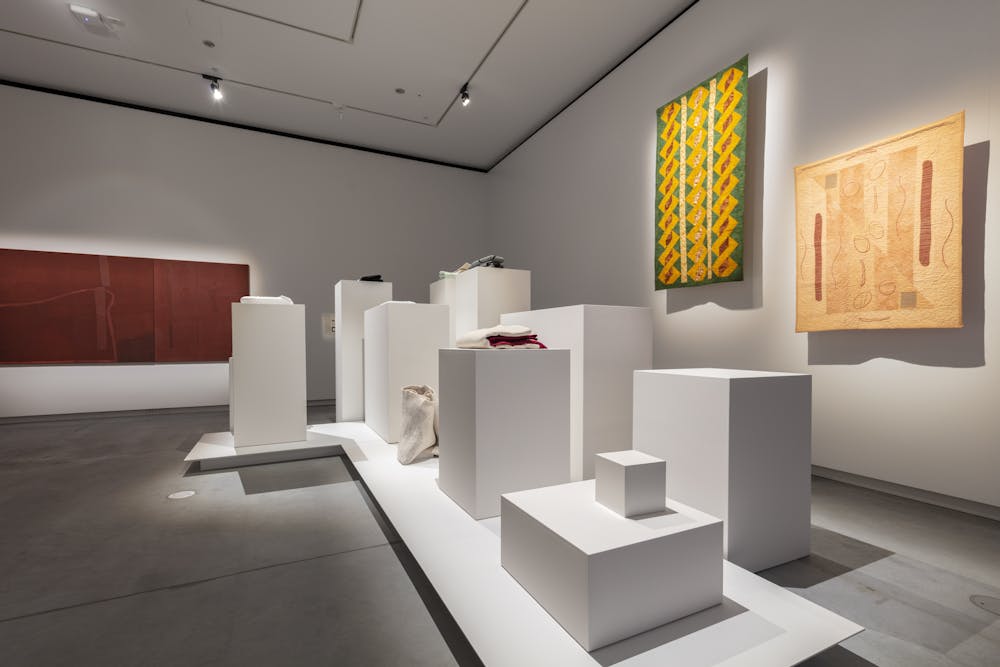
As you enter, the lowest plinth is closest to the entrance, and the highest – standing at two metres tall – is in the back corner furthest from the entry. This creates an undulating landscape for the audience as they enter the gallery, and we feel an invitation to explore.
D told the audience at the opening the plinths signalled “hierarchies of care”. They adopted this gallery convention to present Indigenous culture with the same care reserved for classical treasures. Interventions like this counter the way museums have historically portrayed First Nations culture as anonymous ethnographic curiosities.
Attention to the object
In the middle of the field of plinths are two wrapped objects which remain secret, packaged neatly as if by a conservator preparing for safe storage.
The wall text reveals what audiences cannot see: two of D’s 2018 works Untitled Cloak and Repression cloak (ceremony for a gay wedding). Occupying the remainder of the plinths in the Penelope gallery are six textile works, visible but neatly folded to obscure a clear view.
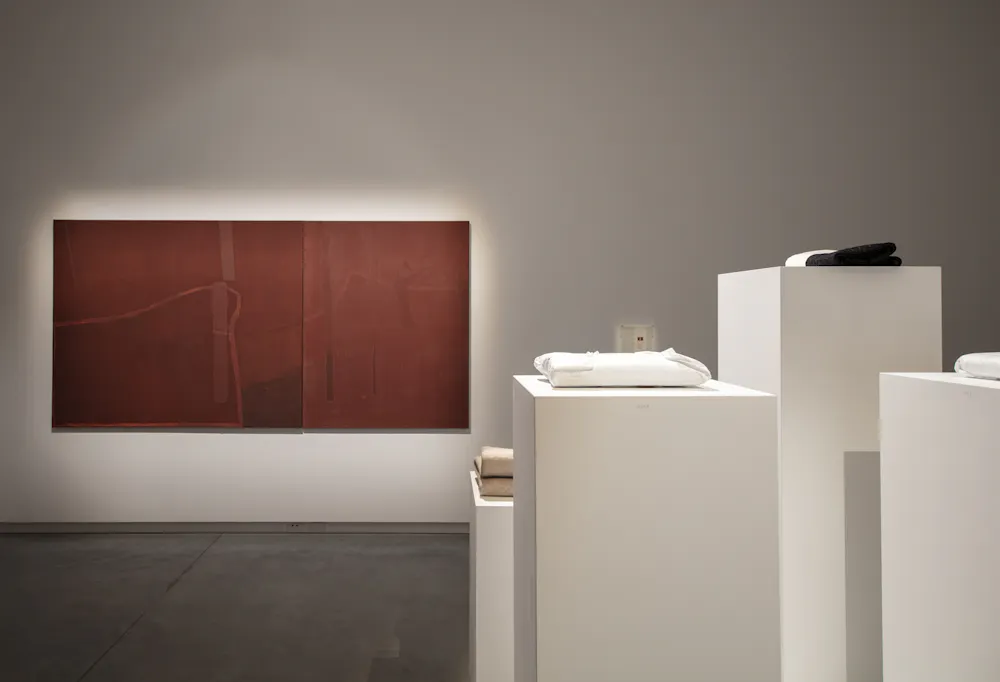 Exhibition view of D Harding with Kate Harding: Through a lens of visitation at the Chau Chak Wing Museum. Photo: David James.
The wrapped objects recall Christo and Jeanne-Claude, drawing attention to the object, asking audiences to look at the overlooked. D’s wrapping safeguards Indigenous knowledge not for general consumption and ensures cultural safety.
This is most explicit in a redacted reproduction of a photograph of Carnarvon Gorge: what is withheld from view may be as significant as what is on display.
Read more: In remembering Christo, we remember what art once was
The exhibition encourages thoughtful inquiry. Each of the works on display was developed through years of sustained practice with deep respect for their materials, knowledge of place, Songlines and Indigenous cultural practices.
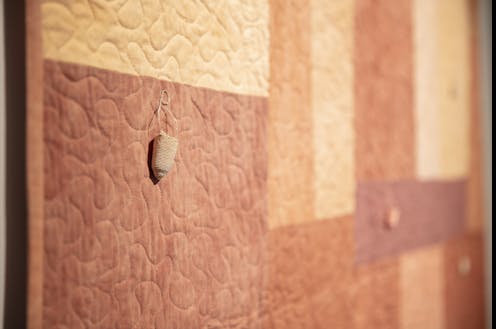
In Kate’s textile work this inquiry is achieved through a range of quilts which employ natural dyes including the bold angular geometry of Carnarvon (2020) to the more organic forms which dominate White Hill – looking for food at Clermont (2020). Her works are stylistically diverse, each conveying different story lines.
In this exhibition, D’s acclaimed painting practice is accompanied with textile work, making the two artists’ work often indistinguishable. This is most visible in Emetic painting (International Rock Art Red and White) (2020), whose forms and colours resonate with those found in Kate’s quilts.
The potential of materials to convey historical stories is clear in Blue ground/dissociative (2017), which uses white ochre on an arresting ground of Reckitt’s Blue pointing to the diverse traditions informing this exhibition.
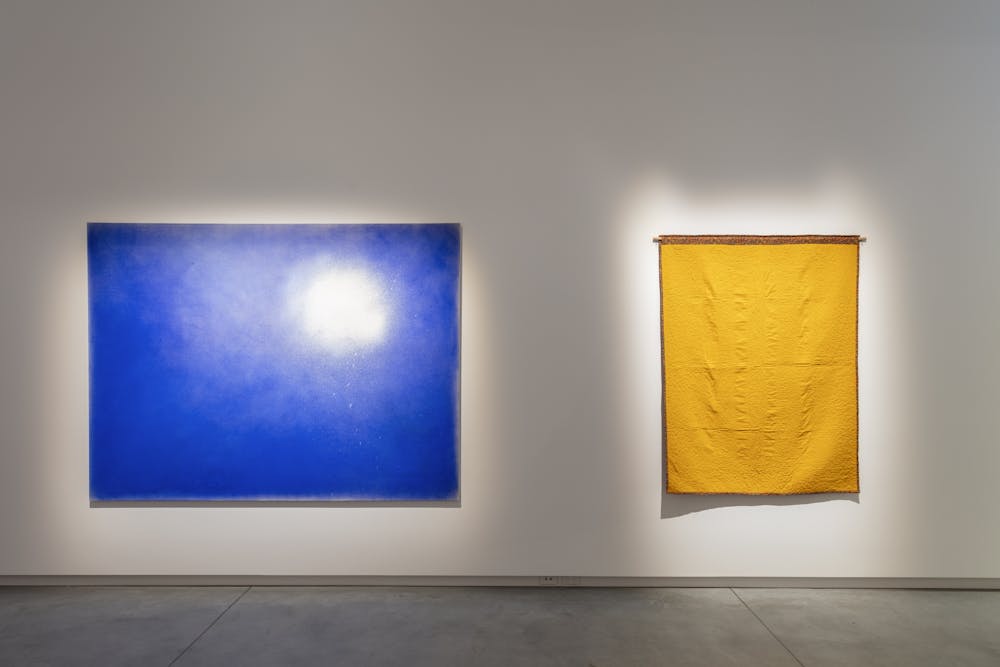 Left to right: D Harding, Blue ground/dissociative 2017 and Kate Harding, Carnarvon underground water 2020. Exhibition view of D Harding with D Harding with Kate Harding: Through a lens of visitation at the Chau Chak Wing Museum.
Photo: David James
Left to right: D Harding, Blue ground/dissociative 2017 and Kate Harding, Carnarvon underground water 2020. Exhibition view of D Harding with D Harding with Kate Harding: Through a lens of visitation at the Chau Chak Wing Museum.
Photo: David James
The individual works, their careful display in this exhibition and the publication demonstrate a profound respect for both the language of contemporary art and Indigenous traditions.
It is a significant achievement.
D Harding with Kate Harding: Through a lens of visitation is on now at the Chau Chak Wing Museum at the Univerity of Sydney.


