

New Zealand is touting a green hydrogen economy, but it will face big environmental and cultural hurdles
- Written by The Conversation
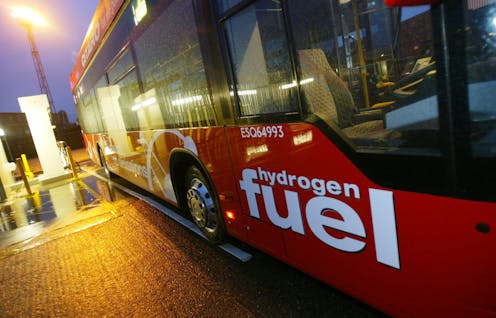
In its plan to retool the economy, the New Zealand government highlighted green hydrogen as a game-changing fuel. It can indeed be used to make climate-friendly fertilisers and steel or to power some modes of transport that aren’t suited to batteries.
But to provide a buffer against the volatility of overseas markets, Aotearoa would need to be as energy independent as possible. Ideally, this would mean consuming only green hydrogen produced here, using abundant renewable hydro, wind and solar resources.
A hydrogen economy is good in theory, but to make the switch at the scale of Aotearoa’s climate ambitions would require about 150 petajoules of hydrogen each year, according to one estimate. That’s about a quarter of our current energy use.
Hydrogen is produced in a process known as hydrolysis – the splitting of water into hydrogen and oxygen gas, using electricity. To produce a quarter of Aotearoa’s energy consumption, hydrolysis would consume an enormous amount of water, about 13 million tonnes each year, the equivalent of a month’s worth of Auckland’s water demand.
This raises both cultural and technical issues, which we must address before embarking on a transition to hydrogen as a green fuel.
Consuming water has cultural implications
Freshwater has enormous significance to iwi and hapū. However, their views on hydrolysis as a consumptive use of water are not widely understood. If cultural complexity is ignored, hydrogen infrastructure or processes may fail to achieve an appropriate fit within Aotearoa New Zealand society and the technology could be orphaned.
Instead, we could start addressing this early through wānanga with representatives from a wide range of potentially affected iwi. Recognising and addressing cultural concerns at the outset will allow Māori to shape how the technology is developed and to share in the economic benefits of a hydrogen economy. The intention is to better understand how green hydrogen technologies and infrastructure could belong in Aotearoa New Zealand.
Supposing we are willing and able to make this vast quantity of hydrogen, our experience with other fuels suggests we would need about a month’s worth in storage at any given time. Storage helps to smooth fluctuating market demand, takes advantage of seasonal excess of renewables (in very windy, very sunny weeks) and provides emergency reserves for “dry year” crises.
Storing hydrogen underground
Unfortunately, hydrogen can’t be stored as a liquid except in specialised containers that keep it at extremely low temperatures. Like a freezer, this is always consuming energy.
Hydrogen could be kept in special high-pressure tanks, but we would need more of these tanks than we have people in New Zealand. These tanks would be costly, cover large tracts of productive land and would be prone to damage by natural hazards. Where would they all go?
Scientists have been looking at the possibility of storing hydrogen underground, in great caverns carved in salt or in old oil and gas fields.
We already do this with natural gas in Taranaki. When it’s not needed, gas is injected into an old field called Ahuroa and then extracted as required. Underground storage of gas (methane) is common practice, providing energy resilience. For example, given the disruptions caused by the war in Ukraine, Germany is accelerating gas storage in geologic reservoirs in time for winter.
We have recently shown there may be enough space in other Taranaki rock reservoirs to store hydrogen underground. But it won’t be easy.
We know the gas can react with certain kinds of rock. It can even be a meal for hungry microbes. Both these processes would consume a valuable fuel. But predicting whether they will happen requires special laboratory experiments that can replicate the extreme pressure and temperature three kilometres below ground.
We are also still learning how to predict how hydrogen will move underground. We know that some of the injected gas will never come back out. This is the “cushion” that acts a bit like a spring that pushes the other hydrogen back to the surface.
Some hydrogen may also escape into the atmosphere through small cracks in the rock. We’ll need to know how much, set up surveillance to watch for it and consider its effect on the climate.
These are just a few of the challenges posed by underground storage of hydrogen. But our experience with natural gas storage gives us confidence we can manage them with the right research and planning.
Read more: Don't rush into a hydrogen economy until we know all the risks to our climate
Making it work
New Zealand’s hydrogen future remains uncertain, but work is underway to prepare. Early signs for underground storage of green hydrogen are promising and there’s lots of enthusiasm for it overseas.
But technical feasibility is not enough: any solution must make economic sense and be acceptable to the wider public, particularly tangata whenua.
Proving the feasibility of any new idea takes time. We need to develop, sometimes fail, refine and then find success. But with each new extreme weather event, its clear we don’t have a lot of time. In this new era of adaptation, governments, industry, communities and scientists will need to work more closely than ever.


