

How do epidurals work? And why is there a global shortage of them?
- Written by The Conversation

More than 40% of people in Australia who access pain relief during labour use epidurals. That amounts to around 92,000 epidurals a year. They’re also used for pain relief outside obstetrics.
However, Australia is feeling the effects of a global supply shortage of particular brands of epidural kits. While this shortage was expected to be resolved at the end of last month, a spokesperson for the Therapeutic Goods Administration (TGA) told The Conversation it would continue beyond July.
Health authorities are reportedly distributing stock to affected hospitals and working to secure additional kits, while the TGA is investigating how it can “allow [the] supply of alternative products to meet market demand”.
In the meantime, Victorian and NSW health authorities recommend conserving epidural kits for obstetric patients.
Remind me, what’s an epidural?
An epidural for people in labour is an anaesthetic procedure used to deliver nerve-blocking drugs, via a tiny plastic tube, into the “epidural space” in the back, through which spinal nerves travel. They’re performed by anaesthetists, who are specialist doctors.
The doctor first identifies the epidural space using a needle and a specially designed syringe, then passes a small tube into the space.
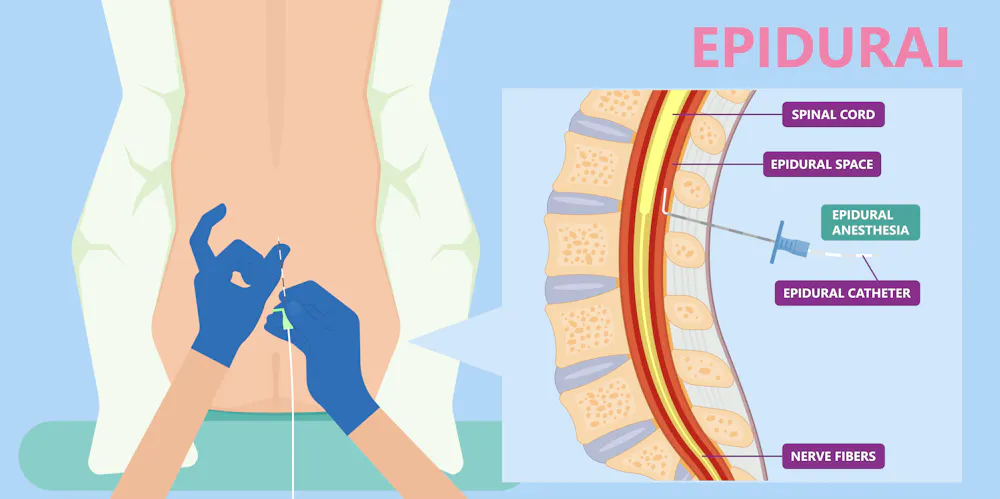
Medications – usually local anaesthetics and morphine-like drugs – are administered down the tube. Pain relief is usually achieved within about 20 minutes.
Why is there a shortage of epidurals?
In April, one of the leading international manufacturers of epidurals announced a temporary disruption to its supply.
This specific supply chain issue relates to the lack of supply of blue dye some manufacturers use to colour the special low-friction plunger-style epidural syringe. This syringe is important because anaesthetists use it to identify the epidural space in the patient’s back.
The syringe is usually filled with saline and connected to the hollow epidural needle, which is then slowly advanced into the back.
The anaesthetist places constant pressure on the syringe and when the epidural space is located, there is a “loss of resistance”. The saline passes easily into it, opening up this space so the epidural catheter can smoothly be passed into it.
 Dye to colour the blue syringes is in low supply.
Screenshot from smiths-medical.com
The familiar blue colour of the low-friction syringe distinguishes it from other syringes, which are clear and used for injecting medications. The colouring of the syringe ensures ease of identification and safety so the correct syringe is used for the procedure.
This unpredictable and sudden loss of a brand of epidural kits has put global pressure on other manufacturers of epidural kits, and their component parts, resulting in a worldwide shortage.
How epidurals have changed
Epidurals have been commonly used for pain relief in childbirth for more than 40 years although the history of epidurals dates back over 100 years.
When first introduced, epidurals were known as “heavy epidurals”, where high-dose anaesthetic drugs blocked the large muscle nerves as well as the smaller pain, temperature and balance nerves. Blocking the nerves to the muscles meant patients were unable to move about their birthing bed, making it difficult to push, and making them feel heavy.
Read more: Explainer: what is an epidural for labour?
Contemporary epidurals now use low doses of anaesthetic that only block pain, temperature and balance nerves. This type of epidural provides excellent pain relief while also enabling movement in bed because the muscles in the legs are not effected.
Modern epidurals can be “topped up” with high-dose anaesthetics to make an epidural suitable to provide anaesthesia for caesarean birth.
However, most caesarean births (69%) use spinal anaesthesia. These use different equipment to epidurals, so caesareans would not be impacted by epidural supply issues.
Epidurals were once used for pain relief for patients undergoing a wide range of surgeries outside obstetrics. While they’re still used to help very unwell patients – for example, after major high-risk cancer surgeries and trauma surgeries – they’re less commonly used and provide fewer benefits for less ill patients.
To manage pain, many of these patients can have a spinal morphine injection, or opioid drugs such as morphine administered via a drip.
Preparing for global supply shortages
In addition to nitrous oxide, and morphine injections, there are some other drug alternatives to epidurals for pain relief in labour. These include the morphine-like drugs, administered via a drip, providing person-controlled analgesia (PCA) or a very low-dose spinal anaesthetic.
However, global supply chain problems will remain with us for many years because of pandemics, wars and natural disasters, and we need to be prepared for them. This means having alert systems to identify sooner potential supply chain issues. Part of this process is to observe what is happening in other countries.
The sooner we know of problems, such as epidural kit supply issues, the sooner we can start to rationalise their distribution. In doing so, such shortages can be anticipated and mitigated. We need to lessen the impact of the supply reduction on those who need it most and ensure people don’t face the potential trauma of uncontrolled labour pain.
Correction: this article originally said more than 40% of people who give birth in Australia use epidurals for pain relief during labour. This has now been updated.
Read more https://theconversation.com/how-do-epidurals-work-and-why-is-there-a-global-shortage-of-them-187640


