

Explainer: how neoliberalism became an insult in Australian politics
- Written by The Conversation

The much-debated term “neoliberalism” again entered the political debate last week, with Greens leader Adam Bandt using a National Press Club speech to decry neoliberalism in the Labor Party.
Bandt claimed that since the Keating and Hawke governments, Labor has adopted neoliberalism by “privatising public services, cutting taxes for the wealthy and adopting more austerity”. Keating hit back, calling Bandt “a bounder and distorter of political truth”, angrily rejecting suggestions that Medicare and compulsory superannuation could be related to “conservative neoliberalism”.
Neoliberalism as insult
Bandt’s speech reflects a more general trend in which “neoliberalism” is used as an insult or political swearword. Even in academic debates, the usefulness of the term has been questioned, with recent articles describing neoliberalism as “a conceptual trash heap”, “hopelessly confused” and “so baggy and unclear that it means almost nothing”.
Read more: Was embracing the market a necessary evil for Labour and Labor?
However, that does not mean it should be abandoned altogether. Many key political terms such as democracy, populism and justice also contain competing and sometimes contradictory meanings. In arriving at a working definition of neoliberalism, it is helpful to consult the writings of those who developed the body of thought.
Origins and definition
Most scholars agree the origins of neoliberalism can be traced to the Mont Pelerin Society, an academic organisation founded in 1947 by Austrian–British economist and philosopher Friedrich von Hayek. The group counted among its members leading neoliberal thinkers such as Milton Friedman, Ludwig von Mises, and James Buchanan.
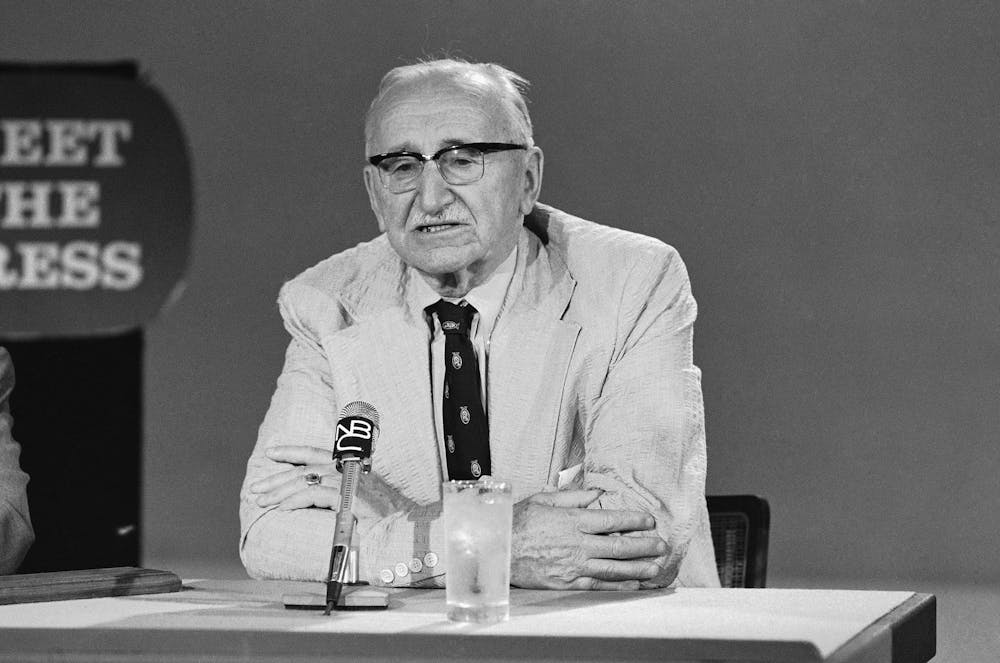
Contrary to the popular caricature of neoliberalism as a free market, anti-state ideology, these early neoliberal thinkers developed a political and economic philosophy that attempted to combine governments and markets.
Where the classical liberals of the 19th century favoured a non-interventionist, laissez-faire approach to economic policy, the key aim of neoliberalism was to recognise that functioning markets must be actively created and maintained by an interventionist state. Neoliberal thinkers argued the chief role of government was to create and enforce the rules of the marketplace.
Read more: Partially right: rejecting neoliberalism shouldn't mean giving up on social liberalism
The ideas of the Mont Pelerin Society entered the political mainstream most prominently in the 1980s under the governments of Margaret Thatcher in the UK and Ronald Reagan in the US. Their policies included privatisation of government owned industries, extensive tax cuts, and creating more “flexible” labour markets by restricting the power of trade unions.
A mixed bag in Australia
In Australia, many of the key reforms of the Hawke-Keating government utilised neoliberal logic to mixed results. For instance, Keating’s signature compulsory superannuation policy replaced the universal pension with a market-oriented system of private savings, allowing workers to gain a share of rising profits on the stock market.
But the system also exposed workers to market downturns. This was most evident during the Global Financial Crisis of 2008, when losses of A$160 billion forced many older Australians to postpone retirement or even return to work.
The superannuation system also reinforces the gender pay gap. Men hold on average 42% more in superannuation savings than women, significantly increasing vulnerability to poverty for older women. Keating was also responsible for repeated privatisations, including the sales of Qantas and the Commonwealth Bank, and broader deregulation of the financial sector which further expanded the scope of the market.
Read more: What is neoliberalism? A political scientist explains the use and evolution of the term
But the Hawke-Keating government was not entirely neoliberal, most notably in its expansion of Medicare. Their relationship with trade unions was also different from the combative stance adopted by Thatcher and Reagan in their countries.
Australian legacy
Taken together, the legacy of these different reforms is complex. However, the Hawke-Keating government was clearly guided by a neoliberal desire to expand the scope of the market.
Neoliberalism in Australia would intensify under Coalition government of John Howard – a card-carrying member of the Mont Pelerin Society and prime minister from 1996 to 2007. He did this through continued privatisation of state assets and deregulation of the financial sector.
Early indications suggest the current Labor government is likely to maintain some market-oriented policies. The refusal to increase JobSeeker payments for unemployed Australians is guided by a neoliberal belief that individuals should attain their basic needs through the market.
And while the exact details of how the government intends to meet its 2030 emissions reduction target are still forthcoming, a market-based approach again seems likely.
Though some may recoil at the neoliberal label they associate primarily with the political right, recent history suggests the neoliberal system has been and will likely remain a bipartisan standard in Australia.


