

10 images show just how attractive Australian shopping strips can be without cars
- Written by The Conversation
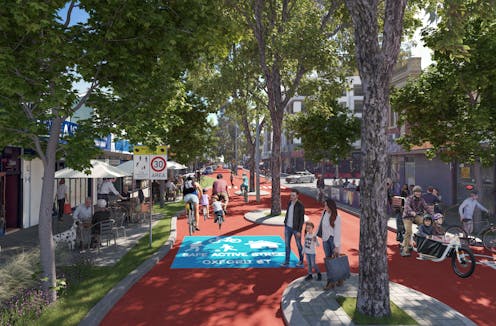
Think of a typical Australian shopping street: parked cars occupy the prime public space in front of the shops. But we could instead create a place that’s good for business and is beautiful too. It would attract customers while being good for our physical, mental and social health.
This isn’t a new idea. Realising they can make better use of the space next to businesses to boost sales, shopping centres design places to attract people. That’s why they provide seats, air-conditioning, music, artwork, cafes and plants outside their shops.
Online shopping is even comfier, but it lacks human contact.
We know what works to create people-friendly local shopping streets. Safer speeds, improving lighting, replacing parking with “parklets”, planting street trees and widening pavements — these are just some of the ways.
Below we’ll discuss four reasons to reallocate parking space next to shops. But first, we’ve re-imagined ten car-centric Australian streets to illustrate the benefits of reallocating space to people … to shoppers, diners, riders, children, prams and the mobility-impaired.
Transforming 10 car-centric shopping streets
These re-imagined streets show thriving liveable communities, supporting friends and families to meet, creating local jobs and providing access to fresh food. (Click on and move the sliders to compare the actual and re-imagined streets.)
1. Chapel Street, Windsor, Melbourne, Victoria
2. Beaumont Street, Hamilton, Newcastle, New South Wales
3. Darby Street, Newcastle, Newcastle, NSW
4. Hall Street, Bondi, Sydney, NSW
5. Princes Highway, Woonona, Wollongong, NSW
6. Belvidere Street, Belmont, Perth, Western Australia
7. Oxford Street, Leederville, Perth, WA
8a. Parklet, South Terrace, Fremantle, Perth, WA
8b. South Terrace, Fremantle, Perth, WA
9. Musk Avenue, Kelvin Grove, Brisbane, Queensland
The elephant in the room
Typically a car transports just one or two customers. A parked car occupies about 13 square metres. That’s about the size of an elephant lying down.
In the same space, 20 shoppers can be walking, 12 diners can sit outside a cafe, or 12 customers can park their bikes.
Before re-imagining the streets, we calculated that car parking (27%) and travel lanes (46%) took up nearly three-quarters of the street space, comparable to other research.
Reducing car parking and travel lanes allowed us to increase green space (up 18%), seating (up 17%) and footpaths (up 6%) in our re-imagined streets.
Read more: Using valuable inner-city land for car parking? In a housing crisis, that just doesn’t add up
Creating beautiful and healthy shopping streets that provide safe and equitable access is key to attracting more business.
Encouraging motorists to park on neighbouring side streets or in off-street car parks can free up space for people. In any case, motorists rarely find parking right out the front of a shop — the (rising) number and size of cars makes that impossible.
4 reasons to redesign shopping streets
Just this week, Perth’s lord mayor proposed ripping out a pedestrian mall in the CBD and opening it to cars. But this logic doesn’t stack up to get more customers.
It’s important to remember: cars don’t buy things from shops, people do. Shopping streets that prioritise people and beauty over cars will attract higher sales, higher retail rental values and reduced shop vacancy rates.
Read more: Parking isn't as important for restaurants as the owners think it is
But where will shoppers park? Shoppers are already used to walking short distances from parking on side streets and in off-street car parks.
Switching to other modes of transport for short journeys to the shops is another option.
We now know that COVID-19 is airborne — meaning we can inhale the virus. Improving ventilation is key to reducing the spread, but this can be a challenge indoors.
The evidence suggests gathering outdoors is safer than indoors.
Almost half of Australians have a family dog, so being able to have a coffee outside opens up further business benefits of outdoor dining space.
Trialling more people-friendly streets can be a great way to demonstrate their benefits. NSW has already run trials of “streets as shared spaces” encouraging outdoor dining.
Read more: What next for parklets? It doesn't have to be a permanent switch back to parking
Great streets are enjoyable and safe places for kids and their families. Streets like this make it easier to get active and have fun.
We should listen to kids’ ideas when it comes to building healthy streets — they want their local streets to be active and fun places to meet their friends.
Shopping streets should make everyone feel welcome. By this we mean streets that:
- are safe and easy to cross
- have shade and shelter
- provide rest stops and benches
- are quiet, walkable and rideable
- have interesting things to see and do
- are relaxing
- have fresh, clean air.
More than half of city car journeys are shorter than 5km — and many are even shorter. Ongoing under-investment in safe walking and cycling means Australians feel forced into driving short distances, even though they might prefer to walk or cycle.
Increasing walking is a cost-effective investment to boost Australia’s physical activity levels. It would reduce the one in ten deaths and A$15.6 billion-a-year burden of inactivity.
Riding or walking to the shops can be a relaxing and enjoyable experience, and shopping streets can be destinations that people enjoy walking around, staying a while and spending more.
When Australians have better access to local destinations, they walk more.
More people on the streets builds a sense of community, essential for optimal mental health.
Take-home message
For shopping streets to compete with larger shopping centres, they need to be more beautiful places to visit, which provide safe and inclusive access for people to spend money locally.
Towns and cities around the world are realising this. Tens of thousands of on-street car parking spaces are being reallocated to people, including in Auckland, Stockholm, Paris, Amsterdam, Milan. Australia can learn from their successes.
The authors encourage the open access reuse of the re-imagined streets. They are freely available to download in multiple formats.


