

Bluey was edited for American viewers – but global audiences deserve to see all of us
- Written by The Conversation
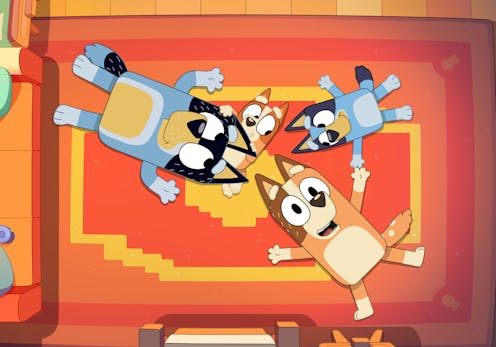
Beloved children’s program Bluey has received some backlash.
Not due to the program, but to Disney’s decision to make edits to various episodes for the US market.
Dubbed “censorship” by some publications, the changes to the third season, released in America on Disney+ this month, include Bandit not being hit in a sensitive area, a conversation about getting a vasectomy replaced with “getting dog teeth removed”, the horse Buttermilk no longer stands next to poo on screen and Aunt Trix is no longer seen on the toilet during a video call.
One episode, Family Meeting, where Bluey accuses dad Bandit of farting in her face, was removed entirely – although due to the backlash it appears this decision has been rescinded.
Episodes in previous seasons have also been edited or unavailable to stream on Disney+.
This decision by Disney comes at a time when there has been a fundamental shift, both in the way audiences consume content and how content is distributed. Through global streaming services, content previously produced for a local market now has a greater opportunity to reach a global audience.
The New York Times has said Bluey “could rival The Wiggles as Australia’s most popular children’s cultural export”.
But can screen content truly be considered a cultural export if it is re-edited to reflect cultural aspects of the market it is being distributed in?
Read more: 'An idealised Australian ethos': why Bluey is an audience favourite, even for adults without kids
Content for global audience
Australian media content being changed for the US market is not a new phenomena.
More than 40 years ago, Mad Max was dubbed with American accents for the US market.
More recently, Australian television shows like Wilfred (2011), Kath & Kim (2009) and The Slap (2015) have been reproduced for a US market.
Since these Americanised series premiered, there has been a shift in the commissioning of media. Content distributors no longer solely rely on local broadcasters: they now are able to go direct to a global audience through streaming services.
Since the start of 2022, Netflix has commissioned content from 44 territories, Warner Bros commissioned work across 27 territories for HBO Max and Discovery+, Disney 23 and Amazon 21.
These streaming platforms aren’t looking for local hits: they’re looking for global hits, from anywhere. It’s not just about making the next Stranger Things, it’s about making the next Money Heist – the Netflix hit from Spain – or the next South Korean juggernaut Squid Game.
A question of quotas
In 2021, the federal government removed the quota requiring local children’s programming on Australian commercial television. This has resulted in a significant decline in the broadcast of children’s content.
We have seen increased investment of Australian content by streaming services. Together, Amazon Prime, Disney, Netflix and Stan spent A$178.9 million in the 2020–21 financial year, including children’s television. This is up more than $25 million in the previous year.
Earlier this year, Netflix launched a partnership with the Australian Children’s Television Foundation to fund the development of original Australian children’s series. Disney has also announced its planned investment in local Australian children’s content.
This increase by streaming service is yet to fill the shortfall by commercial television.
Read more: Cheese 'n' crackers! Concerns deepen for the future of Australian children's television
But is it Australian?
In June, the Make It Australian campaign was launched at the Sydney Film Festival. The campaign calls for Australian stories to be “told on Australian screens by us, to us, about us”.
At the campaign launch, arts minister Tony Burke said international and commercial success for Australian films is “wonderful, but that is a bonus.”
The “first objective” for Australian films, he said:
is to make sure our stories are told so that we know better ourselves; we know better each other and the world has a better way of knowing us.
It is the last point that Tony Burke makes, about the world “knowing us”, that is less considered in the ongoing local screen content debate. Indeed, Australian content is being shown to a global audience.
But what happens when Australian content is edited with these international audiences in mind? Edits like those Disney made to Bluey not only impact the humour and the narrative, but also impact the cultural representation within the program.
Increased investment by streaming services will provide opportunities for Australian local content to be successful locally and globally. But for Australian television and films to be true cultural exports, the world should be seeing the version of ourselves we are seeing, too.
The success of this relies on not only focusing on content production and local distribution, but including strategies that allow Australian content to remain free from localised edits, so it can truly reflect an Australian cultural export.
Read more: TV has changed, so must the way we support local content


