News Daily


Men's Weekly

Australia

  • Written by The Conversation
View from The Hill: Summit triggers immediate action and elevates gender equality

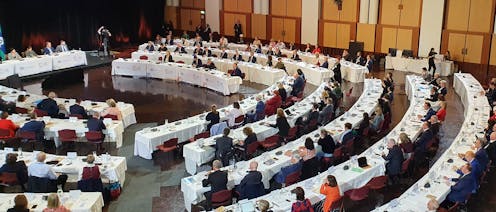
The jobs and skills summit, which concluded on Friday, has been a highly-managed exercise by the Albanese government in maximising policy and political productivity.

The government went into the meeting knowing, broadly, the key initiatives it intended to announce out of it. Most importantly, this included plans for changes to the industrial relations system to try to get wages moving, and for a higher migrant intake to ease the acute labour shortages.

At the end of a day and a half, the government announced 36 measures on which action will be taken this year and around the same number for further work.

One significant announcement, allowing pensioners to earn more, had been recently advocated by the most notable absentee from the summit, Opposition Leader Peter Dutton.

Pensioners will get a temporary upfront “$4000 bank credit” so they can do extra work before they lose some of their pension. At present someone on the aged pension can earn $7800 a year without affecting their pension.
Australian Treasury But, despite the drive to get more women working, the government hasn’t given in to pressure to accelerate the start of its child care scheme, arguing to do so would be too expensive and raise operational issues. To fulfil the prime minister’s commitment to governing by “consensus”, the summit was designed to blunt – though it obviously wasn’t going to eliminate – divisions in the traditionally contested areas of industrial relations and migration. And that it did – partly through bringing stakeholders together so they could air their views in a forum that constrained aggression, and partly by the government making it clear it wasn’t seeking “unanimity”. The most significant negotiations, obviously before the event, were between the government and the union movement. The government delivered on the ACTU demand for the wage-fixing system to open up multi-employer bargaining (at present extremely restricted). The unions, in return, went along with an increase in the cap on permanent migrants from 160,000 to 195,000. The employers are pleased with the prospect of more migrants, but industrial relations is an uncertain path for most of them. Read more: Grattan on Friday: Should Anthony Albanese keep his word on the Stage 3 tax cuts? The government proposes to move quickly on IR legislation – to be introduced this year. Its precise content, however, on which consultations start next week, is unclear. Employers welcome the increased flexibility that is to be put into the Better Off Overall Test for enterprise agreements. The BOOT is there to stop workers going backwards under agreements but has become a tight corset on enterprise bargaining. Under Scott Morrison, the Albanese opposition opposed planned changes to the BOOT – but that was then. Multi-employer bargaining is what worries business: it’s as yet unknown how far that will extend, and what provisions for, or limits on, industrial action it will contain. The series of announcements – including more funding for free TAFE places next year – and the “consensus” reached won’t of themselves fix the critical problems in Australia’s labour market. Achieving that, even partially, will depend on how decisions are followed through, firstly by putting flesh on their bones and then with effective implementation. The government prepared extensively for the summit, with more than 100 roundtables, and gave a lot of thought to representation and the occasion’s atmospherics. It knew the danger of a “talk fest”, and was determined to minimise the risk. It also strove to tap strongly into the themes of inclusion and diversity. (Most speakers, however brief their contribution, started with an acknowledgement of traditional owners.) One area for immediate action is “improving access to jobs and training pathways for women, First Nations people, regional Australians and culturally and linguistically diverse people”. To a considerable extent, the summit was all about women, reflected in both the participants and the problems addressed. Read more: Word from The Hill: Albanese announces more than $1 billion in federal-state TAFE funding Increasing and facilitating Australian women’s participation in the workforce, rewarding them better and advancing their career opportunities were at the heart of much discussion. The plight of low paid, overworked care workers – predominately female – was front of mind. (At a political level, the emphasis on women brought to mind the Morrison’s government’s failures in women’s areas.) Many of the major players at the summit were women, including leaders from the union movement (whose membership has become increasingly feminised with the rise of the “care” economy) and business groups, as well as senior female ministers. One of the biggest “winners” from the meeting was ACTU secretary Sally McManus, whose lobbying for multi-employer bargaining had fallen on open government ears. Read more: Treasurer Chalmers on boosting migration and a 'resilience' budget At the summit’s close Albanese highlighted its 50-50 gender split. In 1983, 96 of 97 participants were male (the woman was minister Susan Ryan). Minister for Women Katy Gallagher said: “Women nailed it at this summit”. “It was no mistake that the panel on gender equality and pay for women was the first thing that we did at this summit. It then fed into every other session.” For all the hype, as with Bob Hawke’s 1983 summit and Kevin Rudd’s 2008 one, the time to audit the level of success (or otherwise) of this summit will be in several years, or even in four decades.

Read more https://theconversation.com/view-from-the-hill-summit-triggers-immediate-action-and-elevates-gender-equality-189883

Cleaner Floors, Healthier Homes: Lefant M3L Arrives as Australians Prioritise Pet-Friendly Hygiene

As pet ownership continues to rise, Australians are placing greater emphasis on maintaining a hygienic indoor environment for both family members and their animals. Issues such as dander, loose fur, and tracked-in dirt require consistent cleaning to support better home... Read more

How Home Removalists Save Time, Money, and Energy During Your Move

Moving to a new home is an exciting chapter in life, but the process of getting there can be overwhelming. From packing and organizing to transportation and unpacking, relocation involves a long list of tasks that can consume both your... Read more

Fulfilment Australia: Streamlining ECommerce Operations for Business Growth

As eCommerce continues to thrive, efficient order fulfilment has become one of the most critical components of customer satisfaction and business success. Companies across the nation are turning to professional fulfilment Australia providers to manage inventory, packaging, and shipping operations... Read more

Evaporative Cooling Cleaning Melbourne: Keeping Your System Fresh, Efficient, and Healthy

As Melbourne’s summers grow hotter, many homes rely on evaporative cooling systems to stay comfortable. While these systems are energy-efficient and environmentally friendly, they require regular maintenance to perform at their best. Professional Evaporative Cooling Cleaning Melbourne services are essential... Read more

4 Benefits of Exploring Australia in an Off Road Caravan

Australia’s vast landscapes offer a kind of freedom that can only be fully experienced on the open road. For travellers seeking caravans for sale, choosing one built for adventure can transform any journey into a memorable one. This article will... Read more

The Importance of Professional eCommerce Web Design for Online Success

The online shopping industry has grown at a rapid pace, and with it, customer expectations have evolved. Today, having a basic website is not enough to attract and retain customers. Businesses must invest in professional eCommerce web design that not only... Read more