

Why do we always need to wait for 'launch windows' to get a rocket to space?
- Written by The Conversation
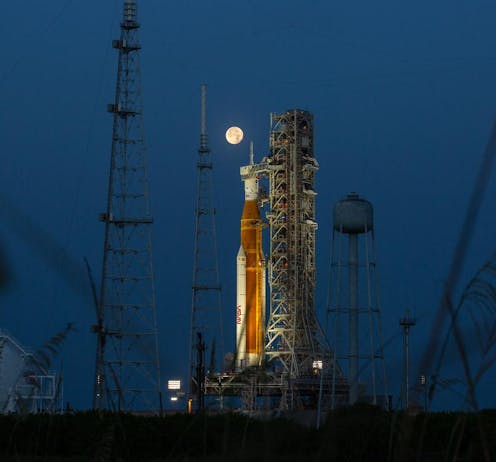
Earlier this week, the Artemis I Moon mission was scrubbed again; now we have to wait for a new launch window.
Just 40 minutes before the Space Launch System rocket was set to take off from Kennedy Space Centre in Florida on September 3, a leaking fuel line caused engineers to scrub the launch.
So what is a launch window, and why can’t a rocket go up at any time? And what does it mean to “scrub” it?
Waiting for the right alignment
A launch window is like waiting for the stars to align. The rocket will be “thrown” off the surface of Earth. This toss must be timed perfectly so the craft’s resulting path through space sends it – and everything it’s carrying – towards the intended location at the right time.
For Artemis I – a mission to send the Orion capsule into orbit around the Moon – the “right time” means waiting for the Moon to be as close to Earth as possible (known as “perigee”) during its 28-day cycle. Hence why we’ll now be waiting roughly four weeks for the next moonshot.
With much of the flight path relying on gravity assists (a “swing-by” that uses the momentum of a large body to increase or decrease the speed of a passing craft) from both Earth and the Moon, and because we want the Orion capsule to come back safely, the timing is crucial.
Orion must slingshot past the Moon, not crash into it, so the positions of the rocket launcher, Earth, Moon and lunar capsule must all be known precisely at all times.
It was a similar story with the launch of the James Webb Space Telescope. In this case, mission controllers were making sure it didn’t hit the Moon on its way to Lagrange Point 2 – a gravitationally balanced spot between Earth and the Sun. The launch of the telescope was scrubbed a couple of times to avoid bad weather; it eventually launched from French Guiana on an Ariane 5 rocket on Christmas Day 2021.

Read more: The Webb telescope has released its very first exoplanet image – here's what we can learn from it
‘Weird’ mission lingo
So why is it called “scrubbing” the launch and not cancelling it? Turns out there’s some fairly specific lingo for space missions.
There are actually five different words used for abandoned space missions. “Scrubbed”, “cancelled”, “scrapped”, “retired” and “terminated” all sound alike, but to mission planners they mean different things.
A mission that is “cancelled” will not be launched. For example, the International X-ray Laboratory was planned to be launched in 2021 as a joint effort by NASA, the European Space Agency (ESA), and the Japan Aerospace Exploration Agency (JAXA), but due to budget cuts it was cancelled. Planning had gone into it, research had been done, but nothing was built. This is a mission cancellation, which usually happens in the developmental stages.
If the mission is part of a program that is axed, this is “termination”. So if Russia leaves the International Space Station program, its participation will be terminated, even though the ISS mission continues. This is the same as when NASA terminated participation in the ESA ExoMars mission.
On the other hand, the last Saturn V rockets were “scrapped” when the last three Apollo missions were “cancelled”. Two Saturn V rockets are on display at Johnson and Kennedy Space Centers, made up of “scraps” from several older rockets and missions.
Finally, we’re used to seeing astronauts retire, but the same happens to space missions too. The Mercury, Gemini, Apollo and STS (space shuttle) programs have all been “retired”. This means no further missions of that type will occur.
Read more: We need to protect the heritage of the Apollo missions
Scrubbed
So, why was the Artemis I launch scrubbed? The expression “scrubbed” is a leftover from the days when mission details were handwritten on a chalk board. If bad weather or equipment failure happened, the mission start time information was wiped off the chalkboard with a damp cloth – scrubbed.
It’s still assumed the mission will happen, but it will be rescheduled for a different time.
This is good news for all those eagerly waiting to see Moon missions happen again for the first time in 50 years. The Artemis I launch has merely been postponed to the next available launch window.


