

Jean-Luc Godard has died. He redefined what film is, and leaves a staggering legacy
- Written by The Conversation
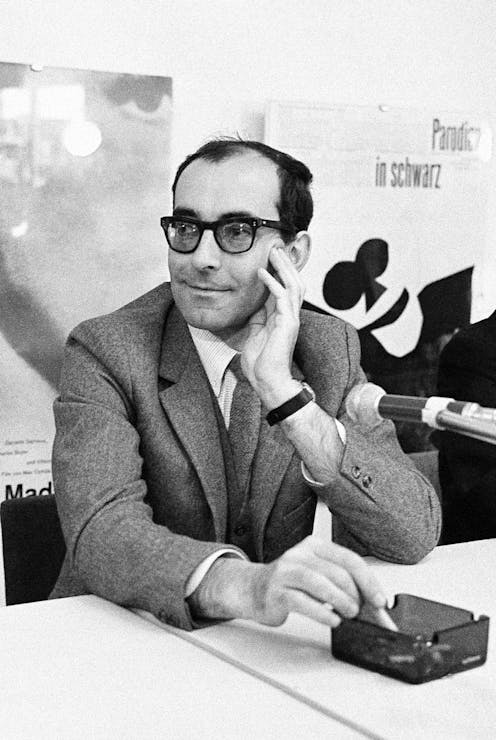
So, adieu Jean-Luc Godard. The titan of French cinema has died, aged 91, leaving behind a staggering legacy.
Godard’s free-wheeling, uncompromising film style kickstarted the French New Wave and its glorious, devil-may-care approach to storytelling.
Godard influenced generations of filmmakers, from Jim Jarmusch and Steven Soderbergh to Wong Kar-wai and Kelly Reichardt.
And he had a wonderful knack of summing up the essence of his cinema in short, sharp phrases:
A story should have a beginning, a middle and an end, but not necessarily in that order.
Or:
All you need to make a movie is a girl and a gun.
And my personal favourite:
Let’s do what has not been done.
A young critic
Born in Paris in 1930 to rich Franco-Swiss parents, Godard grew up in the rarefied world of politics, philosophy and literature. He dabbled with anthropology as a student, but his great love was cinema, and in particular American B-movies directed by Fritz Lang, Nicholas Ray and his idol Howard Hawks.
Drawn to the cinema clubs that flourished in Paris in the aftermath of the war, Godard made friends with fellow cinephiles Jacques Rivette, Eric Rohmer, Claude Chabrol and François Truffaut. Together, these five musketeers landed themselves jobs at a newly established film magazine Cahiers du cinéma.
Godard would watch dozens of films a week, and his reviews were often highly critical of home-grown films made by directors he felt were out-of-touch with modern France.
In a scathing editorial in 1959, he wrote:
your camera movements are ugly because your subjects are bad, your casts act badly because your dialogue is worthless; in a word, you don’t know how to create cinema because you no longer even know what it is.
To show them how to do it properly, he started making his own films.
What followed was a career of immense creativity that redefined the grammar of cinema. Conventional, “invisible” editing was replaced by abrupt jump cuts; smooth long shots alternated with unsettling montages and rapid close-ups; characters broke the fourth wall and directly addressed the audience.
These audacious innovations were all on display in his debut, Breathless (1960).
Read more: From Nazis to Netflix, the controversies and contradictions of Cannes
Breathless film-making
Breathless remains a kind of cinematic Year Zero, marking a point of rupture between everything that came before it (coherence, elegance, neatness) and everything that would follow (iconoclasm, irreverence, rule-breaking).
Watched today, it remains sparklingly modern: a jazz soundtrack to die for, Paris shot in luminous monochrome, and the effortless cool of Jean-Paul Belmondo and Jean Seberg.
The golden rule of cinema up to this point was that your heroes had to be “doing” something. Not so, says Godard.
Instead, in the film’s famous hotel scene, we spend 23 minutes watching Seberg and Belmondo shoot the breeze: nothing happens, but everything happens – two lovers talking, smoking, play acting, being.
Godard’s work rate post-Breathless was astonishing: 25 films in seven years; three alone in 1963.
This was an artist brimming with ideas who shot guerrilla-style on the streets of Paris, becoming the most famous director in the world.
He crisscrossed genres, moving from crime film to science-fiction to Shakespeare adaptation. He’d leave in mistakes – like actors forgetting their lines – to remind viewers that all cinema was essentially fake.
Contempt (1963) is a glorious, technicolour moment of high modernist European cinema. Two or Three Things I Know About Her (1967) sees a remarkable close-up of swirling coffee, complete with Godard’s whispered voice-over.
Read more: Agnès Varda, a pioneering artist who saw the extraordinary in the ordinary
Innovation
He pivoted in the late 1960s into political and militant cinema, addressing the Vietnam War, the May 1968 student riots and radical Marxism in his work.
He continued to innovate: his later films embraced video, 3D and digital technology.
Histoire(s) du cinéma (1998) – a four-hour video project that reflects on the history of cinema – took ten years to produce, and is now considered his greatest achievement.
Godard was awarded an honorary Oscar in 2010, but famously did not attend the ceremony.
As a young man, Godard had tremendous reverence for the American studio system. By 2010, he had fully distanced himself from the Hollywood machine, excoriating it as the worst kind of rampant commercialism.
“Every film is the result of the society that produced it. That’s why the American cinema is so bad now. It reflects an unhealthy society”, he once said.
Godard’s DNA continues to flow through contemporary cinema, from Martin Scorsese’s Casino (1995) to Greta Gerwig’s Frances Ha (2012). Quentin Tarantino called his production house A Band Apart in homage to Godard’s 1964 film Bande à part.
Godard’s final film, The Image Book (2018), was a fitting legacy to this career of formal daring: a collage of iPhone footage, old movies clips, paintings and photographs, narrated by himself. The voice was raspy. The hands frail. But the intellect as sharp as ever.
We will not see his like again.
My much-loved quote from Breathless is when a character is asked what his greatest ambition is. His response: “to become immortal…and then die”.
Well, Jean-Luc, you certainly did that.


