

'Not my king': do we have the right to protest the monarchy at a time of mourning?
- Written by The Conversation
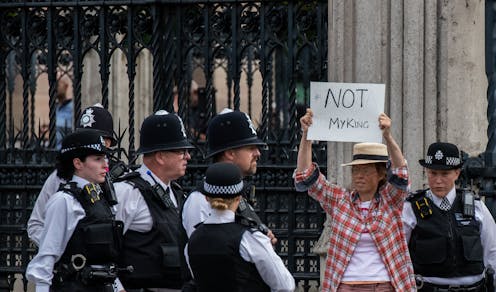
During the present period of mourning for Queen Elizabeth II, public sensitivities in the United Kingdom and Australia are high. There’s strong sentiment in both countries in favour of showing respect for the queen’s death. Some people may wish to do this privately. Others will want to demonstrate their respect publicly by attending commemorations and processions.
There are also cohorts within both countries that may wish to express discontent and disagreement with the monarchy at this time. For instance, groups such as Indigenous peoples and others who were subject to dispossession and oppression by the British monarchy may wish to express important political views about these significant and continuing injustices.
This has caused tension across the globe. For instance, a professor from the United States who tweeted a critical comment of the queen has been subject to significant public backlash. Also, an Aboriginal rugby league player is facing a ban and a fine by the NRL for similar negative comments she posted online following the queen’s death.
This tension has been particularly so in the UK, where police have questioned protestors expressing anti-monarchy sentiments, and in some cases, arrested them.
But should such concerns about the actions of the queen and monarchy be silenced or limited because a public declaration of mourning has been made by the government?
This raises some difficult questions as to how the freedom of speech of both those who wish to grieve publicly and those who wish to protest should be balanced.
What laws in the UK are being used to do this?
There are various laws that regulate protest in the UK. At a basic level, police can arrest a person for a “breach of the peace”.
Also, two statutes provide specific offences that allow police to arrest protestors.
Section 5 of the Public Order Act 1986 UK provides that a person is guilty of a public order offence if:
they use threatening or abusive words or behaviour or disorderly behaviour
or display any writing, sign or other visible representation which is threatening or abusive.
The offence provision then provides this must be “within the hearing or sight of a person likely to be caused harassment, alarm or distress” by those acts.
There’s some protection for speech in the legislation because people arrested under this provision can argue a defence of “reasonable excuse”. However, there’s still a great deal of discretion placed in the hands of the police.
The other statute that was recently amended is the Police, Crime, Sentencing and Courts Act of 2022, which allows police to arrest protestors for “public nuisance”.
In the context of the period of mourning for Queen Elizabeth II, the wide terms used in this legislation (such as “nuisance” and “distress”) gives a lot of discretion to police to arrest protestors who they perceive to be upsetting others. For instance, a protestor who holds a placard saying “Not my king, abolish the monarchy” may be seen as likely to cause distress to others given the high sensitivities in the community during the period of mourning.
Is there a right to protest under UK and Australian law?
Protest rights are recognised in both the UK and in Australia, but in different ways.
In the UK, the right to freedom of expression is recognised in Article 10 of the Human Rights Act.
In Australia, there’s no equivalent of the right to freedom of expression at the federal level as Australia doesn’t have a national human rights charter. Rather, there’s a constitutional principle called the “implied freedom of political communication”. This isn’t a “right” as such but does provide some acknowledgement of the importance of protest.
Also, freedom of expression is recognised in the three jurisdictions in Australia that have human rights instruments (Victoria, Queensland and the ACT).
Can the right to protest be limited in a period of mourning?
In this period of public mourning, people wishing to assemble in a public place to pay respect to the queen are exercising two primary human rights: the right to assembly and the right to freedom of expression. But these aren’t absolute rights. They cannot override the rights of others to also express their own views.
Further, there’s no recognised right to assemble without annoyance or disturbance from others. That is, others in the community are also permitted to gather in a public place during the period of mourning and voice their views (which may be critical of the queen or monarchy).
Read more: The Queen has left her mark around the world. But not all see it as something to be celebrated
It’s important to also note that neither the UK nor Australia protects the monarchy against criticism. This is significant because in some countries (such as Thailand), it’s a criminal offence to insult the monarch. These are called “lèse-majesté” laws – a French term meaning “to do wrong to majesty”.
The police in the UK and Australia cannot therefore use public order offences (such breach of the peace) to unlawfully limit public criticism of the monarchy.
It may be uncomfortable or even distressing for those wishing to publicly grieve the queen’s passing to see anti-monarchy placards displayed. But that doesn’t make it a criminal offence that allows protestors to be arrested.
The ability to voice dissent is vital for a functioning democracy. It’s therefore arguable that people should be able to voice their concerns with the monarchy even in this period of heightened sensitivity. The only way in which anti-monarchy sentiment can lawfully be suppressed is in a state of emergency. A public period of mourning does not meet that standard.


