

Will the National Anti-Corruption Commission actually stamp out corruption in government?
- Written by The Conversation
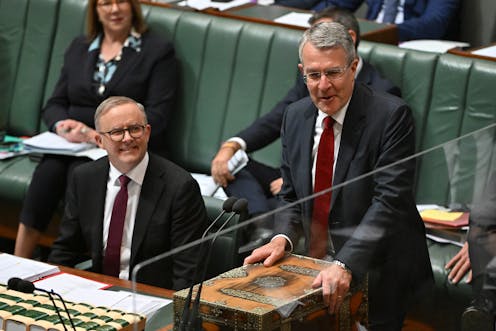
Last week, the government introduced into parliament the bill establishing the National Anti-Corruption Commission (NACC).
This honours the government’s election commitment to introduce a “powerful, transparent and independent” federal anti-corruption commission by the end of the year.
What are the powers of NACC?
So, how does the government’s NACC stack up against other models?
The NACC has strong coercive powers to investigate serious and systemic corrupt conduct in government, equivalent to the powers of a royal commission. This includes the power to compel documents and witnesses.
Retrospective investigations are possible, meaning the conduct of former governments can be examined.
The investigative threshold of “serious or systemic corrupt conduct” compares favourably to the previous Coalition government’s proposal, which required suspicion of corruption amounting to a criminal offence. Such a high bar would prevent investigations from even proceeding.
The NACC’s lower threshold may capture elements of “grey corruption”: that is, where a person has undue influence over a politician, such as by essentially buying that power through making large donations or hiring expensive lobbyists, particularly where it causes public officials to behave in corrupt ways.
Potentially the NACC could investigate the previous government’s repeated rorts scandals, but only where it amounts to serious or systemic corrupt conduct.
The NACC has a broad jurisdiction to investigate the actions of ministers, MPs, ministerial staff, staff of Commonwealth agencies and companies, government contractors, and those acting on behalf of the Commonwealth.
But the NACC cannot investigate parties outside the public sector if they do not have contracts with the government.
In short, the NACC is equipped with strong powers to carry out their task of investigating corruption in the public sector.
Read more: How does the government’s long-awaited anti-corruption bill rate? An integrity expert breaks it down
Who will watch the watchdog?
With such strong powers, safeguards are needed to ensure accountability for the NACC’s actions.
In this vein, decisions of the NACC would be subject to judicial review by the courts to ensure their legality.
The NACC will also be overseen by a parliamentary joint committee. This will be a bipartisan committee with members from government, the opposition and the cross-bench.
The parliamentary committee approves commissioner appointments and can report on the sufficiency of NACC’s budget. However, the budget is ultimately determined by Cabinet.
Anti-corruption commissions are vulnerable to having their budgets cut by hostile governments. For instance, the NSW Independent Commission Against Corruption (ICAC) has had its budget severely cut following its explosive revelations of corruption in government.
Will the NACC be effective?
One criticism of the proposed NACC is the high threshold for public hearings, which can only be held in exceptional circumstances. This is equivalent to the Victorian Independent Broad-based Anti-corruption Commission (IBAC).
However, other bodies, such as the NSW ICAC, have a broader ability to hold public hearings where it is in the public interest to do so.
Public hearings ensure proceedings are not cloaked in secrecy and will increase public trust. Having a higher bar to hold public hearings reduces transparency.
However, there are legitimate issues about damage to individual reputations where a person subject to a public hearing has their reputation tarnished in the media, but is ultimately found not guilty by the courts.
The Centre for Public Integrity has produced statistics showing that, in the seven year period up to 2020, NSW ICAC held 42 public hearings and produced 39 public reports, compared to Victorian IBAC’s 8 hearings and 14 reports.
The centre argued the NSW body’s public interest test does not lead to overuse of public hearings, as in that seven year period, NSW ICAC held 979 private examinations, compared to 42 public inquiries. So, the NSW threshold is arguably preferable.
Read more: View from The Hill: Without those 'lefties' the Liberals can't regain government
Will we have a national anti-corruption commission by Christmas?
After many years of campaigning by interest groups and academics, Australia is finally close to having a national anti-corruption commission.
On balance, the government’s proposed NACC does provide a strong, yet proportionate, vision for an anti-corruption commission with robust powers and both internal and external accountability mechanisms.
The Coalition has signalled its in-principle support for the NACC, but noted reservations about the NACC having extensive powers.
The Greens and teal candidates may seek amendments to the bill to reduce the threshold for public hearings and empower the NACC to investigate third parties outside the public sector, even if they do not have contracts with the government.
Subject to any negotiations, it is now time for parliament to pass the bill.
The electorate has spoken and a federal anti-corruption commission is long overdue. Australians deserve a robust system of accountability that will keep our politicians honest.


