

'No woman could paint': The Story of Art Without Men corrects nearly 600 years of male-focused art criticism
- Written by The Conversation
Have you heard of Surrealist photographer Lee Miller? Or the highly political Dada photo-montagist Hannah Höch? 19th-century sculptor Edmonia Lewis achieved fame and recognition in her lifetime, as did 20th-century sculptor Barbara Hepworth, but none of these women artists have achieved “household name” status, akin to Dali or Duchamp or Henry Moore. That is not, however, because they are not as important, pioneering, or ground-breaking.
Review: The Story of Art Without Men – Katy Hessel (Hutchinson Heinemann)
Katy Hessel’s ambition to plot, position, celebrate and chronologise women’s too-often-forgotten contributions to art is impressive and overdue. The Story of Art Without Men is encyclopaedic in both breadth and intention.

A weighty remedy
I took it with me on a long haul flight and it used up most of my carry on allowance. Physically, it is a work of heft: a weighty remedy to six centuries of male-focused art criticism. That heft is a solid reminder that, though women’s contribution to art may have been consistently rendered invisible or placed at the margins, that in no way reflects the volume of their output.
 The Story of Art Without Men springboards from two seminal texts. The first is clearly signalled in the title: Ernst Gombrich’s The Story of Art has been an introductory manual for generations of fine art students. Women are almost completely absent from its pages.
Hessel tells us that the 1950 edition of Gombrich included not a single female artist. Even when it was updated to its 16th edition, female representation was increased to a resounding total of one. (It’s worth noting that Vasari’s The Lives of Artists, first published in 1550, features four women artists.)
I find myself wanting to describe Hessel’s book as a “companion” volume to Gombrich’s, but this is the wrong designation. Women have been men’s “companions” in the world of art forever; Hessel’s is a text about women artists in their own right, not as an adjunct to men. It is a corrective to the woefully unbalanced, lopsided understanding of art history that has travelled with us into the 21st century.
The second text Hessel references is Linda Nochlin’s game-changing 1971 ARTnews article “Why have there been no great women artists?” Nochlin described the masculine artist-hero myth as the “entire, romantic, elitist, individual, and monograph-producing substructure upon which the profession of art history is based”.
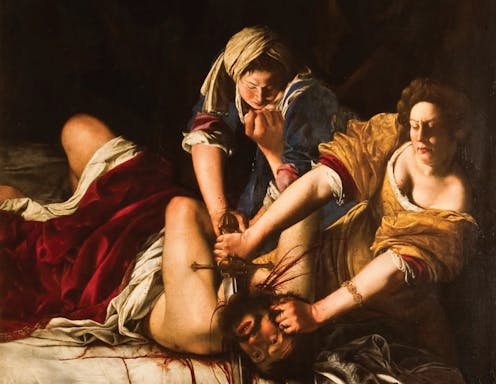
Nochlin’s ideas, striking when first published, remain culturally significant. Only 1% of London’s National Gallery collection is by female artists. (More precisely: 21 out of 2,300.) The first major solo exhibition of a female artist — Artemisia Gentileschi — was not staged there until 2020 (it only took Gentileschi 400 years).
 It was 400 years before Artemisia Gentileschi got a major solo exhibition at London’s National Gallery – she was the first female artist to get one.
picryl
Read more:
Why weren't there any great women artists? In gratitude to Linda Nochlin
Removing the clamour of men
Meanwhile, it’s worth noting that the highest record price for a female artist’s work is only 12% of the equivalent male record (Jenny Saville and David Hockney, respectively). Hessel quotes these statistics in the book.
The Victorian practice of scratching out a woman’s name on a painting and replacing it with a male name (to ensure it sold) complicates what is already “scant” scholarship of women’s artistic practice. This is the sobering – and sometimes angering – context Hessel provides in her opening pages.
“It feels important to remove the clamour of men in order to listen carefully to the significance of other artists in our cultural histories,” Hessel writes. As well as deafening – and blinding – us, “the clamour of men” has impoverished our understanding of the history of art. Strategic exclusionary practices, louder voices, control of the public narrative: all have played a role here.
 Emily Kame Kngwarreye is the one Australian artist included in The Story of Art Without Men. This untitled painting of hers is at the Museum of Contemporary Art in Sydney.
Paul Miller/AAP
The single characteristic that made modernism “modern”, Hessel continues, is its inclusion of the female artist and, with it, the female vantage point. From 1900 onwards, the activity of women artists gained momentum.
Visibility of women’s art was demanded and promoted by female administrators and curators. So was greater access to art education and opportunities for women. And, occasionally (often briefly), women artists attracted public attention and even celebration. The Story of Art Without Men is, as a result, modern-heavy in the telling.
Read more:
Male artists dominate galleries. Our research explored if it’s because ‘women don’t paint very well’ – or just discrimination
Father figures, oblivion and appropriation
Three common themes emerge in Hessel’s accounts of women artists from 1500 to today. The first is the historical importance of fathers. We can’t underestimate the approbation, influence, and financial support given to female artists by their fathers — particularly if the men were artists themselves. A male artist in Renaissance Italy might get himself apprenticed to a master artist; a female artist needed the protective umbrella of a father to harbour beneath.
Another is a recurring pattern of success and oblivion: again and again, Hessel tells us of women artists famed and celebrated in their lifetimes who faded into obscurity after death. Gentileschi herself, celebrated in her time, only came properly to prominence through the efforts of second-wave feminist art historians from the 1970s on. (Starting with Linda Nochlin’s game-changing article.) Meanwhile, figurative painter Alice Neel, feted in the 70s and 80s, died with an apartment “stacked full” of unsold work — far from a household name.
Figurative painter Alice Neel was feted in the 70s and 80s, but died as ‘far from a household name’.
Another constant is the astonishing frequency with which male artists have been credited with women artists’ conceptual and aesthetic breakthroughs.
Anyone who doubts this should look at the paintings of Marlow Moss and compare them to the work of Piet Mondrian. The influence has been understood as Mondrian’s, but in fact the two artists, both working in the early and mid 20th century, were in frequent artistic dialogue and Mondrian was often artistically influenced by Marlow’s work and approach.
Or consider Gustave Klimt’s 1907 The Kiss against Glasgow School artist Margaret Macdonald Mackintosh’s 1902 The Opera of the Sea — it is highly probable that Klimt saw this work, “and yet”, writes Hessel, “has Macdonald Mackintosh’s name ever been mentioned in reference to Klimt?”
 Opera of the Winds.
WikiArt
Marcel Duchamp’s famous ready-made — his 1917 R. Mutt “Fountain” urinal — it turns out, may have been submitted to (and rejected by) the Society of Independent Artists by the Baroness Elsa von Freytag-Loringhoven, and not by Duchamp at all. Did Duchamp merely copy her? Hessel maintains that he did, drawing on letters in which Duchamp references the Baroness’s provocative gesture – though this assertion is contested by art institutions. The Baroness died penniless, possibly by her own hand; Duchamp has been immortalised as the daring provocateur of this famous act of aesthetic irreverence.
Of course, it’s no surprise to anyone that art scholarship is constructed in the image of the male practitioners who have controlled the narrative and steered the conversation for hundreds of years. “[W]omen-led narratives shown through a distinctly female lens” have hardly been glimpsed on this journey, so it is no wonder they are barely referenced in Gombrich’s catalogue of the canon.
Summary pronouncements by male cultural heavyweights, taken as “truths”, have contributed to this. “No woman could paint,” asserted 19th-century critic John Ruskin, in a statement Hessel describes as “barbaric”. There are painters, Ruskin went on, and then there are “paintresses”.
Walter Gropius waxed lyrical that women think “in two dimensions” whereas men think in three, subsequently shunting women off to the Bauhaus’s bookbinding and weaving workshops — where they made huge artistic strides, particularly in the latter field (see, for instance, the abstract wallhangings of modernist weaver Anni Albers).
The Story of Art Without Men demonstrates once and for all the ludicrousness of such statements. As an Australian reader, though, I was disappointed by the inclusion of only one Australian female artist in Hessel’s comprehensive catalogue: Emily Kame Kngwarreye.
Hessel provides a view of women’s artistic contributions over 500 years that is both detailed and sweeping. If the history of art is a star-studded affair, Hessel makes visible the many luminous constellations we have failed to chart. And failed even to see – to our own great detriment.


