

20 years in the making: witnessing the _Dwoort Baal Kaat_ songline's incredible return to Noongar Country
- Written by The Conversation
The Hopetoun Community Resource Centre is a hive of activity this sunny morning in mid-September. It is the height of the Ravensthorpe Wildflower Show, an event that attracts thousands of visitors to small agricultural towns on Western Australia’s south coast each year.
Hopetoun sits on the doorstep of the Fitzgerald River National Park, an ecological wonder and one of 35 crucial Global Biodiversity Hotspots.
The park is also a region of great cultural significance to the traditional custodians of the land, the south coast Noongar people.
This morning’s festival patrons are about to see a cultural presentation 20 years in the making. A songline that has been on a journey away from Country, to the northern hemisphere and back, to be sung in public once again by its people.
I’m a Noongar woman and a member of the Wirlomin Noongar Language and Stories organisation. The songlines criss-crossing Noongar Country connect us to our ancestors and the powerful knowledges that make us who we are.
These cultural stories are impossible to adequately render in the written word alone. The tones of human voices singing and the thrum and cadence of Country are vital parts of a songline’s impact and perseverance.
Here today the Wirlomin community is sharing the text, song and location of a story nearly lost to us.
Dwoort Baal Kaat
The Songline is Dwoort Baal Kaat, a tale of hunting dogs who transform into seals, which was told by Noongar man George Nelly to American linguist Gerhardt Laves in 1931.
The story follows a Wirlomin ancestor who takes his dogs and his brother’s dogs out hunting for tucker. This hunter thinks he’ll have lots of luck with so much help, but every time the dogs take down a kwoor (wallaby), kwoka (quokka) or wetj (emu) by the time he catches up there is none left for him. He’s so hungry he sets fire to the dogs, who run away to escape him, fleeing down into the ocean.
The brother who lent his dogs is further down the coast, and he hears his dogs barking. He looks around then out toward the ocean and sees them swimming towards him. When the dogs emerge from the sea they have smooth glossy bodies, tiny ears and stumpy legs. He says “Dwoort Baal Kaat” (“Dog His Head”), then rolls the words together to say “dwoortbaalkaat”: “seal”.
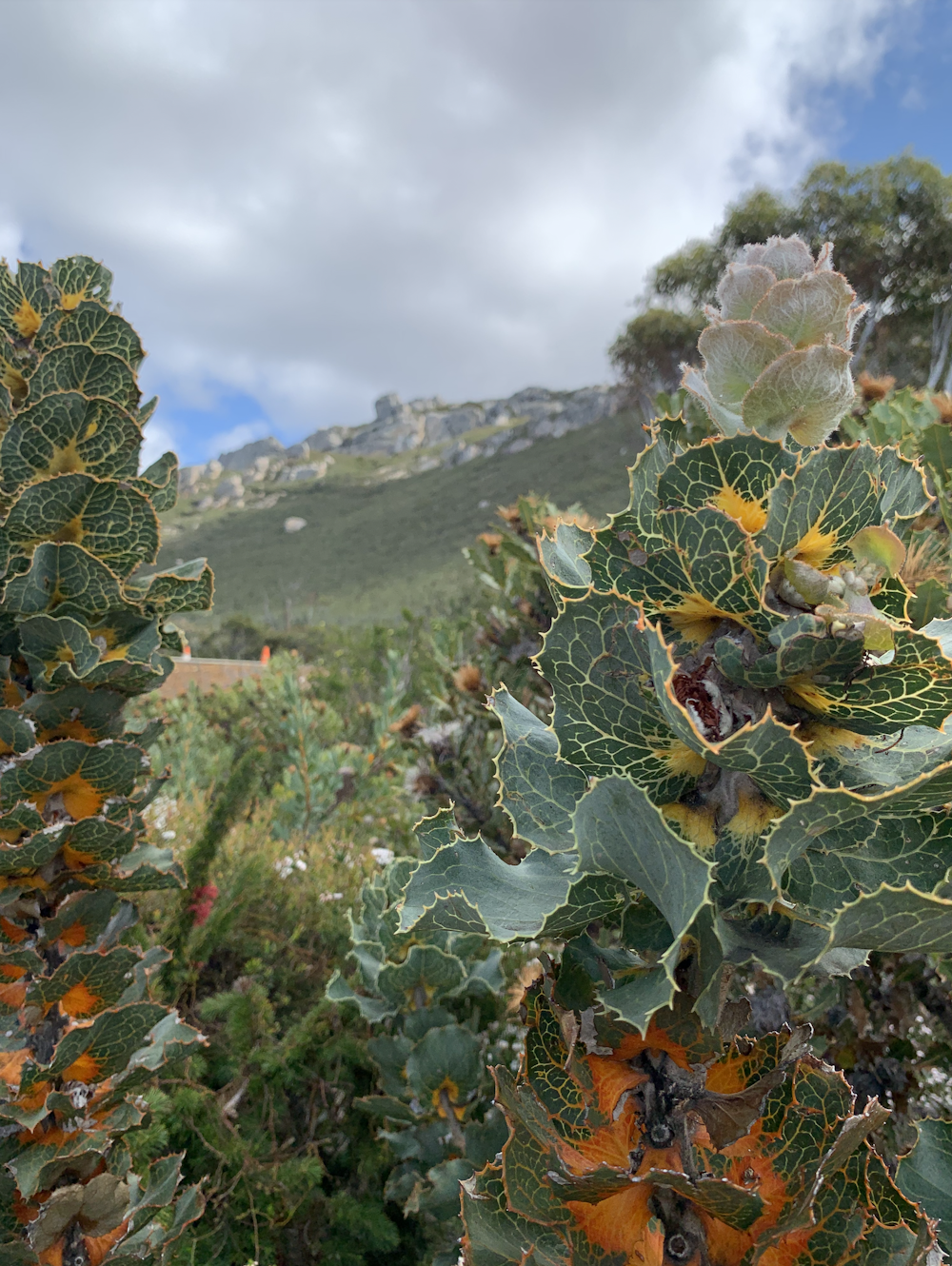
 The Fitzgerald River National Park is a Global Biodiversity Hotspot.
Flora photo by Gaylene Galardi (2022), Author provided
In 1931, Laves recorded south coast Noongar people speaking the Noongar language. He took these field notes back to the United States where they sat unpublished in his lifetime.
In 1985, the Laves estate returned the language documents to Australia. In 2002 the notes were given over to the descendants of those original Noongar speakers, the Wirlomin Noongar community. In 2006, the Wirlomin Noongar Language and Stories organisation was formed to oversee the consolidation and enhancement of this and other archival material.
Noongar author Kim Scott and others developed the Laves language material in collaborative family workshops, where family members gathered around with pens and butcher paper to activate the stories together.
In 2013, Dwoort Baal Kaat was published in English and Noongar. But this was just the first step. The book didn’t reveal any of the songline locations nor the music associated with them.
Now, on this September morning, Scott narrates the story in front of a multimedia presentation, the public debut of a digital songlines map, following the hunter and the dogs moving across the national park.
Returned to Country
In recent years, workshops have cross-referenced the Laves material with surviving songs and stories.
Up on stage, and as Wirlomin community members move up from the audience to join him, Scott reads the last line of Dwoort Baal Kaat:
Yey, maam dwoort baalap boya nyininy kalyakoorlNow, man dog they rock sitting/being forever
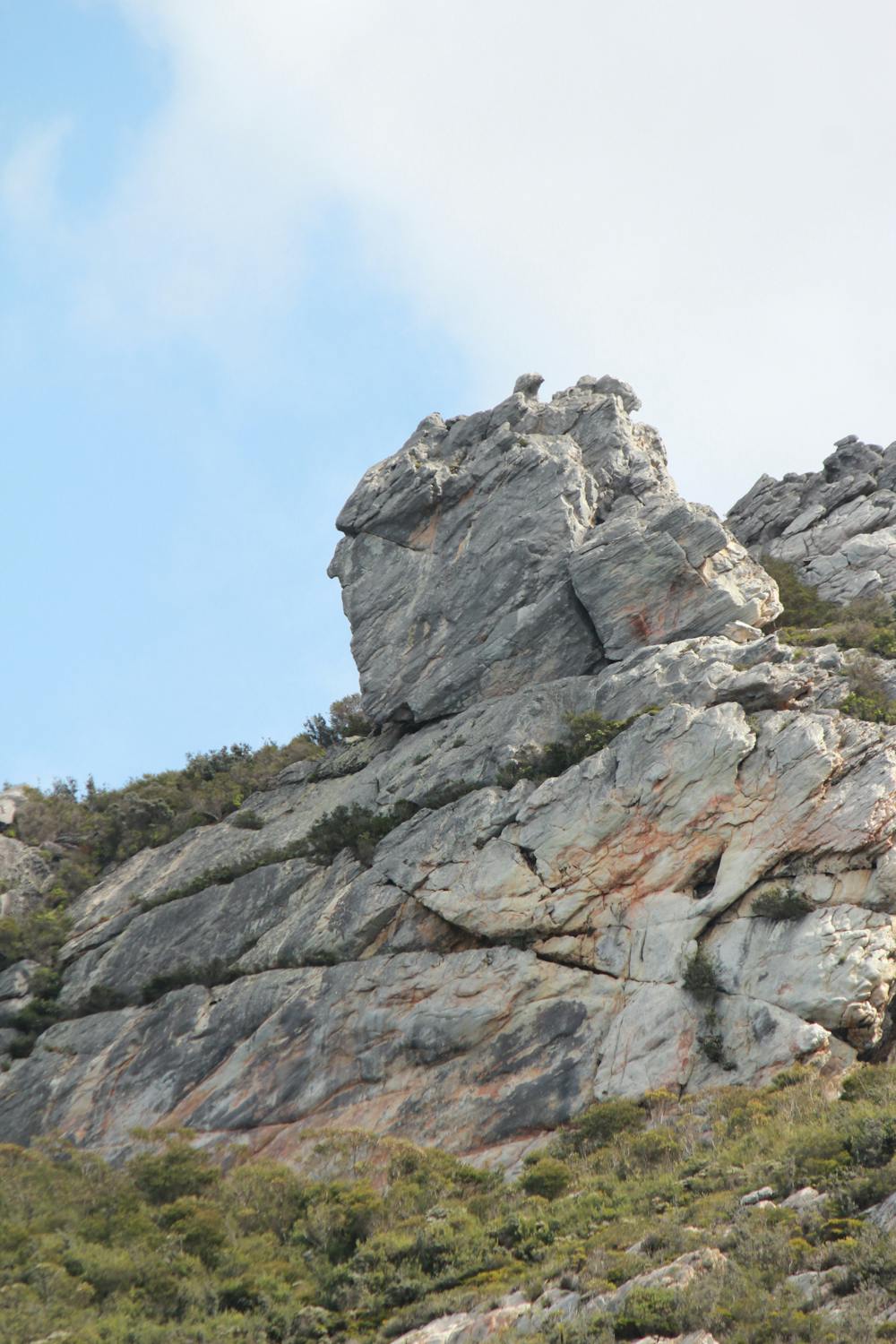 Dwoort Baal Kaat rock formation at East Mount Barren in Western Australia, the ‘giant’s head’.
Photo by Gaylene Galardi (2022), Author provided
A photo of a rock formation at East Mount Barren appears on the screen. It is the head and shoulders of a giant, looking down at smaller stone figures: the brother who has turned his head to see his dogs, transformed into seals.
The Wirlomin mob on stage burst into the old song of the dogs leaping through the flames, igniting and fusing story, place, song and people in a way that hasn’t happened for a long time.
This region is infamous for massacre and overclearing. But cultural heritage has still been passed down via oral storytelling from the Elders. Now, the combination of the oral history and the return of Laves’ material means this song can once again be sung on Country.
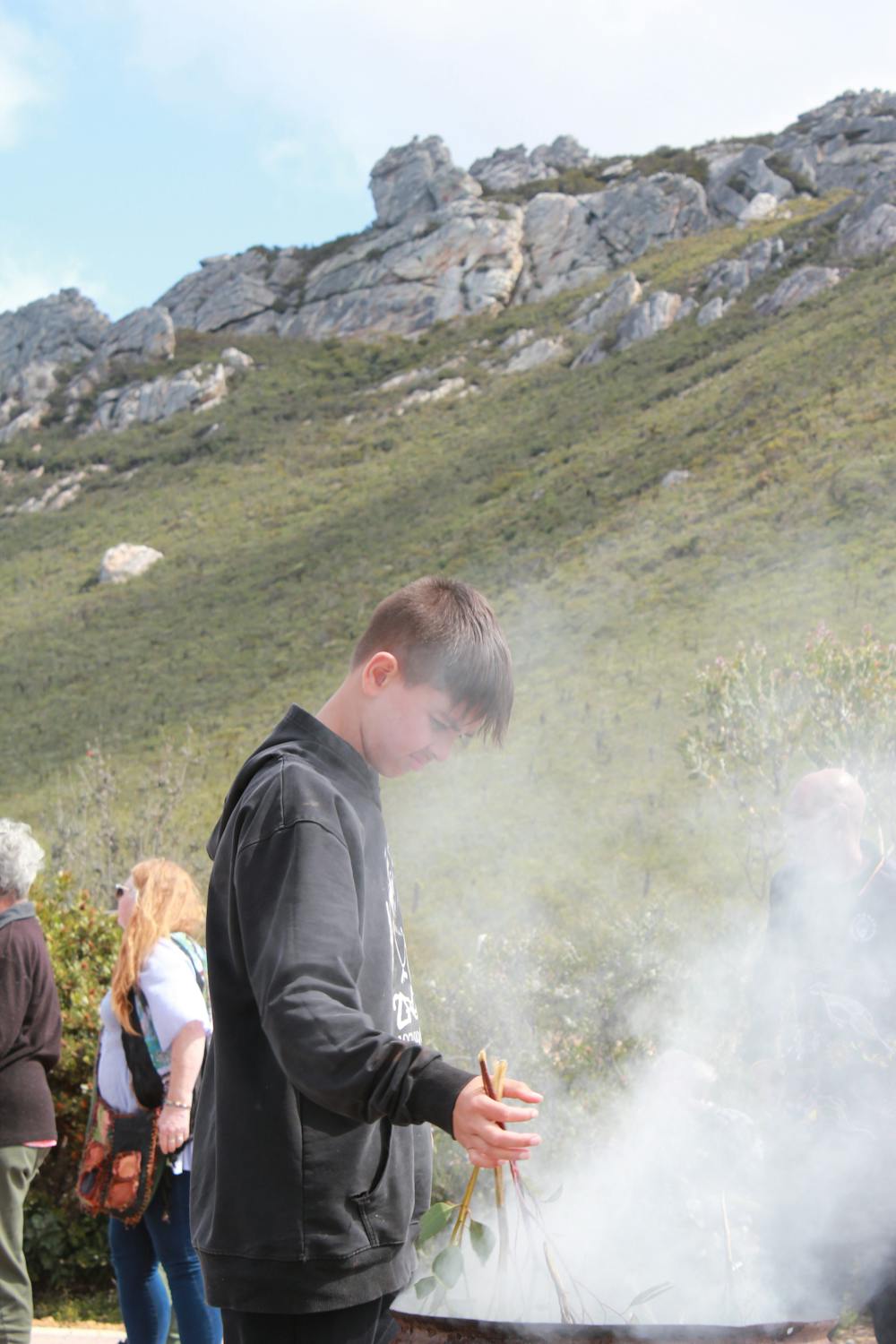 Wirlomin Noongar youngster Xavier helps with the smoking ceremony under the Dwoort Baal Kaat rock formation at East Mount Barren, Western Australia.
Photo by Gaylene Galardi (2022), Author provided
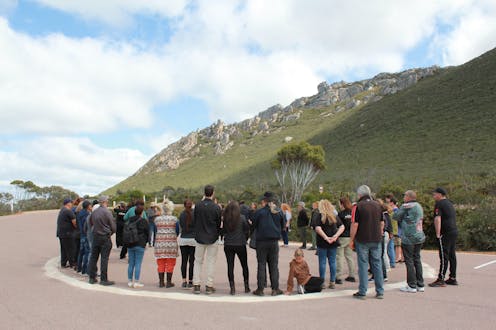
After the presentation, wildflower show guests and VIPs catch a bus with the Wirlomin mob to the carpark at East Mount Barren. The mob conduct a smoking ceremony and everyone stands in a circle of beach sand and smoke.
Looking up at the head and the seals, the Wirlomin hosts have led their audience to a place where culture, community and landscape intersect to offer a deeper sense of identity and belonging.
The singing of this songline today is just a glimpse of what the appropriate revitalisation and consolidation of Noongar culture can contribute to the wider communities of the southwest.
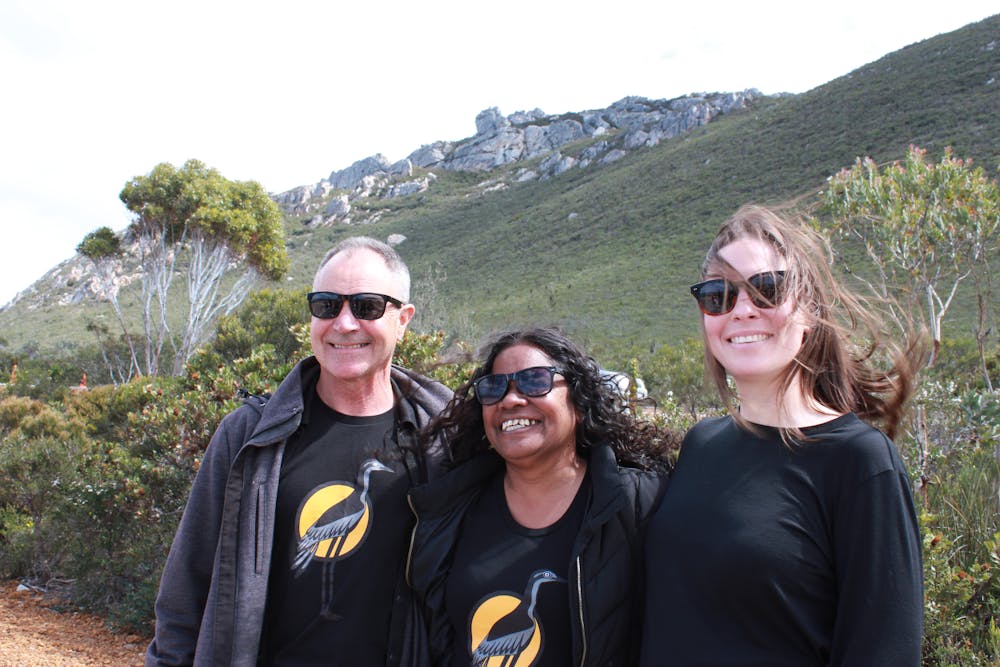 Wirlomin Noongar community members Kim Scott, Gaye Roberts, and Cass Lynch under the Dwoort Baal Kaat rock formation at East Mount Barren, Western Australia.
Photo by Gaylene Galardi (2022), Author provided
Read more: 'Singing up Country': reawakening the Black Duck Songline, across 300km in Australia's southeast


