

Damsels in distress: two new Australian novels fail to achieve their literary ambitions
- Written by The Conversation
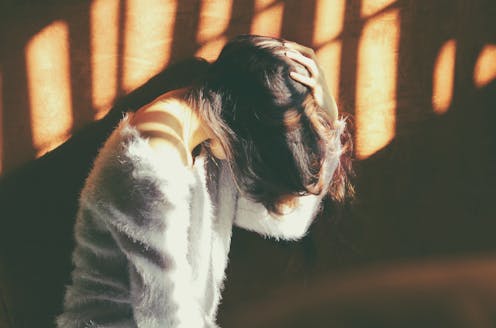
The covers of two new Australian novels, Hydra and Faithless, play into a current design trend in Australian publishing. Faceless women in various states of melodramatic distress – either flung over furniture, or pictured against blurred or monochromatic backgrounds. Arms, hands or long, dishevelled hair conceal their faces. It’s a trend spurred on, no doubt, by the runaway success of Meg Mason’s Sorrow and Bliss.
Review: Hydra – Adriane Howell (Transit Lounge) and Faithless – Alice Nelson (Vintage)
These are our new literary damsels, more muted in their elegant colour-coordinated breakdowns than their Hollywood golden age predecessors. The design did not suit the outrageously funny tone of Mason’s novel, but works well enough here as a portent. In Hydra, of an interior descent into mania. In Faithless, of longing in a decidedly calming shade of forest green.
Hydra’s ‘unhinged’ heroine
We first meet Anja, the heroine of Hydra, on her first day back at work in the high-end, cut-throat world of antique dealing, after a disastrous trip to the titular Greek island – where her marriage has seemingly fallen apart.

 Adriane Howell’s novel, Hydra, is ‘never dull’, but takes too many implausible leaps.
By the time we hit the last third of the novel, we’re in a whirling dervish of jump scares – not rendered entirely successfully. The balance between plausibility and mystery stretches beyond breaking point. In a pivotal scene, where Anja’s unravelling really begins to take hold, a giant navy vessel visible from her house, grounded for decades, is struck by a bolt of lightning in an intense storm. It sinks in a matter of minutes. Anja abruptly falls asleep.
In another, after getting sloshed to calm her mind, Anja clambers down the huge cliff face, glass in hand. She cuts her hand and leaps off a rock into the ocean – where she contemplates suicide for a while, clambers out again, can’t find her way back up, leaps onto some more rocks, smashes her teeth in, then lies on her back and laughs manically. She spends the rest of the novel walking around toothless.
Conceptually, each twist and turn might be justified, but we lose all sense of narrative security – and our confidence that Howell is adequately guiding us out of the eye of this adrenaline-fuelled storm falters. In the end, like Anja, we’re asked to take too many implausible leaps.
Read more:
Barbara Trapido's 'undeniably sexy' novel of academic bohemia still dazzles at 40
Faithless – a ‘questionable plot’
Take away all the literary allusions and carefully constructed prose and the plot of Faithless, by two-time novelist Alice Nelson, skates very close to highly commercial romance.
 Max – a famous, handsome, married, middle-aged writer – meets Cressida, a beautiful young English girl, on her family’s estate in India. It’s recently been converted into a boutique hotel, due to her dead daddy’s mishandling of money. Their affair continues for decades, as she burrows away in her garret back in England working on translations, meeting Max for “clandestine liaisons” where they spend more hours wandering in gardens “rampant with the smell of wisteria” and quoting Goethe and Proust to each other than they do having sex.
Until along comes the “vastly generous” Leo – another handsome man who relieves her of her money troubles, so she can finally write and become fabulously famous and rich herself. The to and fro between Leo and Max continues until fate decides for them all – and Cressida heads to the village town of Dunwich, where Max once lived, to mooch about in her memories under “listless” skies by “roiling” seas, accompanied by the mysterious orphan Clara.
Any potential entertainment value offered by this questionable plot is further weakened by its delivery – everything has already happened and is being told to us. Cressida is writing one long letter to her dead lover Max: “Oh we had delight Max, hour after hour of pure pleasure.” These second-person sections are framed by shorter scenes in contemporary Dunwich, where nothing much happens. This structural decision means the grand love affair, the “all consuming” love Cressida feels for Max, is rendered passionless in recall.
 Alice Nelson’s novel about literature ‘operates in a rarefied world I do not believe or recognise’, says Sally Breen.
Nicole Boenig-McGrade
Max is also, unfortunately, a pretentious cad. The first time he kisses Cressida doesn’t happen until page 91. And he tends to accompany each kiss or interaction with her with a quote, such as, “Now no discourse, except it be of love.” (From Shakespeare’s Two Gentlemen of Verona.) A similar loftiness inhabits the prose, where even the sex (what little there is of it) is strangely sexless and cliched.
On Sunday we woke early, just as the sun was rising in a vast plume of orange above the mountains. We made love slowly, with a tenderness that made me want to weep. You stared down at me as if you were gazing at something extraordinary, something slightly bewildering. It was always the face I believed most revealed you. Max; the one you turned to me as you rose above me in bed.
If this is a book about love and literature, it operates in a rarefied world I do not believe or recognise. Perhaps I’ve seen a guy like Max wandering around a writer’s festival: a lavender cashmere sweater draped around his shoulders, his long-suffering, much younger mistress drinking in his lame references to dead white males.
Maybe, but that image is also cliched. Neither the plot nor the writing is up to the literary ambition that defines this novel. Endless quotes and allusions to the greatness of others cannot save it.


