News Daily

The Times

Australia

  • Written by The Conversation
Budget restraint? When it comes to transport projects, it's hard to find

“Restraint” – that’s what Treasurer Jim Chalmers claimed as the watchword of Tuesday’s federal budget. Perhaps the claim can be made in general, but when it comes to transport infrastructure, the budget is remarkable not for how different it is to budgets past, but how similar. It has left plenty of opportunities for actual restraint for next time around, in May 2023.

The first similarity to budgets past is how much is being committed to transport infrastructure.

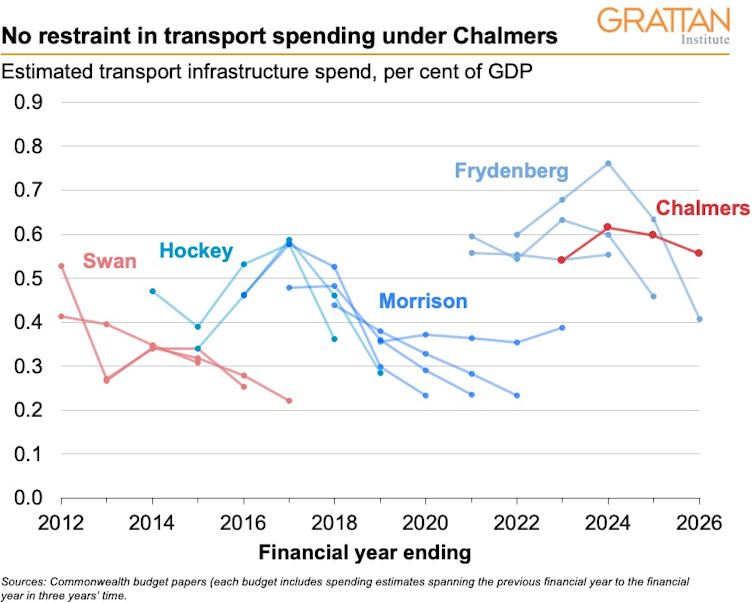
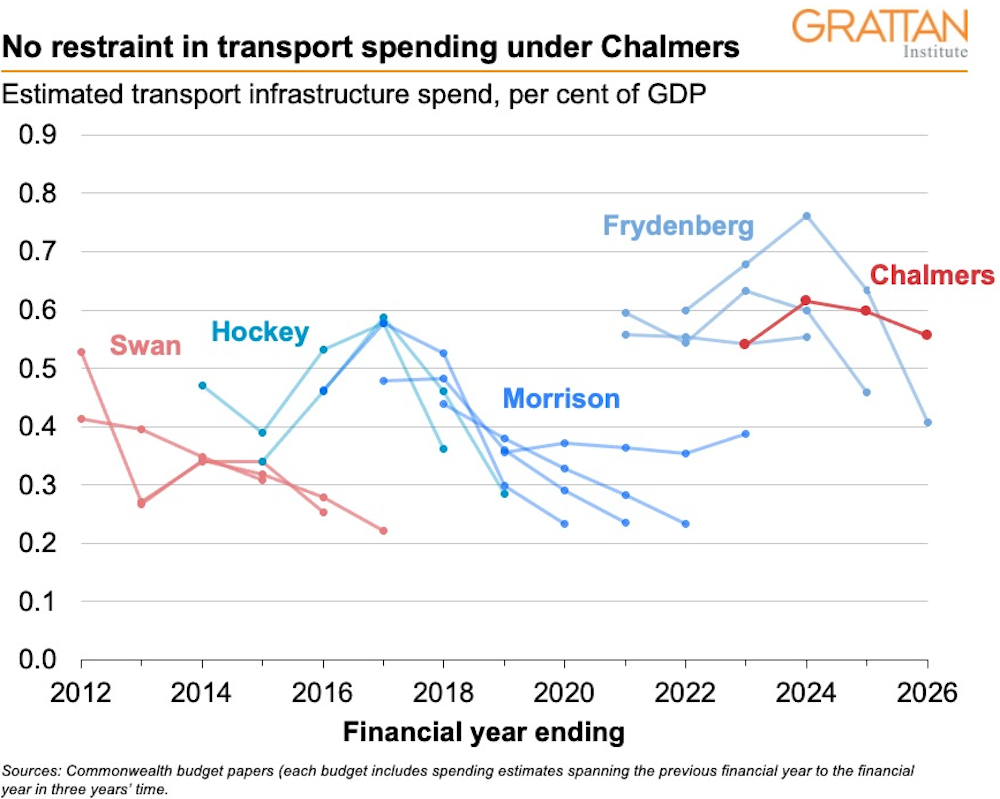
This year the total is about 0.6% of GDP, much like Josh Frydenberg’s budgets of the past three years. That equates to A$13.4 billion this year, rising to about A$15 billion for each of the next three years.

Chart showing level of transport spending in federal budgets, 2012 to 2022
Author provided What Frydenberg and Chalmers have in common is that they have presided over a big shift upwards in the total spend, from around 0.4% of GDP under their predecessors Scott Morrison, Joe Hockey and Wayne Swan. It’s hardly “restraint”. Headline numbers are inflated The second similarity to budgets past is the irresistible temptation to quote far bigger numbers than are actually committed in the budget. It’s all very well to say what you plan to deliver in ten years and beyond, but the budget is all about what you’re committing this year and the following three. It’s just like legislating stage 3 tax cuts in 2019; three years and a pandemic later, it’s hard to backtrack. The problem is exacerbated because the headline number includes projects already committed long ago. The claim in the budget glossy is that the Albanese government “is delivering on its election commitments as part of the more than $120 billion pipeline of investment in transport infrastructure over the next 10 years”. But what’s actually committed in the budget for additional road and rail is $8.1 billion of new money over ten years. Most of the eye-watering $120 billion predates this government. For example, New South Wales residents may applaud the promise to spend $300 million on western Sydney roads and $500 million on early works for high-speed rail, and a total NSW commitment of $1.4 billion over ten years. But it’s hard to square that with the infrastructure minister’s promises of $5.25 billion for the Sydney Metro to Western Sydney Airport, and $1.6 billion for the M12 motorway. Similarly, Victorians may eagerly anticipate the $125 million for the Barwon Heads Road upgrade and $2.2 billion towards the Suburban Rail Loop. There’s a total commitment of $2.6 billion for the state over ten years. But how does that line up with the minister’s promises of $5 billion for Melbourne Airport Rail, along with $448 million for Gippsland Rail? Infrastructure Australia bypassed The third similarity to budgets past is how projects are selected for funding. Prime Minister Anthony Albanese is proud of Infrastructure Australia. It’s the body he set up as infrastructure minister in the Rudd government to help elected representatives who, he said, struggled “with the need to take a long-term non-partisan view” of infrastructure. Yet this budget includes billions of dollars for projects that should have gone through an Infrastructure Australia assessment, but haven’t. The standout is Melbourne’s Suburban Rail Loop. It’s the signature project of the Andrews state government as it heads into a November election. The project was announced three months out from the previous Victorian election, and a business case wasn’t published until three years after the decision to invest. It’s very controversial. The state government claims that building the east and north sections of the rail loop and operating them for 50 years will cost $31 billion to $51 billion. In stark contrast, the Victorian Parliamentary Budget Office calculates it will cost $200 billion. What does Infrastructure Australia think? It considers the project a very long way from investment-ready. Another standout is a $500 million down payment on high-speed rail. Even without a current business case, the government has declared it is “absolutely committed” to the project. If the numbers run in 2013 were correct, this project will cost at least $130 billion, and will compete with the since-begun Western Sydney Airport. What does Infrastructure Australia think? Again, it considers that even corridor preservation for the project is a long way from investment-ready. A third standout is $586 million to upgrade the Bruce Highway through Brisbane’s outer northern suburbs. The Bruce has had a massive program of upgrades over many years. Many sections have been assessed by Infrastructure Australia – but not this one. None of these decisions could be described as restrained, and there are many similar. Still waiting for rigorous assessments Of course, it’s not easy to inherit a swag of major projects from the previous government, many of which are begun or at least anticipated. And it’s to this government’s credit that it has moved $6.5 billion worth of these projects to beyond the budget forward estimates, in recognition that the engineering construction sector is already struggling to keep up with demand. But in this environment, it makes little sense for the government to have thrown its weight behind new commitments, such as east-coast high-speed rail and the Suburban Rail Loop, that will tie its hands for decades to come. Next time around, the treasurer should insist that each individual project up for funding consideration has been properly assessed by the government’s own independent advisory body. If the project is at too early a stage, the government shouldn’t invest public money in it. A more rigorous project-by-project assessment would help the government determine how much of the transport spend is really worth it. Let’s hope. When it comes to transport, restraint is hard to find.

Read more https://theconversation.com/budget-restraint-when-it-comes-to-transport-projects-its-hard-to-find-192848

How Coworking Desks in Melbourne Support Flexible Work

Flexible Seating for Daily Work Coworking desks Melbourne arrangements can provide freelancers, remote workers and small business operators with a professional place to work without needing an enclosed office. Shared desks offer a setting where people can complete projects, use workplace... Read more

Split Corrugated Conduit for Flexible Cable Protection

For wiring assemblies in vehicles, machinery and equipment, choosing suitable cable protection helps keep cables organised and reduces direct contact with surrounding parts. Mojak Plastics supplies plastic tubing and conduit options for different installation needs, and split corrugated conduit can... Read more

Trailers Melbourne Buyers Can Compare: When Box Trailers Make Sense

For many homeowners, businesses and tradespeople, trailers Melbourne customers use every week need to be versatile enough for changing loads. A box trailer can be particularly useful because its enclosed sides help contain cargo while providing a straightforward loading area... Read more

Bottle Label Printing That Balances Design and Readability

Product labels need to attract attention while making information easy to find and understand. On a bottle, the available space may be limited by the container’s shape, so every design decision matters. Bottle label printing should account for visual hierarchy... Read more

Office Cleaning Melbourne: Planning a Consistent Workplace Routine

Businesses looking for office cleaning Melbourne need a plan that reflects the way their workplace operates. A clean office supports day-to-day organisation, helps shared spaces remain presentable and gives employees and visitors a more orderly environment. Eco Green Cleaning Management... Read more

Pinboard Solutions for Offices, Schools and Shared Information Spaces

Why a Pinboard Remains Useful A pinboard provides a simple way to display information that needs to remain visible without being rewritten. Lawdex supplies fabric and cork options for offices, schools, staff areas and other environments. A pinboard can be used... Read more