

Bones of contention: the West Coast whale fossil and the ethics of private collecting
- Written by The Conversation
The past can inform the present in more ways than one.
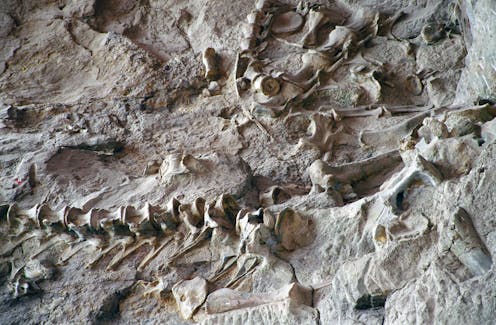
Take the case of the 23-million-year-old whale fossil recently excavated by a private collector on the West Coast of the South Island. It has angered Karamea locals and Ngāti Waewae, who viewed the fossil as a treasured local attraction, and has led to a police investigation.
Despite the upset it caused, the actual legal situation remains unclear. But the incident has generated significant local and international media attention, and raised questions about the role and ethics of private fossil collecting and trading.
In the process, it has reminded us of the way palaeontology provides a unique window into the history of life on Earth, revealing how plants and animals have adapted to our dynamic geological, climatic and human history.
Nearly all species that ever existed are now extinct. Yet their remains are sparse and often destroyed by natural processes or human activity before they can be appreciated or studied. The world is simply too vast, and palaeontologists too few in number, to keep track.
The importance of private collectors
This is where private collectors come in. Driven by a passion for fossils and a desire to protect these fragile echoes of our past, they search land at a scale no professional institution ever could. Their discoveries have enriched both scientific knowledge and public collections across the world.
Local communities benefit from their findings through sharing knowledge, mounting and contributing to exhibitions, or simply from the awe in which fossils are often held.
In Aotearoa New Zealand, perhaps the best known example is Joan Wiffen, who discovered our first dinosaurs and became internationally recognised for her achievements.
There are many other success stories of fruitful collaborations between scientists and private collectors. Some have even become so knowledgeable they can describe new species by themselves.
But sometimes things go wrong, and privately collected fossils become bones of contention.
The legality and ethics of fossil collecting
The excavation of archaeological sites (those associated with human activity) requires an appropriate authority and must involve trained archaeologists. Fossils, however, cannot be managed this way because they occur almost anywhere and in a bewildering variety of forms.
At present, rules guiding fossil collecting are mostly tied to the legal status of the land. Excavations on private property require landowner permission, whereas collecting on conservation land generally needs a permit.
In non-protected public areas, including much of the coast, fossils can usually be collected at will if they are easy to remove. In some cases, this means they must already be lying loose on the ground. In others, limited digging with hand tools may also be allowed.
Larger or mechanical excavations often require resource consent. The exact rules depend on the local council, which means collecting should be planned on a case-by-case basis.
Irrespective of the legal status, any major collecting should be done in consultation with iwi and (where appropriate) local communities as kaitiaki (guardians) of the land. As the Karamea whale suggests, some fossils are more powerful in their original setting than in any museum.
Trading in fossils
While fossil trading can be a murky world, it often helps bring scientifically important discoveries to light. Paying for fossils may seem odd, but has a long precedent. Take Archaeopteryx, the “missing link” between dinosaurs and birds: many of the famous specimens now in museums were bought from private owners.
Putting a price on fossils often reflects the time, effort and experience required to collect them. It can also reflect their rarity, scientific interest, exhibition value and quality of preservation. In many ways, it is comparable to acquiring other cultural, historical and natural treasures.
Read more: How did ancient moa survive the ice age – and what can they teach us about modern climate change?
Acquiring fossils for museums is condoned by professional associations like the Society of Vertebrate Paleontology. But trading is problematic when it relegates important specimens to private ownership and therefore inaccessible to scientists, locals and the general public.
It’s legal to collect, own and trade fossils without a permit in New Zealand, so long as they stay in the country. Fossil exports are regulated by the Protected Objects Act, which prevents scientifically important specimens from being sent abroad permanently.
As a result, the market for New Zealand fossils is relatively small and largely comprised of local collectors and museums. Eventually, many of these specimens do make their way into public ownership.
The future of the past
Incidents like the one near Karamea raise the question of whether New Zealand is doing enough to protect its fossil heritage. Similar concerns are currently driving a public campaign to save Foulden Maar, a nationally significant fossil site in Central Otago.
Protections can apply to particular places or to particular kinds of fossils. Both have some drawbacks, however. Red tape can severely hinder research within protected sites. And sweeping protections applied to whole classes of objects can be difficult to enforce and might drive fossil traders underground.
Applied correctly, however, the current legal and ethical guidelines work well, despite recent exceptions. Given their colonial origins and public facing role, museums should also be raising awareness about ethical fossil collecting. Knowledgeable private collectors have, and always will, play an important role in New Zealand palaeontology.
Rather than pursuing law changes that create extra bureaucracy, we encourage stakeholders to join forces in protecting the interests of iwi and communities, save important fossils from being lost, and keep telling the story of ancient Aotearoa.


