

Humanising capitalism: Jim Chalmers designs a new version of an old Labor project
- Written by The Conversation
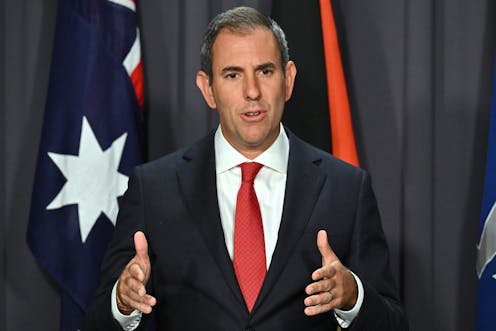
Treasurer Jim Chalmers begins his Monthly essay “Capitalism After the Crises” with a quote from the ancient Greek philosopher Heraclitus: “No man ever steps in the same river twice. For it’s not the same river, and he’s not the same man.”
Chalmers’ main point is that we need new economic thinking to deal with a new combination of crises. However, he actually addresses a very old issue – namely, the relationship between the state and the private sector.
Ever since 19th century British Factory Acts legislated better ventilation in factories to prevent employers from killing their own workers, there have been times when the state has had to save private enterprise.
In 2009, Kevin Rudd argued in The Monthly that the Global Financial Crisis (GFC) was one such occasion when
not for the first time in history, the international challenge for social democrats is to save capitalism from itself.
His government resorted to Keynesian stimulus strategies to protect the Australian economy.
Chalmers is arguing that the combination of the GFC, the pandemic and global energy and inflation crises, aggravated by the war in Ukraine, is another such moment. The possibility of further future crises and challenges makes the issues even more pressing.
‘Value’ in the economy
Chalmers draws his major inspiration from a new generation of economic thinkers such as Mariana Mazzucato . Mazzucato argues that neoliberalism’s belief in facilitating private sector entrepreneurism by reducing government’s role fundamentally misunderstands how modern capitalism has worked.
In fact, direct and indirect state investment has played a crucial role in facilitating major companies’ economic and technological innovation, including Google and Tesla.
Mazzacuto’s work also resurrects the issue of value that was central to 19th century political economy. She aims to put value “once again at the centre of economic thinking” raising issues such as “more fulfilling jobs, less pollution, better care, more equal pay.” She wants to create “an economics of hope” based on dreams “of a better future”.
In the process, Mazzucato has influenced a range of politicians, from the former British Conservative Minister David Willetts to the left-wing US Democrat Alexandria Ocasio-Cortez.
Willetts argues that Mazzacuto highlights the benefits of state intervention for conservatives not just the left. Nonetheless, one can see why her work particularly appeals to social democrats such as Chalmers. A central tenet of modern social democracy has been to humanise capitalism, to produce a more just and fair society through incremental reform.
In Chalmers’ view, the neoliberal neglect of economic planning has left western economies poorly equipped to face ongoing crises. Citing Mazzucato, Chalmers argues that: “the problem wasn’t so much more markets as poorly designed ones.” He urges a new partnership between business, labour and government “to efficiently and effectively direct resources” in order to create a socially beneficial “values-based capitalism”.
Labor’s long project
Chalmers is producing a new version of an old Labor project. Labor has long argued that both business and labour have a common interest in producing a prosperous, socially beneficial capitalist economy.
The Curtin and Chifley Labor governments (1941-9) argued public investment could play a crucial role in stimulating desirable private capital expenditure. The governments set up tripartite industry committees consisting of government, business and labour representatives to facilitate post-war industrial development.
The Whitlam government (1972-5) also set up tripartite industry advisory panels to assist industry planning. So did the market-friendly Hawke/Keating governments (1983-96) as part of their plans to make Australian industry more globally competitive.
More recently, the first Rudd government (2007-10) unsuccessfully attempted to shape a carbon trading market as part of its climate change policies. Prime Minister Julia Gillard (2010-13) argued that
the microeconomic challenges of the future are not a simplistic choice between the market and the state, but the more sophisticated challenges of market design so that we bring public and private resources together to deliver better services and increased productivity.
Of course, such plans did not always work out as Labor intended. Both the Chifley and Whitlam governments ended up facing major business opposition to their attempts to reshape markets. Some business sectors were sympathetic to the Rudd government’s climate change policies. Others, were vehemently opposed.
The Rudd government also encountered difficulties investing in private sector businesses to generate employment and combat climate change. A neglect of occupational health and safety issues contributed to several workers’ deaths as they installed pink batts insulation. The Gillard government’s attempt to develop human capital by subsidising private sector investment in vocational training was undermined by shonky providers trying to game the system.
In addition, Mazzacuto has noted that state investment and bailouts have all too often resulted in private sector profit but without ensuring the future financial benefits for governments and taxpayers. She argues that all too often “we socialize risks but privatize rewards” because we don’t recognise that governments also create value, not just private enterprise.
Chalmers does not address Mazzacuto’s suggested solution of public wealth funds or equity stakes. Nor does he address past Labor governments’ attempts at shaping markets.
However, he has strongly rejected claims he is breaking with the market-friendly Hawke/Keating tradition. Indeed, he discussed his ideas with Keating.
An economy that can be effective – and equitable
Chalmers advocates using forms of co-investment, collaboration, well-being criteria and providing better metrics and information in order to facilitate redesigning markets “for investment in social purposes”. He wants an economy that can address issues such as climate change, technological challenges and unreliable supply chains while putting “equality and equal opportunity at the centre.” He argues such an economy will also strengthen Australia’s democracy, preventing populist appeals to those left behind economically.
In short, Chalmers is reworking traditional Labor aims in the context of contemporary economic developments. He is also potentially positioning himself as a future prime minister. Chalmers is one of Labor’s more innovative and reflective thinkers, but he is no radical leftist. His agenda is one that some far sighted businesspeople, aware of current economic challenges, might well support. Indeed, building a values-based capitalism obviously requires business cooperation.
Read more: If Labor wins, he is set to become treasurer. So who is Jim Chalmers?
Chalmers seems surprised by the response to his essay. As with so many previous Labor government attempts to shape the economy, his essay has met with considerable opposition from sections of business and right-wing commentators. A recent headline in The Australian reads: “Chalmers vision: Corporates wake in fright”. Key business leaders have expressed concern at the prospect of increased government intervention and have instead called for further deregulation of the economy.
Perhaps Chalmers should have begun his essay with an aphorism not from Heraclitus but from the 19th century French writer, Alphonse Karr: “Plus ça change, plus c'est la même chose” — the more things change, the more they are the same.


