Passive vaping – time we see it like secondhand smoke and stand up for the right to clean air
- Written by The Conversation
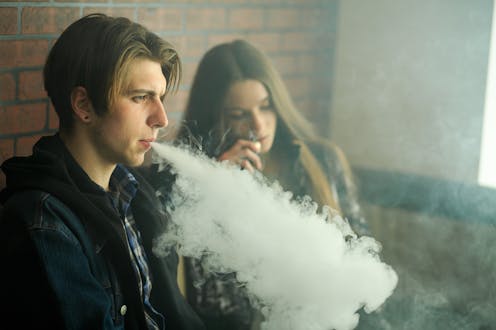
A medical student of mine recently said he loved the smell of vanilla in the house he shared with friends who vaped. “That’s OK, right?” he asked. “Well no,” I said, “If you can smell the vanilla you are probably getting nicotine as well.”
Nicotine is colourless and odourless, and is extremely well absorbed through your respiratory tract, including your nose, mouth, airways and even your ears.
Vapers exhale nicotine and chemicals, including the sweet-smelling flavourings. Bystanders can then breathe them in. The lung defences of smokers, vapers and bystanders are overwhelmed by repeated exposure.
There is a lot of vaping going on in young people aged between 18 and 24. Despite a good amount of debate about the health effects of vaping, there is scant discussion around the risk of passive vaping and the consequences for the health and wellbeing of non-vapers and their right to inhale clean air.
Breathing out, breathing in
Researchers have examined the content of exhaled vapour from users in confined spaces, like cars, and larger venues. Although levels were lower than for tobacco cigarettes, they described levels of the exhaled toxic substances as “ambient air pollution” that should be avoided to protect the health of non-smokers and non-vapers.
The evidence for the effects of passive vaping on the heart is emerging but researchers have compared it to passive smoking, which can clog arteries and cause clotting problems. Publications that demonstrate the harmful respiratory effects of passive vaping are growing.
Lessons from passive smoking
In the late 1980s, passive smoking became the impetus to change legislation around tobacco use.
Health professionals had learnt decades earlier from a study of British doctors who smoked that tobacco smoking caused immense harm and early death in smokers. But later they began to understand that living with a smoker, working with smokers or having close repeated exposure to someone else’s smoke could cause lung cancer, chronic bronchitis, worsen asthma and heart diseases in a non-smoker. The effects of passive smoking on children too were very concerning.
Advocacy groups began defacing or “refacing” billboard tobacco advertising and ridiculing their advertising. In 1982, I wrote a paper published in the Medical Journal of Australia called A Tracheostomy for the Marlboro Man about these efforts, the legal repercussions and the challenges from the tobacco industry.
By the 1990s, people had started suing hospitality venues and workplaces for putting them in harms’ way by exposing them to “secondhand smoke”. Successes led to changes in legislation.
Attitudes changed and non-smokers’ rights came to the fore. We were all able to live in a smoke-free environment in Australia for decades.
What does the law say about secondhand vapour?
In Australia, vaping restrictions are in line with laws around smoke-free areas and World Health Organization recommendations.
For example, New South Wales legislation says people cannot use e-cigarettes in smoke-free areas under the Smoke-free Environment Act 2000. These include:
- all enclosed public places
- within ten metres of children’s play equipment
- public swimming pools
- spectator areas at sports grounds or other recreational areas used for organised sporting events
- public transport stops and platforms, including ferry wharves and taxi ranks
- within four metres of a pedestrian access point to a public building
- commercial outdoor dining areas
- in a car with a child under 16.
Vaping on public transport vehicles such as trains, buses, light rail, ferries is also banned.
But people are still vaping in their homes and other places where it’s permitted. The attitudinal change that made tobacco smoking around others socially unacceptable is yet to develop.
 You can breathe in nicotine and flavourings from others’ vaping.
Shutterstock
You can breathe in nicotine and flavourings from others’ vaping.
Shutterstock
Read more: My teen's vaping. What should I say? 3 expert tips on how to approach 'the talk'
Are smoke-free areas enough?
Though debate continues about vaping, its safety and efficacy as a quitting aid, we cannot wait for years, to see the full effects of passive vaping.
Based on the public health precautionary principle, today’s challenge is to engage and inform non-vapers, particularly young non-vapers, about their rights to be “vape free”, breathe in clean air and take a stand.
Read more: Passive vaping: an impending threat to bystanders