

Cyclone Gabrielle broke vital communication links when people needed them most – what happened and how do we fix it?
- Written by The Conversation
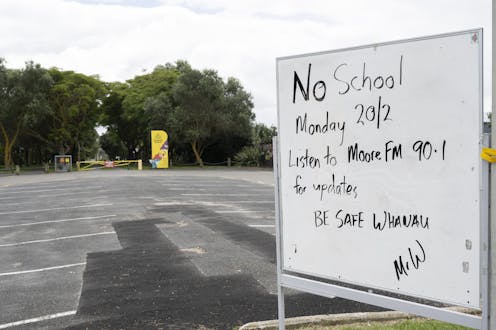
Modern communication systems need two main things: power, and what engineers call “backhaul”, the connections that link cell towers and exchanges to the national network. When Cyclone Gabrielle struck, both were badly compromised.
Many sites lost power not long after the mains went down. They were only designed to run on battery for a few hours (or days at most) – enough for routine faults, not for disasters.
Much of the backhaul – usually fibre optic cables running along main roads, often parallel to power lines – was also knocked out by landslips and flooding. Because of this, even where cell sites still had power, they couldn’t connect anyone to anywhere.
This disconnected large numbers of cell sites, including those run by the Rural Connectivity Group (RCG) – the government appointed provider of broadband and mobile services in sparsely populated areas.
New Zealand’s three big telecommunications operators (Spark, Vodafone and 2degrees) use the RCG service in rural regions, causing all three (along with wireless internet) to lose coverage in affected areas.
Emergency services have also increasingly abandoned their own radio-based communication networks for cheaper cell phones, which offer more privacy and coverage. Imagine calling 111 after the cyclone – if you could – only to find the emergency services themselves were incommunicado.
Furthermore, disaster responses by citizens and emergency services alike require fuel for vehicles, as well as food and other supplies. But electronic payment systems like eftpos and fuel cards need an internet connection.
Clearly it’s time to ask whether systems so vulnerable to single points of failure are fit for purpose, given our exposure to natural disasters and increasing risk from more severe and frequent climate change events.
Power and connection
About 80% of cell site outages after Cyclone Gabrielle were related to power loss, and around 20% to loss of backhaul connectivity (the responsibility of telecommunications infrastructure provider Chorus).
Failed operator-owned urban cell sites can often be covered by nearby neighbouring cells. If mains power stays off, they are generally easily reached and supplied with generators. After the cyclone, much of the initial reconnection progress was made in this way.
To be economically viable and cover enough customers, however, rural sites are often on hard-to-reach hills with precarious power supplies. Without power and road access, helicopters need to fly in generators and fuel – a task Vodafone described as “challenging” in the aftermath of Gabrielle.
Backhaul internet service provider Kordia fared much better. Its core sites (mostly on hilltops) were inherited from the former Broadcasting Corporation and were designed for resiliency. Big battery banks and significant on-site generation let them operate autonomously for weeks. After the cyclone, Kordia provided microwave backhaul links, replacing broken fibres.
Read more: Massive outages caused by Cyclone Gabrielle strengthen the case for burying power lines
Resilience and diversity
Cyclones and storms are not the only risk. Tairāwhiti and Hawke’s Bay, for example, are vulnerable to earthquakes from the offshore Hikurangi subduction zone, which could cause tsunami inundations and slips.
So, what kind of communication system does New Zealand need to cope with potential disasters of all types? To answer that, we need to look at two key technical concepts: site resilience and diversity.
Resilience could mean equipping cell sites with solar or wind generation, larger batteries and “redundant” equipment for operation over long periods without any need for external power or access.
It could mean requiring cell sites to have an independent, alternative backhaul path: a second cable along a different route, a microwave or satellite link. It could mean trying to connect a cable to the wider internet at both ends, rather than just at one. This would mean both sides of a break could be supplied from one end or the other.
Diversity could mean having more sites, and making more use of alternative cable corridors such as railway lines and overhead high-voltage power line pylons. It could mean more interconnections between these corridors for use in emergencies.
No cheap options
International connectivity also matters. New Zealand currently connects to the world via five undersea fibre-optic cables. A significant volcanic eruption on Auckland’s North Shore, for instance, could cut the country off from three or possibly four of these.
A satellite internet service such as Starlink definitely has a role to play. It helped Wairoa reconnect with the world after hours of complete blackout, and has since brought numerous banks and retailers back online. It is easy to deploy, doesn’t depend on local infrastructure, and only needs a small generator for power.
Starlink and other satellite backup can’t provide the amount of international capacity needed in a major disaster. But they are still a valuable option. The terminals aren’t expensive, so kitting out every Civil Defence post with one shouldn’t break the bank.
And in coastal communities, marine VHF radios are also abundant – something that could also be used onshore when other systems fail. It’s ironic that boaties are told to have two different means of communication, but emergency services are expected to make do with one.
Disaster risk assessment and mitigation must now be a vital component of all communication projects. Affordability can no longer be the only question. Sometimes, you just can’t afford cheap.


