

Russia's foreign minister got laughter, cheers and shrugs in India. Outrage over the war isn't universal
- Written by The Conversation
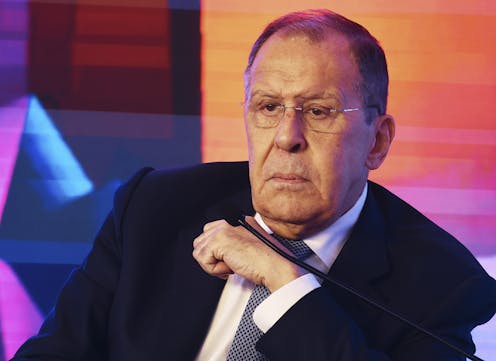
Russian Foreign Minister Sergei Lavrov made headlines over the weekend when his claim the Ukraine war was “launched against” Russia provoked laughter from the audience during a forum in India.
But I was in the room and can report he also received applause and indifference. Understanding why can help explain the differences in views on the war between developing countries and the West.
The incident happened at the Raisina Dialogue, India’s premier geopolitics forum featuring more than 26 foreign ministers and six current and former heads of state. Many represented the developing countries in Latin America, Africa, Asia and the Pacific that have variously been called the “Global South” or “majority world”.
The organisers’ decision to invite Lavrov to speak was controversial. To be fair, it was counterbalanced by speakers such as former US Defence Secretary Jim Mattis and Australian Chief of Defence Angus Campbell, who eloquently presented the case that Russia is involved in an illegal war.
While pro-Ukraine parts of the audience openly laughed at the claim Russia was the victim in the war, there were also those who showed support for Russia’s side.
On Twitter, Indians voiced opinions ranged from neutral to suspicious of the West and resisting taking sides, given India’s long-standing links with Russia.
The rest of the audience seemed simply disengaged.
One of the European experts I spoke to posed the question starkly – why doesn’t the Global South care more about the war?
Why some countries understand Russia’s point of view
Past links with Russia are clearly important in how countries have responded to the Ukraine war. This is most evident for India, but also for others such as Vietnam and Laos. They may have bonds of affection with Russia or more tangible links, such as a reliance on Russian arms.
These three countries were among 32 that abstained from voting on a resolution at the UN General Assembly last week – alongside China, South Africa and others – calling for an end to the war and demanding Russia leave Ukraine’s territory.
And some countries in the Global South are repulsed by what they see as Western hypocrisy and double standards. Lavrov received audience applause, for example, when he criticised the US-led invasion of Iraq and other Western transgressions.
He also tried hard to paint the flow-on effects of the war – such as the impact of the Ukraine war on grain supplies to developing countries – as the fault of the West.
These factors tend to push countries towards a pro-Russian or neutral stance.
But it is vital to the international system that countries are prohibited from using force against other countries. Even if all the things Lavrov said about Ukraine were factually true, it would still fall short of justifying an invasion.
The fact that Western countries have broken international law – such as the invasion of Iraq – doesn’t mean we should give up on it.
But why are so many countries simply disengaged?
For countries that are disengaged from the Ukraine war, there are other factors at play.
They may see Ukraine’s plight as something unique to countries with a great power as a neighbour. The reaction of such countries to Ukraine might be: “It’s terrible to be you. But I don’t have the same concerns.”
There’s some evidence that countries adopting stronger positions against Russia tend to have a more acute sense of vulnerability.
Some developing countries may also believe that while the invasion of Ukraine is a bad thing, it’s not something they can do much about. There might be a sense of fatalism that this is simply “how the world is” and the Global South has limited ability to change it.
This plays into the most important factor why so much of the Global South is disengaged by the war – it has other problems and challenges to deal with. These include equitable access to healthcare, climate adaptation, insufficient digital infrastructure, terrorism, lack of development finance, food and fuel insecurity, the debt crisis and the overriding imperative of sustainable growth.
Read more: Russia-Ukraine war: decoding how African countries voted at the UN
This can explain why a country like Brazil has condemned the invasion but not offered significant support to Ukraine.
This point was made strongly by India’s foreign minister, S. Jaishankar, in a video clip at the start of the Raisina Dialogue:
Europe has to grow out of the mindset that Europe’s problems are the world’s problems but the world’s problems are not Europe’s problems.
This seemed to prompt self-reflection with some in attendance. Slovakia’s foreign minister and others repeated the same point.
Could India be a bridge to greater understanding?
I left the forum thinking perhaps there is more of a role for India in building understanding than I’d initially thought.
Meenakashi Lekhi, the minister of state for external affairs, suggested India can act as a bridge as a country of the north (geographically), south (economically), east (culturally) and west (democratically).
She talked with passion from the perspective of the Global South – the part of the world that has been subject to imperialism and exploitation – making her argument more persuasively than any Global North politician could.
Whenever a conflict breaks out in any part of the globe, it is going to impact an individual at a faraway distance.
This is exactly what we’ve seen with the invasion of Ukraine causing a spike in the cost of food, fertiliser and energy, which has been devastating for developing countries.
Precisely because India cares about being a “voice for the voiceless”, it’s more likely to be listened to in the Global South.
This drives home an important point that Western leaders should keep top of mind: If the West wants developing countries to care about its concerns, it needs to care about the issues that matter to the developing world. Development and defence are linked.


