

Forget the conspiracies, 15-minute cities will free us to improve our mental health and wellbeing
- Written by The Conversation
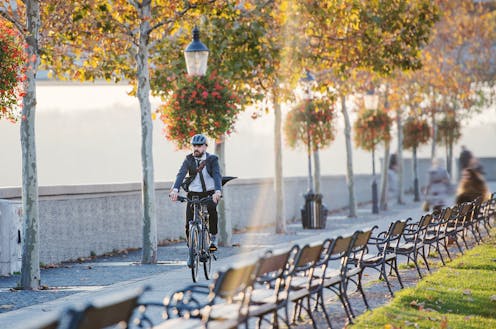
The idea of the 15-minute city, according to its originator Carlos Moreno, is that people are no more than a 15-minute walk or bike ride away from all the services they need to live, learn and thrive.
The idea is appealing in its simplicity: it puts people and the environment at the centre of urban planning. It involves building new urban centres and restructuring existing ones to ensure the services people need for work, food, health, education, culture and leisure are all close by – a walk or bike ride from home. Key elements are: the proximity of necessities; local participation and decision-making; community solidarity and connection; and green and sustainable urban living.
This re-imagining of local living is quickly going global. Its proponents are many and growing, and the idea is being applied on big city stages. Most notably, the 15-minute city was a feature of Paris Mayor Anne Hidalgo’s successful re-election campaign in 2020.
The United Nations has hailed the 15-minute city as a means by which cities can emerge from COVID, as well as reduce the damaging dependence on cars. The potential to promote mental health and wellbeing is significant.
Read more: We're at a fork in the road: do we choose neighbourhoods to live, work and play in?
Enter the conspiracists
In 2023, though, conspiracy theories and protests have threatened to drown out the discussion of such positives.
How did that happen? By finding itself sitting at the centre of debates about COVID living, climate change and car-centric societies, the 15-minute city has become a focal point of attention for those who imagine more sinister motives are at work. Conspiracists have spouted misdirected fears of the forced loss of cars, the creation of locked urban zones people cannot leave, and government surveillance and control.
These notions were even raised recently in the UK parliament. Conservative MP Nick Fletcher called the 15-minute city an “international socialist concept” that “will cost us our personal freedom”.
Read more: 15-minute cities: how to separate the reality from the conspiracy theory
A chance to improve mental health and wellbeing
In fact, personal and community freedom, by way of giving people back meaningful time currently lost to commuting and other travel, is exactly what Moreno and proponents of 15-minute cities are focused on. In their drive to grow, cities tend to push people, the environment and their health to the periphery. Through their sprawl, Moreno argues, cities take away freedom by taking time and disconnecting their inhabitants from services and each other.
Importantly, these effects increase the risks to people’s mental health. Moreno wants us to move away from fracturing our living into “inhuman bigness”, and towards planning that focuses on what access to services, local connection and community means for the wellbeing of people and communities.
Read more: People love the idea of 20-minute neighbourhoods. So why isn't it top of the agenda?
This is why the 15-minute city presents a great opportunity for better mental health. Long commuting times and the stressors of traffic congestion, road conditions and punctuality are linked to declines in subjective measures of mental health and wellbeing for workers. The benefits of reducing these stressors could be immediate.
Physical activities like walking and cycling are also widely understood to benefit mental health, as does exposure to natural, green spaces. Creating local spaces for leisure and play is vital for children and parents alike.
But, deeper than that, we need cities and urban spaces purposefully designed to promote mental health in ways that are globally recognised as impactful and essential. This process involves improving a range of social and environmental factors for individuals and community.
Read more: 1 in 4 Australians is lonely. Quality green spaces in our cities offer a solution
COVID sharpened the focus on wellbeing
Lessons learned from COVID lockdowns have sharpened global understanding of the mental health crises and harm done to people’s wellbeing by loneliness, social isolation and disconnectedness. These conditions damage the wellbeing of communities too, by fostering stigma and promoting exclusion.
We need to move quickly towards ways of living that promote connection, inclusion and healthy communities and environments. We can achieve these goals through participation, local decision-making and sustainable ecologies.
Imagine cities with accessible housing, work and education. Imagine cities with mental health service where the focus is on inclusion, participation, connection and equitable access. Where health workers and essential services are local and available, with minimal obstacles. Imagine mental health service that is threaded through the community in meaningful, impactful ways – where every square metre is considered for its potential to improve health and wellbeing.
Mental health, wellbeing and recovery require social connection, inclusion and accessible health services. These are, without doubt, key factors in achieving better mental health. And the 15-minute city could be the template for its delivery.
Read more: Greening the greyfields: how to renew our suburbs for more liveable, net-zero cities


