

Government must use trauma-informed approach to end uncertainty on refugee visa applications
- Written by The Conversation
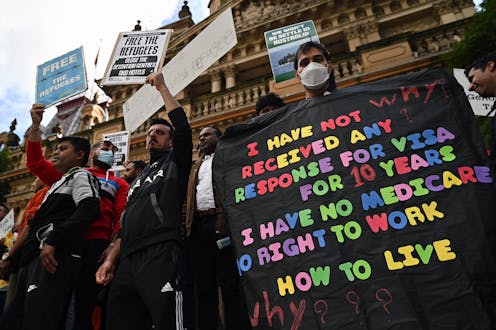
In February this year, the Albanese government announced that thousands of refugees living in Australia who were on Temporary Protection Visas (TPV) and Safe Haven Enterprise Visas (SHEV) would now be moved onto a permanent visa known as a Resolution of Status Visa (ROS).
When making the announcement, Immigration Minister Andrew Giles said this would end the limbo for refugees after they had “endured ten years of uncertainty”.
The change was welcomed by an estimated 20,000 refugees who can move to permanent visas. They are part of a larger group of around 31,000 asylum seekers who arrived in Australia by boat before January 2014. Known collectively as the “legacy caseload”, their refugee status was subject to a “fast track” process.
The trauma of uncertainty
The minister’s recognition of the impact of visa uncertainty resonates with recently published research we conducted with lawyers and migration agents who work with this group. They encountered clients in mental health crises, feeling marginalised, defeated and in some cases “lethal hopelessness”.
This research adds to existing evidence about the negative impact of temporary visas on the mental health of asylum seekers. The research goes further and found that years of delays and the process itself contributed to deteriorating mental health.
This research reveals how the government can use a trauma-informed approach to end visa uncertainty and create a shared future.
What is the new procedure for obtaining permanent residence? What are the options for those who do not have a TPV or a SHEV? How can the government end ongoing uncertainty for them?
Resolution of Status Visas
Refugees who currently hold TPVs and SHEVs will be eligible for a permanent Resolution of Status Visa.
Processing is under way and as of late March 2023 100 visas have already been granted. The department predicts most of these visas will be granted within 12 months. Funding to provide legal assistance to refugees is a welcome step towards facilitating a sense of stability and predictability as they await a visa.
Permanent visas will mean refugees can begin the process of family reunion after over a decade of separation. Last year, the government removed policy barriers that meant sponsors who arrived by boat were the lowest priority in the visas queue.
However, processing delays, high visa charges and strict rules around which family can be sponsored to Australia will mean refugees will continue to face ongoing separation from their partners and children.
What happens to those who do not hold a TPV or SHEV?
Giles has stated that the February 13 announcement “includes a pathway for all those in the cohort who are ultimately found to be owed protection”.
Statistics published by the department in February 2023 state there are 9,861 people who have been through the fast-track process and were refused visas. Around 5,000 of those are challenging those refusals in the courts. If successful, their cases will be re-examined by the Immigration Assessment Authority (IAA). If they are then found to be a refugee, they would be eligible for a Resolution of Status Visa.
Others may seek ministerial intervention. In late 2021, almost 200 people from Afghanistan were waiting for the minister to use his personal discretion to allow them to reapply for protection based on the Taliban takeover in 2021.
The minister also has the discretion to grant visas to individuals who may not meet refugee criteria, but may have Australian citizen partners, children or employers – as already done in the case of the Nadesalingham family.
Flaws in the fast-track process and in particular with the review process of the IAA have been documented previously. Dismantling the “fast track” system was part of the Labor Party platform. But, to date, no announcements have been made and the IAA continues to hear cases.
Reform may come as part of the upcoming overhaul of the administrative review system. What changes, if any, might be made are unclear, but this group of people face ongoing limbo.
Deterioration in mental health is directly linked to treatment
While the minister has declared there is a pathway for all those who are found to be owed protection, there continues to be doubt about what will happen to those whose cases have been refused.
In 2018 and 2019, we surveyed and interviewed lawyers and migration agents who worked directly with clients going through the “fast track” assessment process. They heard stories of overwhelming emotions (for example, despair and anger) as well as witnessing self-harm and suicidal behaviour.
A key driver of people’s mental distress was their inability to apply for a visa for several years. This was followed by a difficult and fast-paced application process in which they were expected to relay their stories of persecution. Many individuals were distressed and destabilised before the process began.
Legal professionals described clients feeling trapped by ongoing visa insecurity and having no control over their future. Family separation combined with uncertainty about their future undermined individuals’ capacity to cope with everyday life and decision-making.
These findings have significant practical implications for how the government handles law reform and policy development with this group. For those who have now found permanency, uncertainty around family reunification will continue to be a significant stressor. There are options to amend laws, policies and processes, which would make them more humane.
Clarity and trauma-informed approaches are essential. For those who do not hold a TPV or SHEV, the Australian government should urgently collaborate with community groups, mental health experts and legal providers to co-design pathways and communication on how their cases will be reviewed and progressed.
A recent High Court decision relating to how the minister’s intervention powers have been exercised will force a review.
The government has an opportunity to amend the guidelines and provide clear guidance for this group, which will allow those who were refused under the “fast track” system to be considered for visas that provide a pathway to certainty.


