

Photos from the field: spying on Antarctic moss using drones, MossCam, smart sensors and AI
- Written by The Conversation
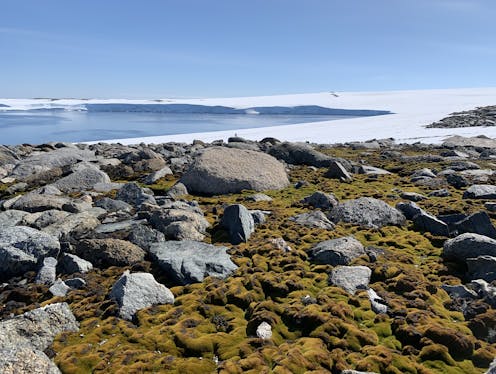
The Antarctic continent conjures visions of white ice and blue sky. But not far from Australia’s Casey Station, 3,880km due south of Perth, moss beds emerge verdant and green.
Sadly, the health of these moss beds is declining due to changing climate conditions, ozone depletion and heatwaves. Yet our understanding of the problem is limited. Conducting research in Antarctica is difficult. Periods of data collection are short, and there can be years between each research opportunity. Fortunately, new technology offers solutions.
In December 2022, we travelled to Casey Station. We spent two months in the field – combining our skills in biology, flying drones, programming and artificial intelligence – to learn more about the moss and find better ways to remotely monitor biological changes.
We mapped large moss beds and trialled a new sensor system that can deliver continuous, year-round moss data. While this research is ongoing, we’re thrilled to share the early results with you here.
Read more: An epic global study of moss reveals it is far more vital to Earth's ecosystems than we knew
Miniature forests, bustling with life
Plants need sunlight, warmth and liquid water. Antarctic plants face months of darkness, freezing temperatures and drought from frozen water – but moss has adapted to this hostile environment.
Moss is the dominant plant life in Antarctica. It provides habitat for invertebrates, microbes and fungi, which make up more than 99% of Antarctica’s land biodiversity. The moss beds resemble miniature forests, bustling with life.
Antarctic moss creates its own warm microclimate, using pigments to absorb sunlight. This warmth aids photosynthesis and helps the mosses to melt snow to obtain liquid water. The tiny hills and valleys across moss beds determine the amount of light mosses receive and creates differences in their microclimates and health.

Once we reached the moss, we’d carefully balance on rocks to take samples and place data loggers. These consisted of four sensors that measured canopy temperatures at different positions in the moss bed. We also measured photosynthesis and collected moss samples for pigment analysis, which indicates health and stress levels.
The below photo depicts a moss bed with our equipment attached. You can see the complex micro-topography and a mosaic of healthy and stressed mosses. Healthy moss is green and velvety. Stressed mosses are red and eventually turn grey.
Mosses growing just centimetres apart can experience vastly different microclimates. In the photo below, some mosses had warmed up to 19℃ (next to the red marker), while only about 30cm away the moss was at 0.6℃ (next to the white marker).
Collecting this data enables us to explore connections between the physical structure of the moss beds, microclimates and indicators of moss health.
Read more: Antarctica's 'moss forests' are drying and dying
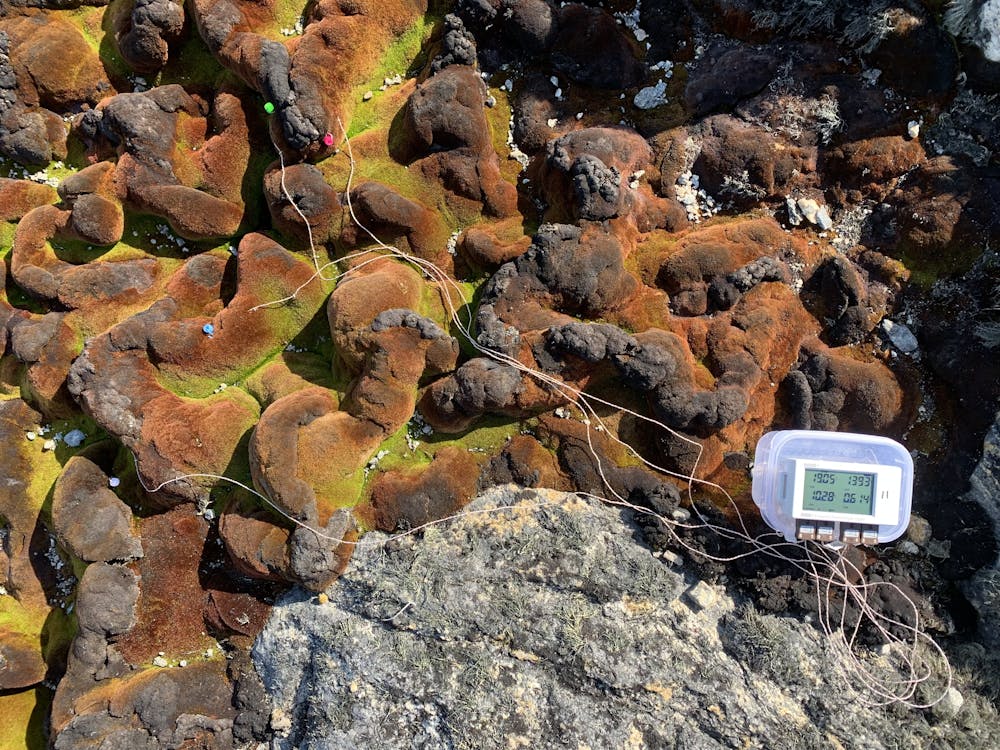 Mosses growing just centimetres apart can experience vastly different climates.
Krystal Randall
Mosses growing just centimetres apart can experience vastly different climates.
Krystal Randall
Smart sensors, cameras and transmitters
While in Antarctica, we also tested the first prototype of an intelligent, autonomous and long-term sensing platform. It offers scientists more information than previous data-collection devices as it can collect and transmit data over an extended period outside regular summer field campaigns, including winter time.
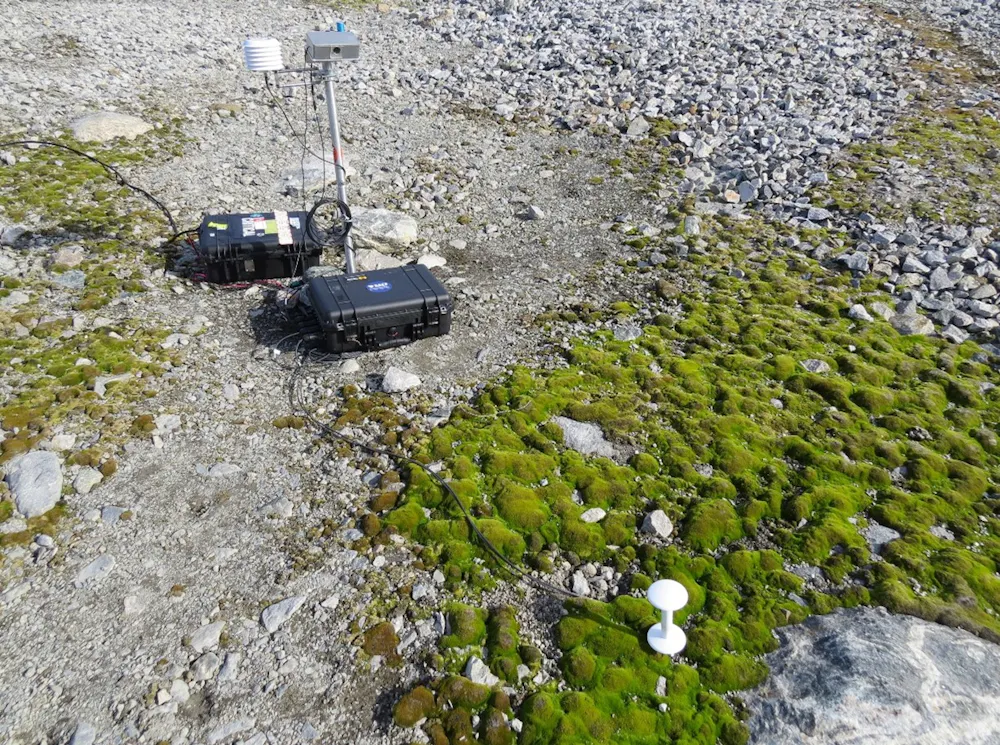 The remote sensing platform watching a moss bed.
Johan Barthélemy
The remote sensing platform watching a moss bed.
Johan Barthélemy
The prototype monitored the moss bed near Casey Station for a month and a half. Its sensors captured light intensity, ambient air temperature and humidity, moss canopy temperature and, finally, energy exchanged between soil and air. A webcam, affectionately nicknamed MossCam, captured regular images of the moss bed.
We also installed the first antenna in Antarctica for the LoRaWAN wireless network. This network is low power, long range and free to use. This allowed us to send data back to Australia in near real-time and display it on a website dashboard that is visible to Australians only.
After some early bug fixes, the platform performed better than expected. We brought it home at the end of the season for further refinement and deployment next season.
A 24-hour time-lapse captured by MossCam. Johan Barthelemy.Drones and hyperspectral imaging
We sent drones on 25 flights, collecting data from two Antarctic Specially Protected Areas (ASPAs 135 and 136).
Operating drones in the Antarctic presents significant challenges. The proximity to the magnetic pole disturbs the GPS navigation, and strong winds make it difficult to fly. Severe cold reduces battery life – and it’s also tough on the operator’s fingers. We customised drones with RTK (real-time kinematics, a technique to eliminate position errors) GPS, multiple redundancies and battery warmers to increase their resilience to harsh conditions.
We used a compact mini drone as a reconnaissance unit, scouting new areas and providing videography like this. Juan Sandino.Our drones could capture 5,000-10,000 images on each flight. They were also equipped with high-tech sensors. These sensors are programmed to record “spectral signatures”, which is a term we use to describe a kind of optical identity or visual “DNA” that differentiates landscape features like moss, rock and snow within the image.
These images will be stitched together and mapped to their ground coordinates. Using machine learning, we will train a model to identify vegetation, including moss, lichen and cyanobacteria. We will also develop vegetation and hydrology maps, 3D fly-throughs and virtual reality experiences to support decision-making around conservation and management.
Read more: Drones help scientists check the health of Antarctic mosses, revealing climate change clues
One journey ends, while another is just beginning
Often while we were working, curious penguins wandered over to see what we were doing. Making friends with these locals was always the highlight of the day.
But after a couple of fantastic months in the field, it was time to pack up and head home. On the 60km journey inland to Wilkins Aerodrome we ventured into the Antarctic Circle. We waited in -20℃ to watch our plane land on the blue ice runway before boarding and flying back to Tasmania. There, it felt like we’d just woken up from a dream.
Our Antarctic adventure was over, but we all felt so grateful for the experience.
Now we’re exploring the data, to see what stories it can tell, while further developing our moss sensing platform. We hope to return to Antarctica to deploy it at the end of the year.
The authors travelled to Casey Station as part of the Australian Research Council Special Research Initiative Securing Antarctica’s Environmental Future (SAEF).
 The team as they crossed the Antarctic Circle: Johan Barthélemy (left), Dr Krystal Randall (centre), Ashray Doshi (front), Dr Juan Sandino (right) and Prof Barbara Bollard (back right).
Krystal Randall
The team as they crossed the Antarctic Circle: Johan Barthélemy (left), Dr Krystal Randall (centre), Ashray Doshi (front), Dr Juan Sandino (right) and Prof Barbara Bollard (back right).
Krystal Randall


