

A new virtual museum reveals 600 million years of Australian fossils in unprecedented 3D detail
- Written by The Conversation
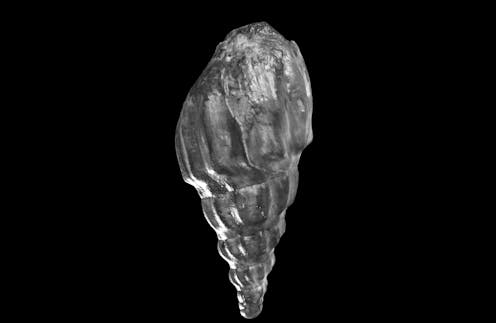
Palaeontology is the study of evolution and prehistoric life, usually preserved as fossils in rocks. It combines aspects of geology with biology and many other scientific disciplines.
But a lot of palaeontology really is about rocks. For 200 years, hammers and chisels have been some of its most commonly used tools.
However, advances in modern scanning technology are revolutionising the way we do palaeontology. Precise scans of the internal and external features of fossils let us see them in new ways.
And these digitised scans can readily be made available to the public online. At the new Virtual Australian Museum of Palaeontology, we offer free access to 600 million years of digital Australian fossils, from enigmatic early lifeforms to gigantic extinct marsupials.
How do palaeontologists learn about the past?
There are many different types of fossils. For example, a dinosaur leg bone can become a fossil, but so can a leaf from a tree, the footprint of an extinct kangaroo, poo from a shark, or even geochemical traces preserved in ancient soils.
The field of palaeontology was formally solidified into scientific enquiry by people such as Georges Cuvier (1769-1832). Cuvier was a French naturalist and zoologist sometimes referred to as the “founding father of palaeontology”. Others such as the Scottish geologist Charles Lyell (1797-1875) gave us the geological framework through which fossils could be classified and compared.
Palaeontology has come a long way in the past 200 years.
Records of long-extinct animals also survive in the rock art and oral traditions of First Nations peoples. These are increasingly being recognised as an important complement to traditional Eurocentric approaches.
Read more: Of bunyips and other beasts: living memories of long-extinct creatures in art and stories
How to scan a fossil
Different kinds of scanning technology are playing an increasing role in palaeontology. Computed tomography, or CT scanning, uses x-rays to create three-dimensional models of the internal and external features of dense objects.
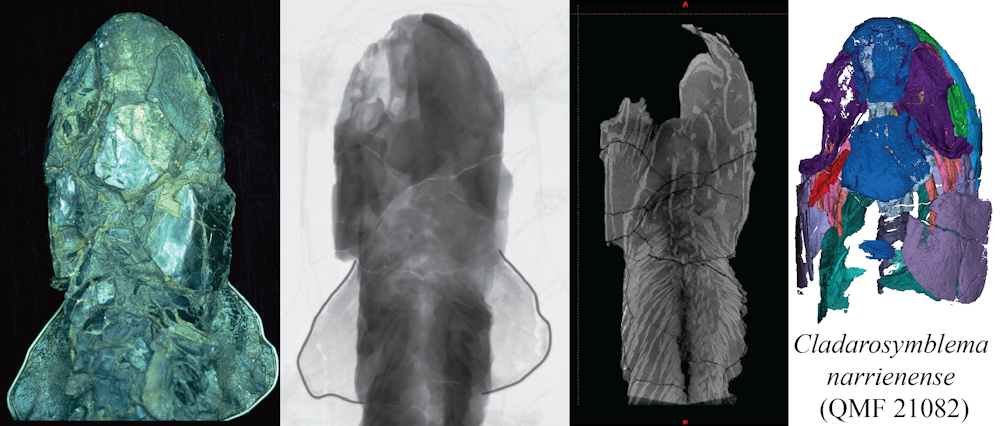
Other imaging methods include photogrammetry, or surface scanning using lasers or projected patterns of light. These methods capture the external three-dimensional shape of an object or site, sometimes with colour and textural detail. They also have the advantage of being more portable and can often be taken directly to the fossil.
The most powerful scanning methods are the synchrotron and neutron imaging. A synchrotron works on the same principles as CT scanning, using radiation to look inside an object, but uses much stronger radiation. Neutron imaging uses neutrons instead of x-rays or other radiation, and it can be useful for particularly dense or large objects.
These advances in scanning technology are opening up whole new avenues for exploring, sharing and analysing Australia’s unique fossils. Now what to do with all our digital palaeontology data?
That’s where the Virtual Australian Museum of Palaeontology comes in.
About the museum
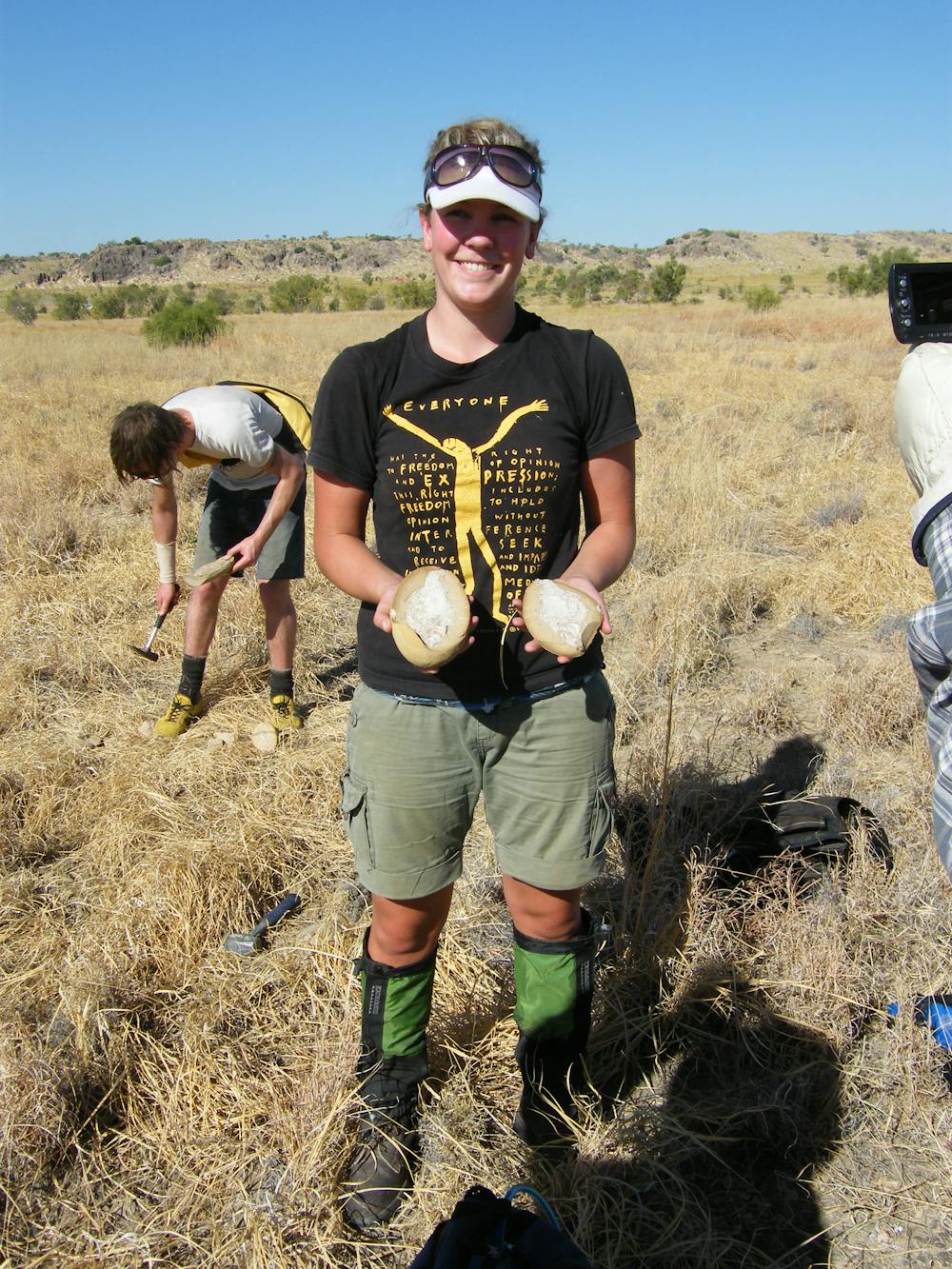 Palaeontologist Alice Clement in the field with a new fossil discovery.
Alice Clement, Author provided
Palaeontologist Alice Clement in the field with a new fossil discovery.
Alice Clement, Author provided
We are a group of researchers at Flinders University, working with the South Australian Museum, the Western Australian Museum, and the Museum and Art Gallery of the Northern Territory. Between us, we have spent many hours scanning, processing and uploading hundreds of three-dimensional virtual models.
Australia is geologically old with a rich fossil heritage. We are fortunate to have captured high-quality examples spanning nearly 600 million years of evolution on our continent.
We have scans of some of the earliest complex life from Ediacaran and Cambrian sites from over 500 million years ago. We have exquisite examples from the best ancient fish deposit in the world, and many amazing extinct megafauna not known from anywhere else.
Examples include the marsupial lion Thylacoleo, the giant wombat-like Diprotodon, and huge short-faced kangaroos such as Sthenurus.
In the pilot phase of this project we have digitised more than 500 fossils across more than 30 genera. Some highlights include:
- one of the world’s most complete marsupial lion skeletons (almost every bone from the skull to the toe bones)
- one of the only known bones of a pterosaur (flying reptile) from South Australia
- scans of one of the oldest known sharks in the world
- fossil mammal footprints that are now known only from our digital data, as the original trackways have been destroyed.
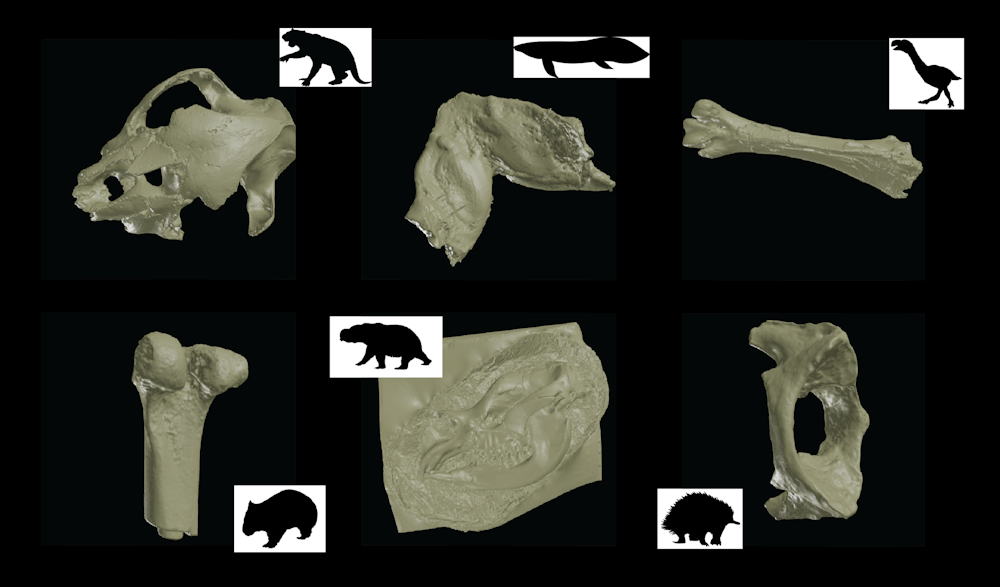 Six digital models of scanned fossil specimens from the museum.
Virtual Australian Museum of Palaeontology, Author provided
Six digital models of scanned fossil specimens from the museum.
Virtual Australian Museum of Palaeontology, Author provided
You can explore the VAMP website yourself. All you need to dig into a world of 3D fossil scans is a computer or a smartphone.


