Blacklisting PwC won't stop outsourcing: here are 3 reasons it has become embedded in the Australian public service
- Written by The Conversation

Labor had pledged to wind back the use of the big four consulting firms by the public service well before the scandal engulfing PricewaterhouseCoopers over the sharing of confidential government information.
The policy it took to the May 2022 election pledged to stop “the excessive reliance and waste of public funds on contractors, consultants and labour hire companies for work that can be done more effectively by public servants”.
It costed the budget saving at $1 billion over four years, a modest sum given that at the time the Coalition government was reported to have entered into contracts worth $1.28 billion with PwC, Accenture, Deloitte, EY and KPMG over the previous ten months.
In May the Finance Department effectively banned PwC from winning new work by ordering officials to consider confidentiality breaches when evaluating bids.
But undoing the relationships that have been developed over decades will prove more difficult than it might seem for several reasons, the most important of which is that they suit public service managers.
One quarter of the public service off the books
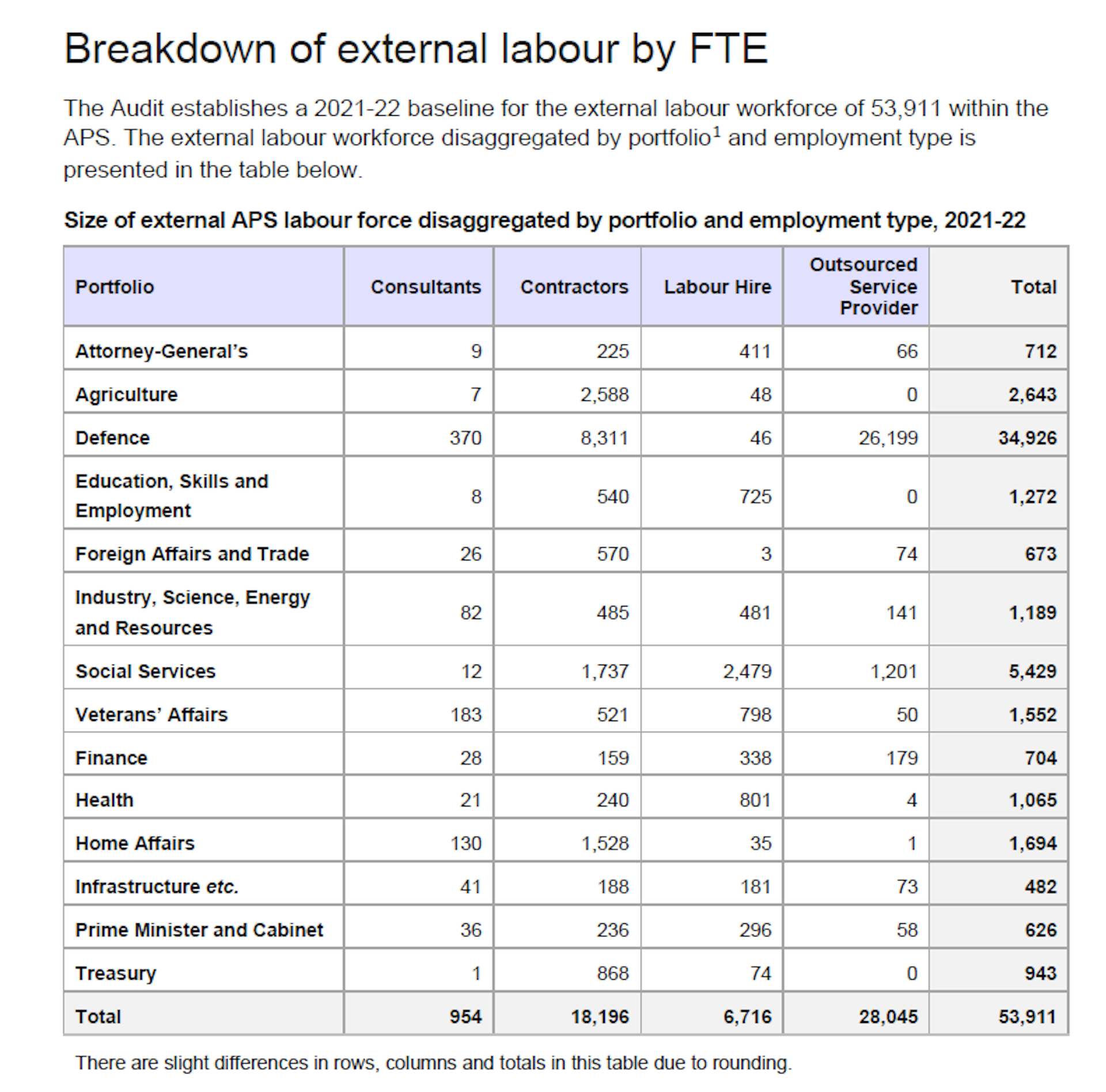
After decades of growth, outsourcing has become so embedded in the Commonwealth public service that the government’s latest employment audit identified 54,000 equivalent full-time staff engaged as consultants or contractors or through labour hire firms, compared with 144,000 employed directly.
It means every fourth person working the public service is employed externally rather than directly by the government.
The audit distinguishes between four types of external labour: outsourced service providers, contractors, employees of labour hire firms, and consultants.
Each makes life more comfortable for public service managers, though in different ways.
Outsourced service providers include those doing routine functions such as cleaning and security, and account for 35,000 of the 54,000, with the bulk working in defence. They provide welcome efficiencies, and no one is seriously suggesting that they be brought back into the public service.
Labour hire includes staff employed on a temporary basis, and makes up another 6,700 of the 54,000 (mostly in the department of social services but with significant numbers also in health, veterans affairs, education, and other agencies).
Such workers are not subject to full public service conditions of employment and offer attractive administrative shortcuts. Though such positions could, in theory, be easily brought in-house, public service managers can be expected to drag their feet in order to retain flexible control of their workforces.

Contractors, defined as specialists engaged to provide designated outcomes under government direction or supervision, account for about 18,000 of the 54,000.
They include the increasing numbers of information technology specialists on whom governments are heavily dependent.
Information technology outsourcing dates from the Howard government’s determination to rely solely on private businesses for IT, but has been compounded by the inability of public service pay to keep pace with the private sector.
Any stemming of this tide would require radical adjustment of pay rates for technical staff.
Pure consulting is rarer. It is defined by the audit as the provision of
professional, independent advice, and other strategic services that involve the development of an intellectual output which represents the independent view of the service provider and assists with entity decision-making.
This is the realm of PwC and the other big consulting firms and accounts for only 950 of the 54,000 external employees, although these firms also provide more routine services as contractors.
3 reasons public servants like consultants
The consultants are often themselves former public servants, and operate more as partners with the public servants who hire them than as service providers.
Many are well integrated into the upper levels of agencies, particularly policy-focused departments. They perform functions that could, in theory, be done in-house but, for several reasons, their apparent independence is useful to their paymasters.
First, their apparent independence gives senior public servants and governments the ability to present their advice as if it comes from outside government, either backing the government or, if it doesn’t, allowing the government to quietly bury it, as it did with PwC’s advice on Robodebt.
Read more: There's more than reputation at stake: PwC faces penalties, including possible jail time
Second, senior public servants can commission a sympathetic consultant’s report to help persuade reluctant ministers who distrust the public service, a technique used most often when dealing with Coalition ministers who are more likely to be receptive to advice that comes from outside the public sector.
Third, and finally, providing a flow of work for consultants helps maintain a revolving door through which senior public servants may wish to escape, knowing they can leave their job (and perhaps collect their super) but continue to work on the issues they know best for the employer they know best.
It’s why actually winding back the use of consultants will be an uphill battle.