

How Jurassic Park changed film-making and our view of dinosaurs
- Written by The Conversation
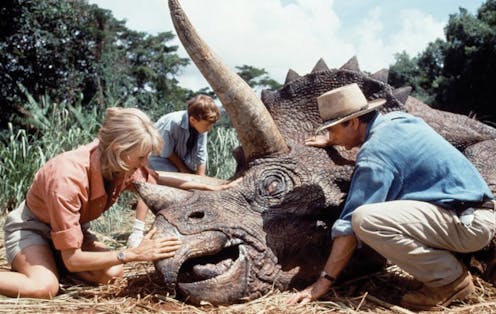
In June 1993, director Steven Spielberg released a film that unleashed a wave of technological change in film-making and simultaneously helped to revive popular interest in dinosaurs.
Jurassic Park, based on Michael Crichton’s novel, spawned five blockbuster sequels as well as a multitude of spin-off games, toys, novels, and multiple animated television shows. It features a theme park housing de-extincted dinosaurs that break out of their confines and cause havoc.
Underpinning the plot is clever genetic engineering that has allowed the Park’s scientists to assume they could control all aspects of the dinosaurs’ development, including their sex, much to their later horror when it becomes apparent such control was never possible.
The film franchise has taken an average of over $1 billion dollars at the box office, according to Variety.
From puppets to CGI
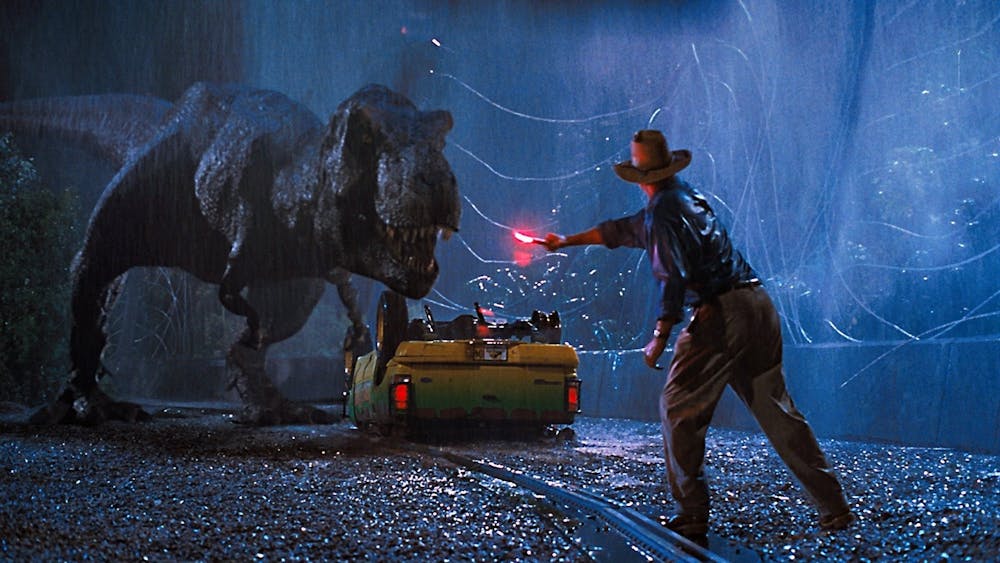
According to industry legend and multiple documentaries, Spielberg had planned to use only practical effects, including stop-motion Velociraptors and an animatronic Tyrannosaurus Rex. However, well into the filming schedule, he was convinced to also include wholly digital dinosaurs after viewing test footage produced by staff at special effects house Industrial Light & Magic.
In a critical history of Industrial Light & Magic, Julie Turnock observes that the film “relied on a canny mix of large-scale mechanical effects cut together with a few digitally generated shots”. After its success, ILM embraced digital composition technology more fully and integrated it into many later films.
As it stands, Jurassic Park features about 50 shots of digital-only prehistoric creatures, including the first full-body scene of a dinosaur – the sauropod Brachiosaurus - flocking Gallimumus, and the T. rex chasing a Jeep.
Industrial Light & Magic now claims on their website that “Suddenly, directors could imagine making films in which realistic animals, fantasy creatures, even digital people could perform without restraint.”
Nowadays, films and television productions are replete with photoreal computer-generated animals and people and the next revolution in screen production has them projected live behind actors on a series of large screens known as “the volume”.
Palaeontologists aren’t extinct
Shortly after seeing their first dinosaur, on-screen palaeontologist Alan Grant (Sam Neill) suggests to his palaeobotanist partner Ellie Sattler (Laura Dern) that the de-extinction success of Jurassic Park might make their profession redundant. Their colleague Ian Malcolm (Jeff Goldblum) responds, “Don’t you mean extinct?”
But far from extinction, palaeontology and associated sciences have seen an extensive rebound in public interest in the thirty years since Jurassic Park was released.
In 1975, palaeontologist Robert Bakker popularised the term “dinosaur renaissance” to describe a spate of developing research findings which argued the creatures were endothermic (warm-blooded), active, and related to the birds rather than cold-blooded, slow and wholly extinct as had been the public perception for much of the previous century. This renaissance lasted from about the 1960s into the 1980s and Jurassic Park reflected many of these new orthodoxies.
Bakker himself consulted for the film and was referenced by the character Tim Murphy. A Bakker lookalike also appeared in the sequel The Lost World, further reinforcing its role in reflecting these new perspectives.
But the film also arrived at the dawn of yet another new age of dinosaur discoveries which Steve Brusatte, in his 2018 book The Rise and Fall of the Dinosaurs, described as “the golden age of discovery”. Brusatte referred to the cohort of scientists making these newer discoveries as “men and women from many backgrounds who came of age in the era of Jurassic Park.” Among their findings are new understandings that many dinosaurs were feathered like their modern avian cousins.
Elizabeth Jones recently chronicled the history of the field of “ancient DNA” science, noting the “Jurassic Park effect” playing out on this fascinating area of research:
Even as scientists rejected the conclusions or the implications of the Jurassic Park narrative, they drew on the popularity of the book and movie to emphasise the importance of the technical enterprise in which they were engaged.
And a recent review of the last 60 years of dinosaur research by celebrated palaeontologist Philip J. Currie suggested “public interest continues to be stimulated by a multibillion-dollar movie, media, and toy industry founded on our interest in dinosaurs.”
The Jurassic Park legacy
Dinosaurs have long featured in popular media such as films and television. The first animated dinosaur, Gertie, debuted as part of a vaudeville performance in 1914. Dinosaurs, including a fearsome Tyrannosaurus featured in Disney’s groundbreaking and famed 1940 film Fantasia. But it was Jurassic Park which truly presented them as believable living creatures for the first time.
Though the science of the film has been widely criticised since its release, Jurassic Park succeeded in revolutionising film-making and reigniting a public fascination with dinosaurs even as palaeontology itself underwent a boom in new research efforts. In his recent memoir, actor Sam Neill described the film’s visuals as “a perfect collision of coming-of-age computer generated imagery… with state of the art puppetry”.
The sequels sequels and spin-offs have continued to adapt to changing social expectations, featuring strong female and queer characters, and even feathered dinosaurs in response to changing scientific understandings.
Perhaps the next Jurassic film will feature a full-lipped Tyrannosaurus?
Read more https://theconversation.com/how-jurassic-park-changed-film-making-and-our-view-of-dinosaurs-203147


