

How should we teach climate change in schools? It starts with 'turbo charging' teacher education
- Written by The Conversation
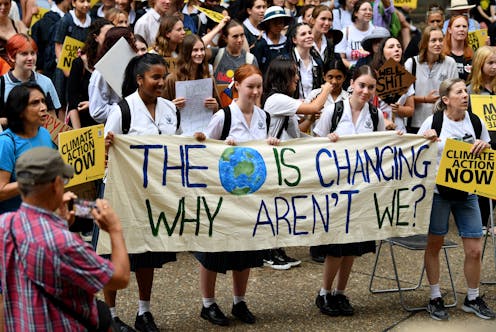
The case for action on climate change no longer needs to be laid out.
We see, almost daily, disturbing images of bushfires, floods or a mass extinction crisis. But however widespread that sense of urgency may be, we are struggling as a nation to respond in a substantive, coordinated way.
One thing is clear: these responses will need to be sustained and developed by future generations. Education is crucial for the workforce needed now and for young people who will be increasingly faced with the accelerating realities of climate change.
The Academy of the Social Sciences in Australia has done a review of research on climate change education in schools around the world.
Here we outline three areas needing urgent attention: the emotional and psychological effects of learning about climate change, the school curriculum and the education of teachers.
The emotional side of learning about climate
Teaching climate change in schools raises basic and potentially divisive questions about the purpose of education and the nature of childhood. We are supposed to teach children about their world. But what if in doing so, we scare them with facts about climate change?
We also know children are worried about climate change anyway. Many children and teenagers are stressed and anxious due to their growing awareness of climate change.
An increasing body of research is identifying approaches to teaching and learning about climate change that address students’ understanding in this complex area and engages them with positive actions.
This includes making climate change personally relevant, interacting with scientists to experience scientific practices and designing projects to address an aspect of climate change.
Read more: Ignoring young people's climate change fears is a recipe for anxiety
Climate change is (almost) missing from the curriculum
In 1975, UNESCO’s Belgrade charter on environmental education bluntly said the “youth of the world” needed a “new kind of education” if we were to avoid politically and economically short-sighted responses to environmental crises.
To date, environmental sustainability has not had a specific home in the Australian curriculum. It has been taught across various different subjects such as geography and science, or art, according to school and teacher priorities.
Our review found schools seem almost perfectly evolved to avoid, let alone prioritise, an educational area that relies on cross-curriculum activity.
The most recent update to the curriculum (agreed) under the former Morrison government in April 2022 included a more substantial focus on climate change at Years 9 and 10 in geography and science. But it ignores other foundational year levels in these subjects, and other potentially powerful parts of the syllabus, such as English and the arts.
Students need to receive a nuanced education, to understand the attitudes, motivations, and technologies that will address climate change. They need knowledge, but also the intent and skill to apply that knowledge faithfully and responsibly.
Student agency in confronting climate change is also becoming a key feature within international education circles. Australia participates in three main international tests, one of which is the Programme for International Student Assessment (PISA).
The next PISA test in 2025 will measure
the degree to which 15-year-olds are knowledgeable of, concerned about, and able to act on environmental issues as a result of their science education.
So teacher education is key
So we need teachers to adapt their teaching. And the urgency lies now in developing their confidence, knowledge and supports to do this.
Our review found teachers around the world don’t always have the knowledge and training they need to tackle climate change in their classrooms. For example, one 2016 study found US science teachers had an “insufficient grasp” of climate science. A study of Australian education degree students came to a similar conclusion, despite their favourable attitude to environmental education.
This is understandable. Knowledge about the scale and nature of this complex problem has expanded so rapidly that whatever a new national curriculum may mandate, it is unrealistic to expect teachers (and teacher educators) to have naturally kept up.
Our review argues we need to “turbo charge” teacher education in universities and professional development programs in schools to develop a culture around climate change education. We need a national initiative to support teachers across all year levels in their knowledge of climate change and how to meaningfully engage students.
This needs to cover the interconnected issues of climate change, environmental destruction, social justice and Indigenous knowledges. We also need to be able to counter misinformation.
The scale of government decision-making around climate change mitigation, energy policy, and environmental reconstruction is huge. But as part of this, school education, and teacher education, need to be high on the agenda.


