

Explainer: why was the winner of Thailand's election blocked from becoming prime minister?
- Written by The Conversation
The Thai parliamentary election was held over two months ago and yet, the country still has no prime minister or government. While much remains in flux, one thing appears certain – the popular reformist leader of the party that received the most votes in the election, Pita Limjaroenrat, will not be the country’s next prime minister.
In demoralising, though familiar, scenes this week, the Constitutional Court announced Pita would be suspended as an MP until a ruling is made on allegations he knowingly held shares in a media company when he contested the May election.
The parliament then voted to void his prime ministerial nomination, preventing him from contesting a second vote in the legislature for the premiership. (He had already failed in one vote last week.)
Pita is clearly the people’s choice for prime minister. And under a more democratic system, he would already be sitting in the PM office.
So, why has the winner of the election been blocked from taking office?
Who is Pita?
The charismatic 42-year-old Pita is a Harvard-educated businessman who entered parliament in the 2019 election as a member of the Future Forward Party, led by another young, charismatic, American-educated politician, Thanathorn Juangroongruangkit.
After the election, in an almost identical complaint to Pita’s case, the Election Commission accused Thanathorn of holding shares in a media company when he registered as an MP, violating election laws. He was convicted by the Constitutional Court, disqualifying him as an MP.
Read more: Thailand at a critical juncture with pro-democracy protesters again set to clash with police
Thanathorn’s party was then dissolved by the court for allegedly accepting an “illegitimate” loan. However, it was soon replaced by the newly established Move Forward Party, and Pita was elected its leader in March 2020.
Pita proved to be a talented campaigner, and the newly established party stunned political analysts in this year’s election by winning 151 seats in the House of Representatives. Even more astonishing was Move Forward’s almost clean sweep of Bangkok, winning 32 out of 33 seats. The military-backed parties of the previous government were eviscerated.
Pita then built a coalition of eight parties that together controlled 312 of the 500 seats in the House, a clear majority.
Why was Pita disqualified?
The problem for Pita, Move Forward and any democratic party in Thailand is the prime minister is elected under the 2017 constitution, which was written by the military. It gives the 250 members of the Senate, who were appointed in 2019 by the previous military junta, a vote in electing the prime minister.
This means a candidate needs 376 votes of the total 750 parliamentarians to be elected prime minister, but just 500 have been democratically elected. Of those, Pita’s coalition only controlled 312 seats. This feature of the Constitution is designed to allow the military-appointed Senate to play the role of spoiler.
Before the first round of parliamentary voting, Pita and his party were presented with two other significant hurdles – the Constitutional Court had received two cases against them.
The first complaint accused the Move Forward of “attempting to overthrow the democratic system with his majesty the king as the head of state”. The second, referred by the Election Commission, argued Pita should be removed as an MP for knowingly holding shares in a media company when he registered.
Pita was allowed to contest the first round of voting on July 13 nonetheless, but fell short, winning 324 votes. Only 13 senators supported him.
Then, before Wednesday’s second round of voting, the court announced Pita’s suspension and conservative forces in parliament joined to block him from standing again.
It should be noted both the Election Commission and the Constitutional Court are generally considered to be the vehicles of the conservative elites and have repeatedly made bogus or adverse judgements against liberal parties and politicians who might challenge the power of the military or monarchy.
Why do conservatives oppose Pita?
Pita ran on a platform of liberalising reforms in most areas of Thailand’s society and economy.
The party’s key policy proposal was to push for a referendum to establish an assembly to rewrite the Constitution and remove its anti-democratic elements, such as the appointment of the Senate and its ability to elect the prime minister.
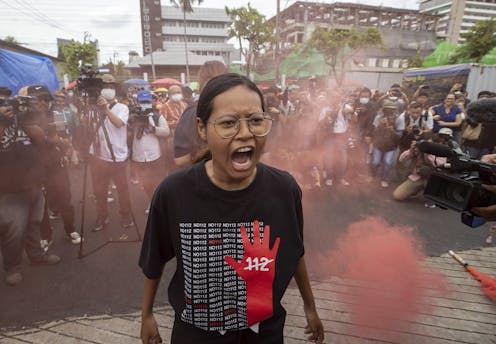
Another key policy was to amend Section 112 of Thailand’s criminal code, the lèse-majesté law, which punishes anyone who criticises the king or other senior royals with up to 15 years in prison.
Since 2020, at least 250 people have been prosecuted under the law. A new book on the Thai king by an exiled academic, Pavin Chachavalpongpun, was also recently banned for defaming the monarchy. Anyone importing it could be imprisoned for three years and fined, despite the book not yet being published.
Pita and his party have also committed to push for a bill to legalise same-sex marriage and improve gender equality in Thailand.
Significantly, they sought to restrict the power of the military, as well. Move Forward proposed significant reductions in the defence budget, which is always a courageous stance in a country bedevilled by regular military coups.
In addition, the party planned to pass wealth and land taxes and increase corporate taxes for large companies to pay for its welfare policies focused on education, children, people with disabilities and retirees.
All of these positions made Pita popular with younger, more cosmopolitan voters. But it also made the party a target of powerful, anti-democratic, conservative forces, particularly the military, the monarchy and their supporters.
So what could happen next?
After the decision to suspend Pita and the vote to deny him a second nomination, protesters began to gather outside parliament, then later at Bangkok’s famed Democracy Monument. Many young people feel as though the conservative forces in Thai society have stifled the democratic will of the people – yet again.
It is now likely one of the three prime minister candidates of the second-place party, Pheu Thai, will be nominated in the next round of parliamentary voting, scheduled for July 27.
Despite Pita being suspended from parliament, Move Forward still commands the most seats in the House and will still be a powerful force in pursuing its agenda. There are rumours Pheu Thai could abandon its coalition with the party, though that remains to be seen.
When Pita left the parliament this week to applause from his supporters, he adopted an optimistic tone. He said Thailand had changed since the May election and “the people are now half way to victory”.
There is a chance this is true and we are on the cusp of a surge of democratic power in Thailand. But for many long-time observers of civil-military relations in Southeast Asia, this view might turn out to be overly optimistic.


