

China is criminalising clothing 'hurtful to the spirit and sentiments of the nation' – could this mean a kimono ban?
- Written by The Conversation
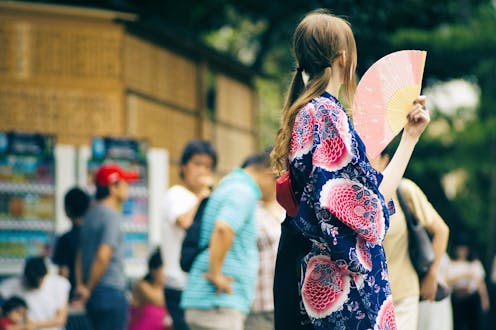
In August 2022 a young woman wearing a yukata – a simple, summer-weight kimono – was having her photo taken on a street in picturesque Suzhou, China, when she was accosted by a police officer. Following an angry exchange, partly captured on her phone, she was arrested for disturbing the public peace.
The Suzhou Kimono Incident, as it came to be known, sparked an internet debate over the propriety of wearing kimonos and the legality of the policeman’s actions.
This was not the first time wearing a kimono in China had caused a furore, and it would not be the last. Another broke out in March this year, after a visitor to Nanjing, site of an infamous massacre by the Imperial Japanese Army in 1937, reported seeing a woman in a white kimono posing amidst the cherry blossoms in a Buddhist temple. He complained to the attendants but they said it was merely a matter of ethics: after all, people were free to wear what they like.
That may soon change. A new draft law on public security published online at the beginning of this month includes a clause criminalising the wearing of clothes that might be “hurtful to the spirit and sentiments of the nation”. If the law is passed, offenders will face penalties of up to 5,000 yuan (A$1,000) and up to 15 days jail.
Draft laws, routinely posted for comment, rarely attract many responses. The response to this one has been huge, with around 100,000 submissions to date. Legal scholars in China have weighed in, pointing out the fuzziness of this clause and its openness to abuse by local law enforcers.
And as one Beijing lawyer intimated, the legislation seems directly aimed at the kimono.
A ‘hurtful’ kimono?
Half a century ago, the target of sartorial struggle in China was “strange clothing and outlandish dress” – tight pants were the example par excellence in the 1960s, succeeded by flares in the 1970s.
Such clothing was associated with the United States, the Soviet Union and Hong Kong, all sink-holes of decadence and natural enemies of China under Mao.

Things have changed. Soviet revisionists have morphed into Russian allies; Hong Kong has been swallowed up by the mainland; and with jeans and t-shirts now ubiquitous in China, the US is no longer open to attack on the sartorial front.
Enter Japan, with its spectacular array of distinctive cultural products, strong youth following across East Asia and a wartime history that since the 1980s has been leveraged to foment nationalism in China.
 Jeans and t-shirts are now ubiquitous in China.
EPA/MARK R. CRISTINO
Jeans and t-shirts are now ubiquitous in China.
EPA/MARK R. CRISTINO
In 1980, Japanese movie star Nakano Ryoko received a rapturous welcome when she visited China. Over the next few years, Japan inspired and provided training for the first generation of post-Mao fashion designers, who helped lay the foundations for a now-flourishing industry.
In the mid-1980s, a fully accessorised kimono as a symbol of excellence in Japanese design was perfectly acceptable for publication in a Chinese magazine.
Simultaneously, however, a “new remembering” of Japanese wartime atrocities – specifically the Nanjing massacre – was emerging, soon to be endorsed by the ruling Communist Party. By the 1990s, a history that had been buried in the Mao years was being given full play.
All this helps explain the visceral responses to young Chinese women wearing kimonos today.
In April 2009, two high-impact films about the Nanjing massacre were released. Images of Japanese soldiers raping Chinese women were fresh in people’s minds when, in September, young model Ding Beili posted a photo of herself online wearing a kimono. She attracted a storm of criticism.
“With so many countries in the world to pick from,” asked one blogger, “why did she have to pick Japan?”
 Kimonos are often worn at cosplay conventions, like this one in Nanjing in 2022.
Leiem/Wikimedia Commons, CC BY-SA
Kimonos are often worn at cosplay conventions, like this one in Nanjing in 2022.
Leiem/Wikimedia Commons, CC BY-SA
Why indeed? The answer lies in something else that came to China from Japan: cosplay, popular across East Asia. The girl of the Suzhou Kimono Incident was a cosplayer, performing a role from the Japanese anime Summer Time Rendering. Naturally, cosplayers view Japanese-inspired dress differently from their critics.
Among the great occasions for Chinese cosplay until recently were Japanese-style “summer festivals”, or matsuri. It was for a matsuri in Shanghai that Ding Beili donned a kimono in 2009. Increasingly popular in China in recent years, summer festivals were cancelled in at least seven cities in August 2022 under rising anti-Japanese sentiment.
Read more: How the kimono became a symbol of oppression in some parts of Asia
Adding the US to the mix
The ultra-nationalist Hu Xijin, former editor of the Global Times, has dismissed the issue of the kimono in China as a matter of no consequence. “Little Japan,” in his view, is just “a lackey of the US”.
The US-Japan alliance undoubtedly exacerbates Chinese hostility towards Japan, a country that like Australia is an easier target for payback than the US. China’s response to the new tripartite agreement between Japan, South Korea and the US was to slap a ban on Japanese seafood imports, on stated grounds of health security.
The new draft law against “hurtful” dress was posted soon after the implementation of the seafood ban, leaving observers with a distinct impression of China as a place where people can neither eat Japanese fish nor wear Japanese clothes.
Older people must be reminded of a time half a century ago, when young people wearing “strange clothing and outlandish dress” were attacked on the streets, while seafood was hardly available at all.


