

Why are dead and dying seabirds washing up on our beaches in their hundreds?
- Written by The Conversation
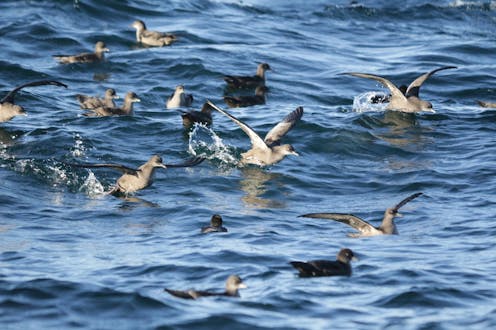
In October and November, horrified beachgoers often find dead and dying muttonbirds washing up in an event called a seabird “wreck”.
Again this year, there are reports of Australia’s beautiful east coast beaches turned grim with hundreds of dying seabirds.
Here’s what we do and don’t know about seabird wrecks, and what you can do if you come across one.
Wrecks are becoming more common
Millions of short-tailed shearwaters (Ardenna tenuirostis), commonly known as muttonbirds, return to southern Australia from the Arctic each spring – a round trip of up to 35,000km.
Not all birds survive their long migration. The fit and healthy largely return in late September and October. The less fit lag behind. To some extent, deaths are natural.
Muttonbirds keep a strict timetable and, while failed migrants can wash up any time during spring, mass mortalities can occur from mid-October to November. Muttonbird wrecks have happened on rare occasions since time immemorial, but are becoming more common.
The many ideas about what is causing wrecks range from storms and overfishing to plastic, blue-green algae and irradiated water from Fukushima.
University of Tasmania researchers have studied the muttonbirds for decades. While we can’t pinpoint the exact cause for every wreck, we can explain what we know and eliminate the unlikely culprits.
What we know

When muttonbird wrecks occur, the casualties are starving. These birds weigh only half their healthy body weight. The factors leading to this starvation start before they reach Australia.
Muttonbirds chase an eternal summer. After returning to Australia from the North Pacific, they lay eggs in late November on Australia’s southern islands and raise a single chick. When the weather cools in April the adults depart on a great migration north where the sea ice is melting on the Bering Sea ahead of an Arctic summer.
Ecosystem changes in the sub-Arctic, where the birds fatten up over the northern summer, can lead to death on Australian beaches.
Many marine animals share the North Pacific Ocean with muttonbirds. Among them are several salmon species, which compete with muttonbirds and other marine wildlife for the same zooplankton prey – the abundant small animals floating in the surface waters of the ocean.
Read more: It might be the world's biggest ocean, but the mighty Pacific is in peril
The pink salmon (Oncorhynchus gorbuscha), in particular, is central to the muttonbirds story. You may have seen them in documentaries, being eaten by bears on the annual “salmon run”. You may also eat them yourself, as tinned salmon.
Pink salmon live hard and fast. Their life cycle from hatching to spawning lasts two years. However, wild numbers couldn’t satisfy consumer demand and by the mid-20th century the species was in trouble.
To take pressure off wild fish stock and meet soaring demand, salmon hatcheries now release billions of fry, many more than would exist through nature, into the North Pacific Ocean. Pink salmon numbers, both hatchery and wild fish, have more than doubled in recent decades.
Increased salmon numbers have caused crashes in zooplankton in odd-numbered years, when most pink salmon reach spawning size and are 25 times more abundant than in even-numbered years. The effect is so strong that even healthy breeding muttonbirds arriving in Tasmania are lighter most odd-numbered years.
Other factors are also affecting zooplankton. The Arctic seas are among the fastest warming on Earth. Marine heatwaves have been causing shifts in where and when zooplankton occur, and how large they grow.
When seabirds on a strict schedule arrive to feed, they can miss the zooplankton buffet. This has led to devastating wrecks for Arctic and sub-Arctic seabird species, including muttonbirds.
Read more: Seabirds are today's canaries in the coal mine – and they're sending us an urgent message
In 2013, millions of muttonbirds starved along Australia’s coast from K'gari/Fraser Island to Tasmania. Though we don’t know the exact cause, this was likely influenced by a double whammy: competition for food with salmon and a severe marine heatwave called “the blob”.
But what about the other causes? Examination of wrecked birds rules out plastic, blue-green algae and irradiated water from Fukushima as causes of death.
Birds are already in poor condition when they arrive. Storms or strong winds might push an already poorly muttonbird over the edge, but are generally not the cause of its poor condition. People often find muttonbirds after storms because onshore winds blow them from the sea onto beaches.
What should I do if I find a muttonbird?
If a muttonbird is too weak to fly, sadly it’s unlikely to recover.
If you want to give them a chance, though the odds are low, contact a specialist seabird rescue group. Seabirds have very specific care needs. Taking one home or feeding it, while well intended, may cause more harm than good.
If you find more than a few along the beach, you can report the wreck by emailing the author or contacting the University of Tasmania. Note the time, date, location and number of birds per kilometre.
If you find a muttonbird (or any bird) with a metal ring on its leg, please report the number to the Australian Bird and Bat Banding Scheme.
What if I find other dead seabirds or waterbirds?
There’s another reason to watch out for unusual bird deaths this summer. A deadly bird disease has a high probability of reaching Australia’s shores. High pathogenicity avian influenza (HPAI) has killed millions of birds worldwide, including seabirds.
The disease could enter Australia if carried by birds, including muttonbirds, migrating from the Northern Hemisphere (where HPIA is infecting wild bird populations) to Australia.
If you find an unusual number of sick or dying seabirds, shorebirds or waterbirds, report the incident to Wildlife Health Australia.
Read more: Migrating birds could bring lethal avian flu to Australia's vulnerable birds


