

Growing NZ cities eat up fertile land – but housing and food production can co-exist
- Written by The Conversation
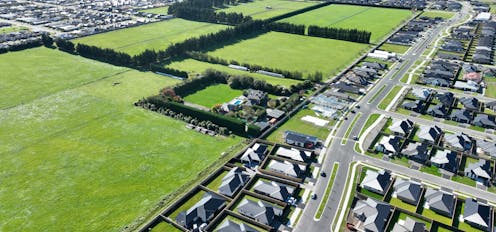
Auckland Council recently voted to decrease the amount of city fringe land available for development, citing flood risks and infrastructure costs.
Meanwhile in Christchurch, plans for an 850-home development north of the city have been rejected because of the area’s “existing rural nature and the lack of public transport and local jobs”.
Cities around the world face a similar dilemma: population growth and housing shortages mean urban expansion often encroaches on rural productive land.
Fertile soil is one of the reasons why many cites were originally set up in certain sites, but now the loss of these food-producing landscapes to urban growth is widely recognised as a concern to local food security.
The edges of cities – the “peri-urban” zone – are critically important for urban resilience. Apart from food, they supply ecosystem services such as flood and stormwater mitigation, cooling and climate regulation, carbon storage, waste treatment and recreation.
It could be said that the conversion of peri-urban agricultural land for urban expansion unwittingly undermines the very life support on which city dwellers depend.
Our research explores possible solutions that allow food production and housing to co-exist within peri-urban zones.
Read more: How sustainable, liveable and resilient housing can help us adapt to a changing future
The housing-agriculture conundrum
In Aotearoa New Zealand, the competition for land for either housing or food production within the peri-urban zone is intense. Local and regional councils have to attempt to mediate between two recently gazetted national policy statements that seem at odds.
The 2020 National Policy Statement for Urban Development requires councils to remove barriers to urban expansion, both up and out. The 2022 National Policy Statement on Highly Productive Land requires councils to avoid urban encroachment and protect highly productive land for agriculture.
A recent Ministry for the Environment report states:
The area of highly productive land that was unavailable for agriculture (because it had a house on it) increased by 54% from 2002 to 2019.
Urban resilience and food production
Peri-urban zones have an important role in supplying locally produced food. This helps reduce transport emissions to meet New Zealand’s emissions reduction targets. But there is a growing disconnect between where New Zealand’s food is produced and where the majority of New Zealanders live.
The dominant approach to urban growth is through greenfield development (building on undeveloped land), and this ultimately compromises the productive land belt around many cities and settlements. This can result in the irreversible loss of some of our most fertile soils.
Read more: National’s housing u-turn promotes urban sprawl – cities and ratepayers will pick up the bill
Multiple factors affect where food can be produced within the peri-urban zone. This includes policy, land value, soil versatility, natural resources such as water and, increasingly, the level of “reverse sensitivity” – a term used to describe, in this instance, the impacts of newer land uses (such as housing) on prior activities (agriculture) in mixed-use areas.
Planning policy often fails to keep up with changes in housing markets, agricultural practice and lifestyle choices. This then results in reactive planning approaches, putting high-value soil and other land suitable for food production at continued risk of development and fragmentation.
This is compounded by public and political pressures that can lead to tensions between food producers and their residential neighbours.
Combined land use
Our team has surveyed households and food producers living and operating within the peri-urban zone of Ōtautahi Christchurch to better understand the issues. We also wanted to explore opportunities arising from food production and housing co-existing within peri-urban zones.
Based on the views of surveyed participants, we developed five land-use design concepts, which were then evaluated by participants during a public workshop.
Of these five options, a multi-functional green belt (below) was most favoured. This green belt is a publicly accessible buffer between urban areas and conventional farms, including public open spaces, community gardens, sports fields, walking tracks, native plantings, stormwater management zones and playgrounds.
Other scenarios included different options of either separating or integrating urban and rural land uses.
What did peri-urban residents and food producers say?
Our research reveals that residents like having food-producing landscapes close to where they live. More than 60% of respondents felt “extremely positive” and 32% “mostly positive” towards these landscapes.
One of our key findings suggests residents were mostly happy to accept the day-to-day nuisances of farm operations, but they wanted their household to benefit by being able to access food produced locally.
Food producers expressed more neutral feelings towards operating in the peri-urban zone. For them, being close to their potential customers, as well as benefiting from urban infrastructure such as high-speed internet, was important.
But our survey also highlights that peri-urban residents are concerned about possible negative impacts of nearby intensive farming, and producers fear facing complaints from their urban neighbours. Both groups called for greater agricultural literacy for urban New Zealanders.
Integrating people and production
How should we prioritise peri-urban food production alongside strategic urban expansion?
The loss of agricultural land to urban development, the disconnect between local farms and their urban markets, and the recent drive to create more sustainable infrastructure within and around cities, have all engendered planning and urban design programmes that aim to protect and reconnect cities with their food.
Redesigning peri-urban land-use patterns to integrate housing with productive land uses has the potential to connect New Zealanders with the land while mitigating the current rural-urban dichotomy approach to planning.
Embedding mana whenua values of connectedness with the environment offers significant opportunities to nourish both the land and communities that reside within. The reintegration of mahinga kai (food-gathering sites) and māra kai (food gardens) principles would support the health and resilience of both people and the land connected to cities.
Accessible local food production is an essential component of long-term urban resilience. To achieve this, we argue that we need a new approach to peri-urban land-use planning for Aotearoa New Zealand in which landscapes for both people and production are integrated and mutually beneficial.
We are grateful for the significant contribution to this research made by Guanyu Hanley Chen and Naomi Darvill from Lincoln University, and John Blyth, Sara Hodgson and Lydia Shirely from BECA.


