

A Stanford professor says science shows free will doesn’t exist. Here’s why he’s mistaken
- Written by The Conversation
It seems like we have free will. Most of the time, we are the ones who choose what we eat, how we tie our shoelaces and what articles we read on The Conversation.
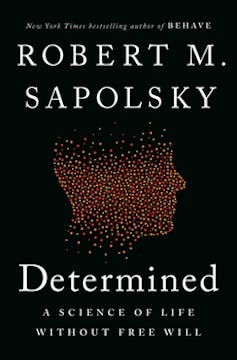
However, the latest book by Stanford neurobiologist Robert Sapolsky, Determined: A Science of Life Without Free Will, has been receiving a lot of media attention for arguing science shows this is an illusion.
Sapolsky summarises the latest scientific research relevant to determinism: the idea that we’re causally “determined” to act as we do because of our histories – and couldn’t possibly act any other way.
According to determinism, just as a rock that is dropped is determined to fall due to gravity, your neurons are determined to fire a certain way as a direct result of your environment, upbringing, hormones, genes, culture and myriad other factors outside your control. And this is true regardless of how “free” your choices seem to you.
Sapolsky also says that because our behaviour is determined in this way, nobody is morally responsible for what they do. He believes while we can lock up murderers to keep others safe, they technically don’t deserve to be punished.
This is quite a radical position. It’s worth asking why only 11% of philosophers agree with Sapolsky, compared with the 60% who think being causally determined is compatible with having free will and being morally responsible.
Have these “compatibilists” failed to understand the science? Or has Sapolsky failed to understand free will?
Read more: Science communicators need to stop telling everybody the universe is a meaningless void
Is determinism incompatible with free will?
“Free will” and “responsibility” can mean a variety of different things depending on how you approach them.
Many people think of free will as having the ability to choose between alternatives. Determinism might seem to threaten this, because if we are causally determined then we lack any real choice between alternatives; we only ever make the choice we were always going to make.
But there are counterexamples to this way of thinking. For instance, suppose when you started reading this article someone secretly locked your door for 10 seconds, preventing you from leaving the room during that time. You, however, had no desire to leave anyway because you wanted to keep reading – so you stayed where you are. Was your choice free?
Many would argue even though you lacked the option to leave the room, this didn’t make your choice to stay unfree. Therefore, lacking alternatives isn’t what decides whether you lack free will. What matters instead is how the decision came about.
The trouble with Sapolsky’s arguments, as free will expert John Martin Fischer explains, is he doesn’t actually present any argument for why his conception of free will is correct.
He simply defines free will as being incompatible with determinism, assumes this absolves people of moral responsibility, and spends much of the book describing the many ways our behaviours are determined. His arguments can all be traced back to his definition of “free will”.
Compatibilists believe humans are agents. We live lives with “meaning”, have an understanding of right and wrong, and act for moral reasons. This is enough to suggest most of us, most of the time, have a certain type of freedom and are responsible for our actions (and deserving of blame) – even if our behaviours are “determined”.
Compatibilists would point out that being constrained by determinism isn’t the same as being constrained to a chair by a rope. Failing to save a drowning child because you were tied up is not the same as failing to save a drowning child because you were “determined” not to care about them. The former is an excuse. The latter is cause for condemnation.
Incompatibilists must defend themselves better
Some readers sympathetic to Sapolsky might feel unconvinced. They might say your decision to stay in the room, or ignore the child, was still caused by influences in your history that you didn’t control – and therefore you weren’t truly free to choose.
However, this doesn’t prove that having alternatives or being “undetermined” is the only way we can count as having free will. Instead, it assumes they are. From the compatibilists’ point of view, this is cheating.
 Compatibilists believe humans are agents who act for moral reasons.
Shutterstock
Compatibilists believe humans are agents who act for moral reasons.
Shutterstock
Compatibilists and incompatibilists both agree that, given determinism is true, there is a sense in which you lack alternatives and could not do otherwise.
However, incompatibilists will say you therefore lack free will, whereas compatibilists will say you still possess free will because that sense of “lacking alternatives” isn’t what undermines free will – and free will is something else entirely.
They say as long as your actions came from you in a relevant way (even if “you” were “determined” by other things), you count as having free will. When you’re tied up by a rope, the decision to not save the drowning child doesn’t come from you. But when you just don’t care about the child, it does.
By another analogy, if a tree falls in a forest and nobody is around, one person may say no auditory senses are present, so this is incompatible with sound existing. But another person may say even though no auditory senses are present, this is still compatible with sound existing because “sound” isn’t about auditory perception – it’s about vibrating atoms.
Both agree nothing is heard, but disagree on what factors are relevant to determining the existence of “sound” in the first place. Sapolsky needs to show why his assumptions about what counts as free will are the ones relevant to moral responsibility. As philosopher Daniel Dennett once put it, we need to ask which “varieties of free will [are] worth wanting”.
Free will isn’t a scientific question
The point of this back and forth isn’t to show compatibilists are right. It is to highlight there’s a nuanced debate to engage with. Free will is a thorny issue. Showing nobody is responsible for what they do requires understanding and engaging with all the positions on offer. Sapolsky doesn’t do this.
Sapolsky’s broader mistake seems to be assuming his questions are purely scientific: answered by looking just at what the science says. While science is relevant, we first need some idea of what free will is (which is a metaphysical question) and how it relates to moral responsibility (a normative question). This is something philosophers have been interrogating for a very long time.
Interdisciplinary work is valuable and scientists are welcome to contribute to age-old philosophical questions. But unless they engage with existing arguments first, rather than picking a definition they like and attacking others for not meeting it, their claims will simply be confused.
Read more: Curious Kids: what is the most important thing a scientist needs?


