

Astronomers finally caught radio waves from 40 large galaxies in the nearby universe
- Written by The Conversation
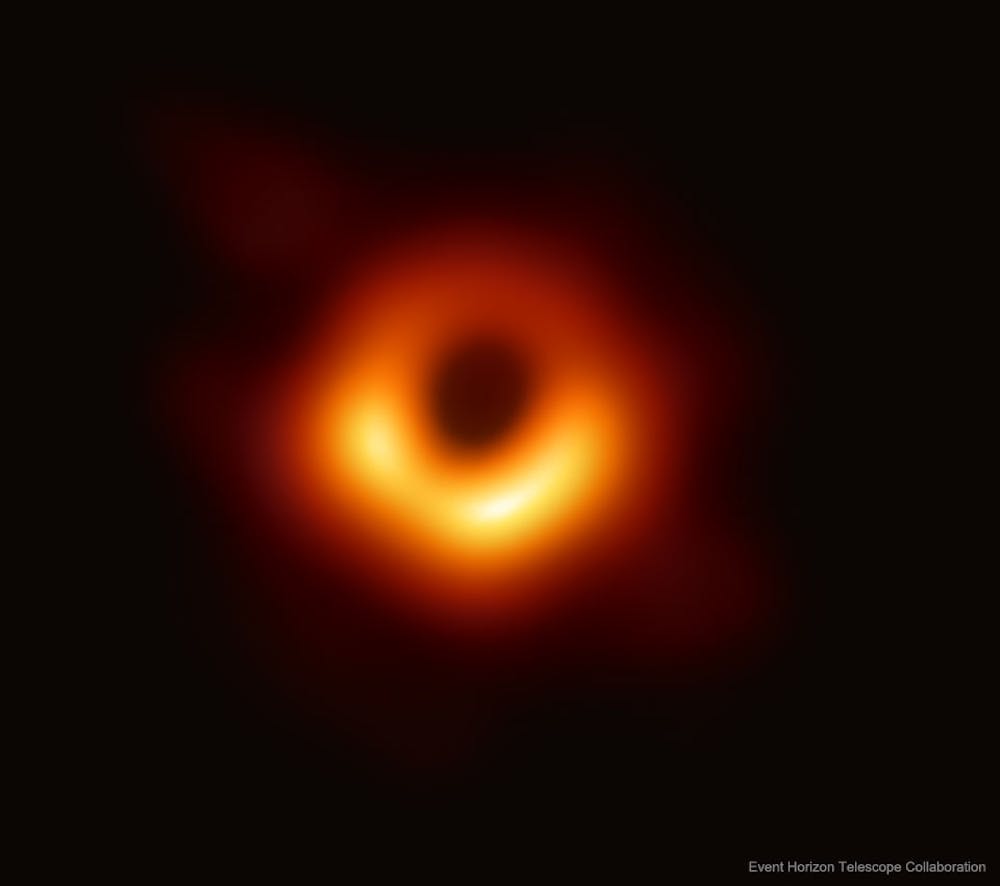
Supermassive black holes reside in some of the biggest galaxies in the universe. They tend to be billions of times more massive that our Sun, and not even light itself can escape a black hole once it gets too close.
But it’s not all darkness. Supermassive black holes power some of the most luminous celestial objects in the universe – active galactic nuclei, which shine across the spectrum of light, including radio waves.
The active galactic nucleus in nearby galaxy Messier 87 is a prodigious emitter of radio waves, 27 orders of magnitude more powerful than the most powerful radio transmitters on Earth.
But not all galaxies blast radio waves like Messier 87. Some very massive nearby galaxies have gone undetected in the radio spectrum despite containing supermassive black holes. Are they switched on in the radio at all, or are they – and therefore their black holes – totally silent?
To find out, we searched for radio waves from the most massive galaxies in the nearby universe, with our results now accepted for publication in the Publications of the Astronomical Society of Australia.
A big engine
It may seem odd that black holes can power anything. After all, no matter – not even light – can escape a black hole. But a lot can happen before the point of no return, known as the event horizon.
As matter falls towards the black hole, it picks up tremendous speed. Particles can end up travelling close to the speed of light, and when particles smash at that speed, they can release a staggering amount of energy.
Read more: Curious Kids: how do black holes pull in light?
Several percent of the mass that falls towards a black hole – “feeds” it – can get released as light. Feed a black hole, and it can be a big engine that blasts out radio waves.
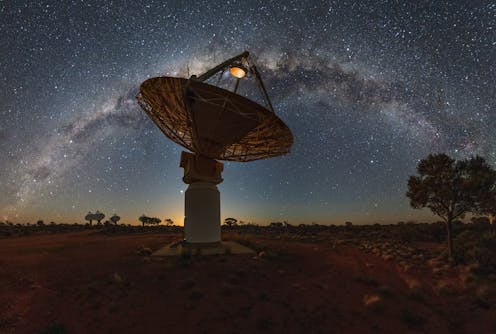
So, supermassive black holes are in all the biggest galaxies, but are they always being fed? That question motivated our study. To listen for radio waves from these enormous objects, we used the ASKAP radio telescope in Western Australia, owned and operated by CSIRO – Australia’s national science agency.
Tuning in on the radio
Way back in the 1940s, astronomers started detecting radio waves from some massive galaxies using the first radio telescopes. This includes galaxies familiar to amateur astronomers, including Messier 87 in the Virgo constellation and NGC 5128 in Centaurus.
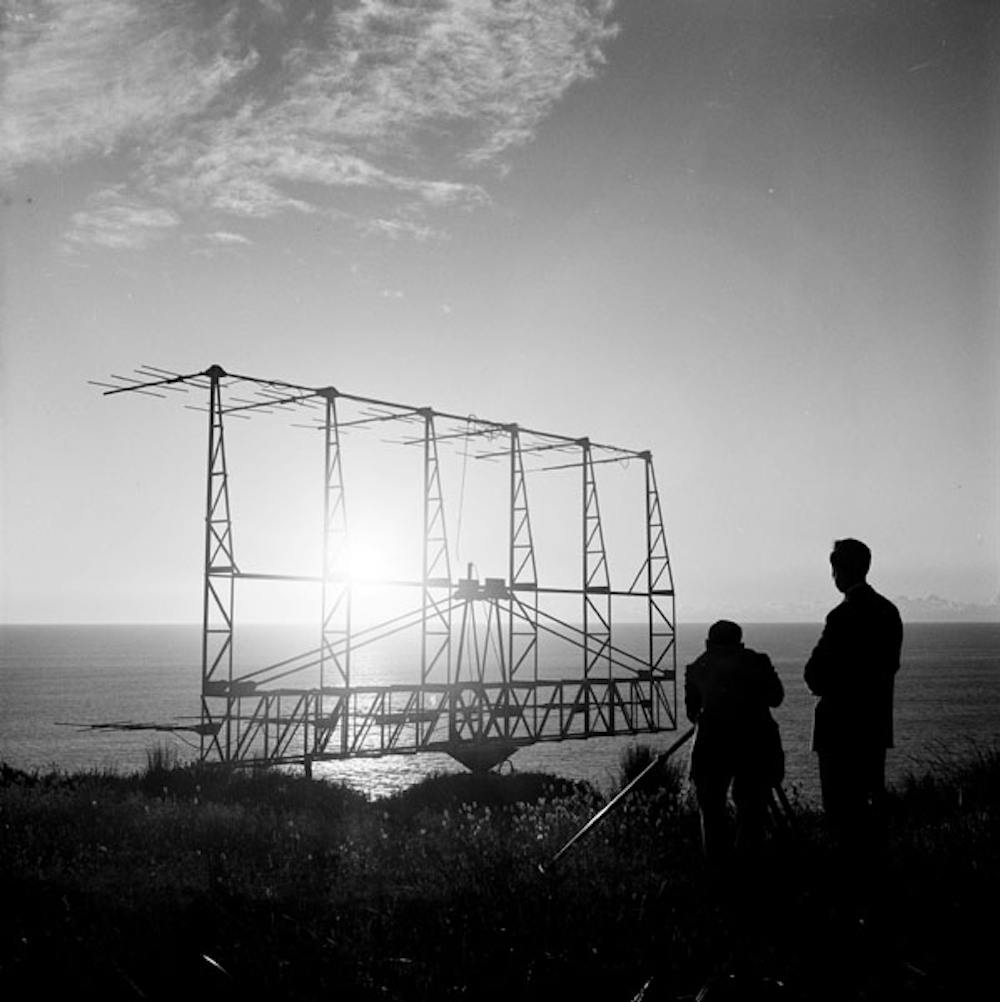 Very powerful celestial sources of radio waves were detected back in the 1940s, thanks to radio telescopes like this one at Dover Heights, Sydney.
CSIRO Radio Astronomy Image Archive
Very powerful celestial sources of radio waves were detected back in the 1940s, thanks to radio telescopes like this one at Dover Heights, Sydney.
CSIRO Radio Astronomy Image Archive
As technology advanced, more very massive galaxies were detected in radio waves. In the early 2000s, astronomers found that about a third of very massive galaxies in the Sloan Digital Sky Survey were detectable in the radio data from the Very Large Array, located in New Mexico.
A decade ago, our team also used data from the Very Large Array to search for radio emissions from the most massive nearby galaxies. Some were easily detected while others were indistinguishable from noise.
However, there was a strong hint. While the radio signals from the most massive galaxies were sometimes not distinguishable from noise individually, we always found a positive signal.
If some galaxies were not emitting radio waves, we would expect random noise to produce a mix of positive and negative signals. Getting a positive signal every time suggested all massive galaxies are radio sources. But digging into the noise left us unsure, until now.
New telescopes and a new view
There have been major advances in radio telescopes during the past decade, both in radio receivers and computing power. New radio telescopes include the ASKAP radio telescope and the Murchison Widefield Array, both located at Inyarrimanha Ilgari Bundara, CSIRO’s Murchison Radio-astronomy Observatory on Wajarri Yamaji country in Western Australia. There is also the Low Frequency Array (Lofar) in Europe.
These telescopes can survey the sky with greater sensitivity and speed than the previous generation of radio telescopes. For example, the Rapid ASKAP Continuum Survey is just a preliminary radio survey of 83% of the entire sky, but is already three times more sensitive than comparable surveys with the previous generation of radio telescopes.
For our new study, we no longer needed to look for mere hints of the noise. We detected radio waves from all 40 of the most massive galaxies in our survey area.
Dialled up and down
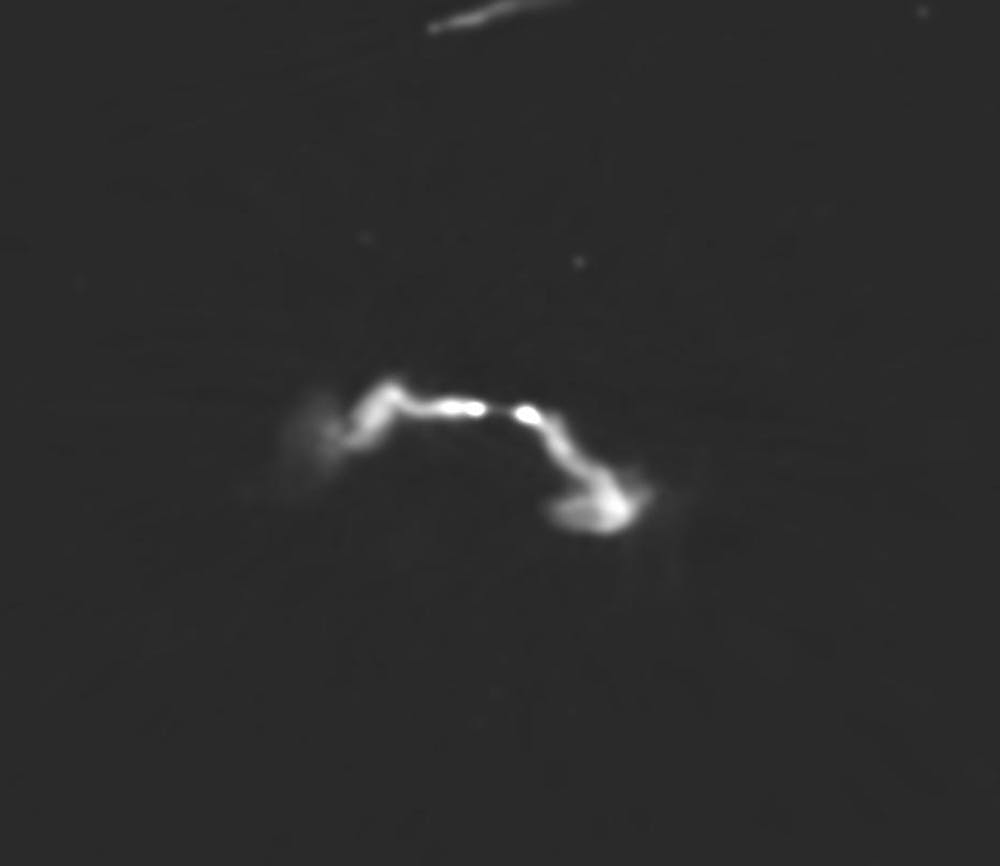 An ASKAP radio image of galaxy ESO 137-G 6.
Michael Brown/CSIRO
An ASKAP radio image of galaxy ESO 137-G 6.
Michael Brown/CSIRO
So, it now looks like all very massive galaxies are emitting radio waves, but are all of their black holes being fed? Most are, but probably not all.
Studies with Lofar suggest some radio sources in massive galaxies are afterglows from earlier activity. It is likely these are temporary pauses, and these black holes will fire up again.
Another piece of the puzzle is the radio power. Two galaxies of the same mass can differ in radio power by a factor of 10,000. Why does this happen?
We don’t know the answer yet, but there are some clues. Our work and a recent study with Lofar find that, on average, the galaxies that rotate the least are the strongest radio wave emitters. Some of the exceptions to this trend are curious, with evidence of mergers with other galaxies.
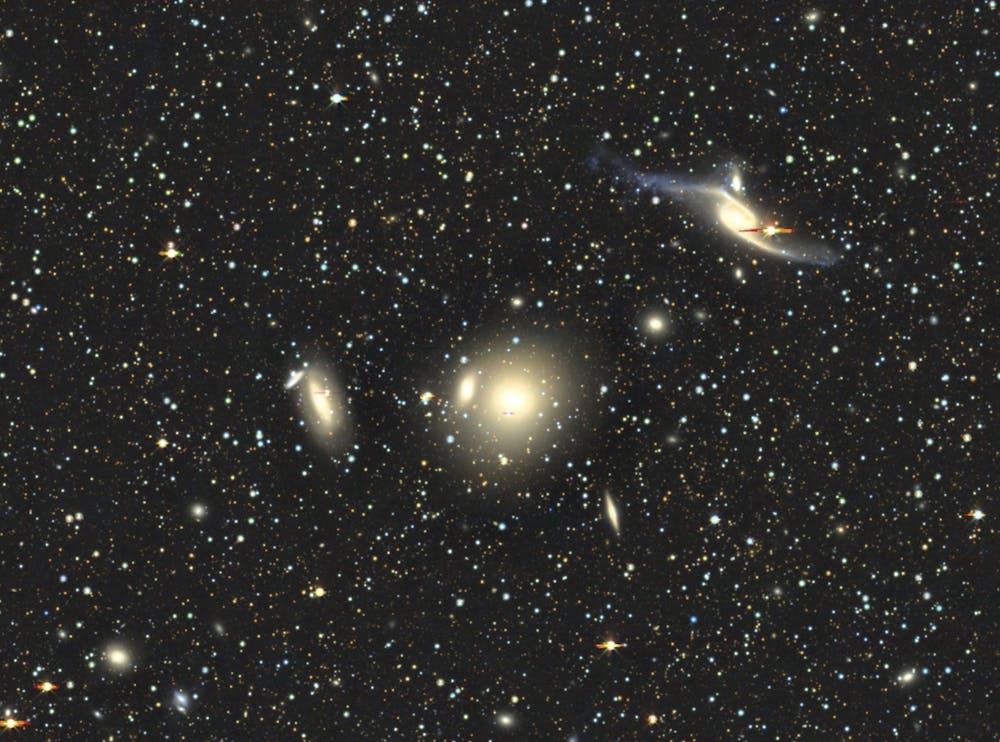 Galaxy NGC 6876 emits radio waves, but is thousands of times fainter than Messier 87.
Legacy Imaging Surveys/D. Lang (Perimeter Institute), CC BY
Galaxy NGC 6876 emits radio waves, but is thousands of times fainter than Messier 87.
Legacy Imaging Surveys/D. Lang (Perimeter Institute), CC BY
There is much to learn about very massive galaxies and their black holes, but data from the new generation of radio telescopes has revealed a great deal.
All very massive galaxies emit radio waves, but their power varies. Determining how all this works will be a challenge, but there are clues for astronomers to now follow.


