

As Aussie as vanilla slice: how the delicate European dessert became the snot block of Aussie bakeries
- Written by The Conversation
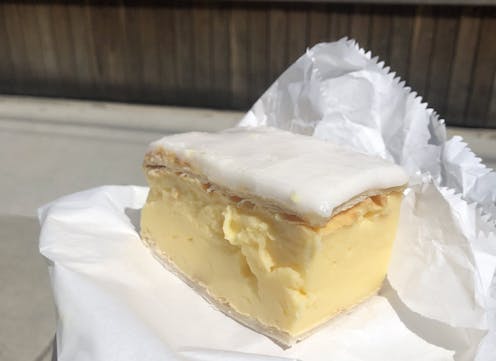
In 1998, Victorian premier Jeff Kennett visited a town in regional Victoria and said he had discovered, in his opinion, the best vanilla slice in Australia at the local bakery. He was so inspired by his slice experience that he established a new competition to determine, conclusively, Australia’s best vanilla slice. The inaugural “Great Australian Vanilla Slice Triumph” was held in Ouyen, Victoria on October 23 that year.
Kennett’s press release promoting the event declared this “important Australian culinary delicacy has tantalised Australians since white settlement” and “the pursuit of the best vanilla slice and the best vanilla slice baker in Australia should be of great national interest”.
The competition became an annual event, hosted at Ouyen until 2001, when the honour was passed to nearby Merbein and has continued.
After some COVID-related cancellations, the contest was on again in 2023. Judges advise entrants on the Triumph website that they are looking for “a custard with a creamy smooth texture and a balance of vanilla taste with a crisp crunchy pastry topped with a smooth and shiny glaze fondant”. North End Bakehouse in Shepparton, Victoria took first place this year, fulfilling baker Matt Aylett’s career-long quest for top honours.
Proclaimed as a national icon, the vanilla slice is a familiar sight in Australian bakeries – but where did this pastry come from?
Slices from around the world
Across Europe and the United States there are many versions of the vanilla slice, with the earliest mention found in a 1651 French cookbook as a gateau with frangipane.
The French version is called a mille-feuille, translated as “one thousand leaves” of pastry created by repeatedly folding a thin sheet of butter wrapped inside a dough covering. In the oven, the butter melts and its water content creates steam, separating the dough to make countless crunchy layers.
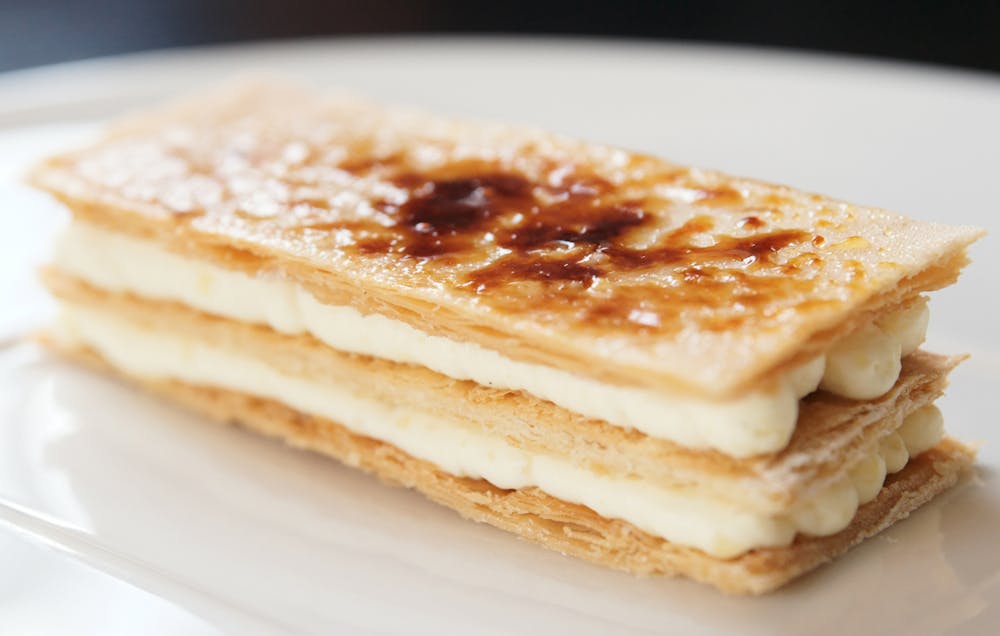
Unlike the Aussie slice with its thick layer of custard, the mille-feuille has three sheets of puff pastry and only a centimetre of crème pâtissière in between.
In America, the same three-layer design is called a Napoleon, a corruption of Napoletana, referencing the origin of another version from Naples.
In Poland, there is the kremowka; in the Netherlands, the tompouce; in Serbia, the krempita; in Croatia the kremšnite; and then the caramel-covered version, the Hungarian Szegedinertorte.
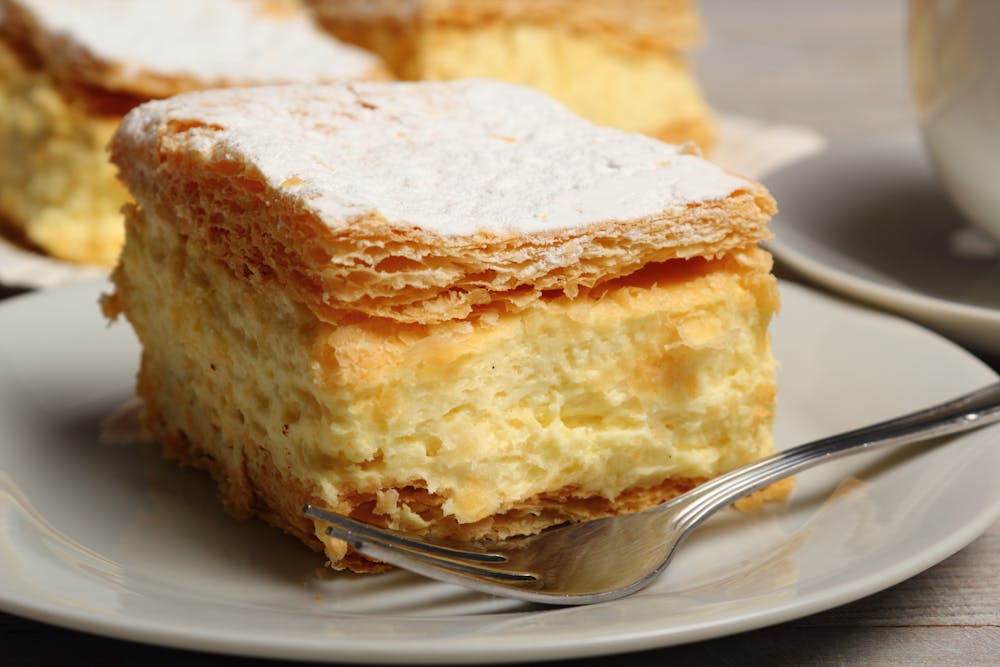 In Poland, you can have a kremowka.
Shutterstock
In Poland, you can have a kremowka.
Shutterstock
With similar versions across the globe, it is impossible to trace the genealogy of the Australian treat, but the combination of crunch and cream clearly has universal appeal.
A rose by any other name
Replacing the plain English name (vanilla slice, custard block) with an irreverent and outrageous moniker (“snot block” or “phlegm sandwich”) is standard practice in Australia, where informality and a lack of pretence are hallmarks of the vernacular.
The Macquarie Dictionary blog suggests that “snot block” is a regionalism that originated in central Victoria, with less frequently cited variants in other states, including “snot brick”, “phlegm cake” and “pus pie”.
Has the original delicate nature of the pastry followed the slide into slang from the French mille-feuille to snot block? The slice has grown in size over time, now with so much filling it can be difficult to eat gracefully. Extra skill is also required of the baker, tasked with making a custard-filled tower with the structural stability to stand on its own.
The baker’s slice?
Consulting the archives of Australian Women’s Weekly provided tips and tricks offered to help home bakers “make your custard set”.
For a dainty portion, with an extra layer of puff pastry, this is not a challenge.
Traditional pastry cream is not expected to be sliced like a jelly – it is a filling for cream puffs and eclairs.
The taller the slice, however, the more thickening power is required, usually in the form of cornstarch, gelatine or pudding mix. This is a delicate balancing act, however, as too much thickener produces a filling with the consistency of a bouncy ball, and too little will result in an uncontrollable blob.
 So Aussie they can even be decorated for your footy team.
AAP Image/Morgan Sette
So Aussie they can even be decorated for your footy team.
AAP Image/Morgan Sette
Cooking the custard just enough to maximise the thickening power of the cornstarch but not scramble the eggs is also a tricky business, requiring either a keen eye or a thermometer and constant supervision.
This may account for the staying power of the vanilla slice in the bakery, especially in its new high-rise evolution. Only the most daring of home cooks would tackle such a temperamental recipe, only to have guests say “Oh, you made snot block!”
Imported from Europe, the vanilla slice has been fully assimilated into Australian food culture, an identifiable icon. A sure measure of its acceptance as a genuine element of Aussie culture is its unpretentious alias – snot block. You know you really belong when you finally get a nickname.
Read more: A rose in every cheek: 100 years of Vegemite, the wartime spread that became an Aussie icon


