

When you sit down to build a sandcastle, take a look around you: the beach is already sculpting
- Written by The Conversation
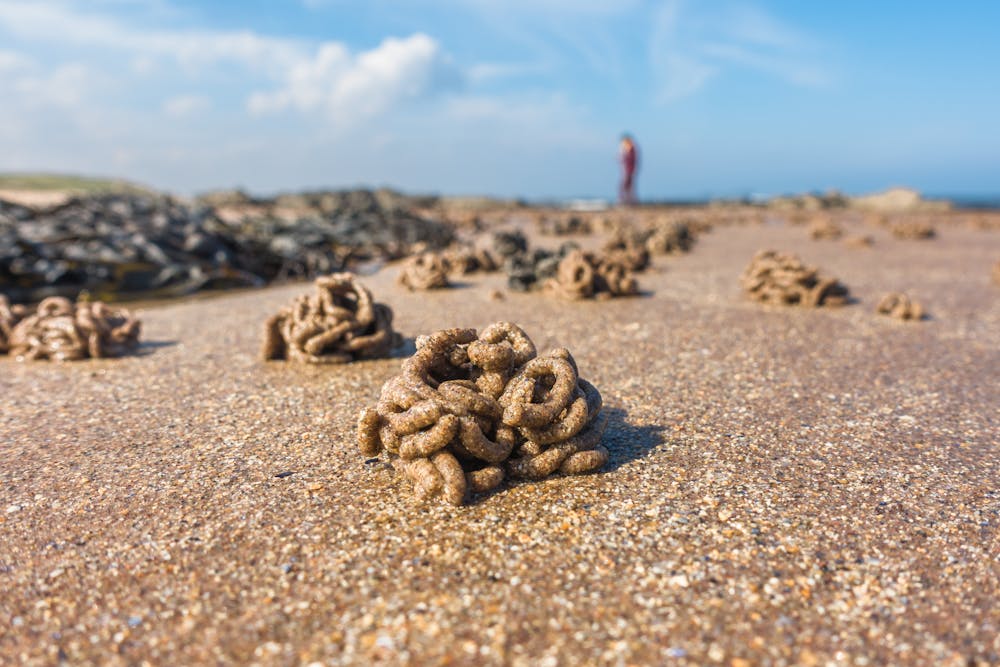
Arenicola, or lugworms, make some of the most beautiful structures on the beach. Little piles of wet sand are cast in a swirl from their rear end as part of their feeding cycle.
They are but one of an untold number of other participants in the constant evolution of forms at our water’s edge. Co-contributors include the wind, birds, rain, foliage, foot traffic and detritus, all shaping sand and associated debris into mini peaks and troughs, lines, blobs and tracks.
The forming of grains into what we commonly call a sandcastle on the other hand, speaks to a particularly human intentionality. Centred around the activity of building, these edifices rise and fall through a wild negotiation of the intent of a person and the intent of the materials they work with.
This dynamic and fickle nature of the granular shells, quartz, coral, glass and rock is perhaps its greatest appeal. Accrued since childhood, our knowledge of sand’s properties sits deep within our personal sculptural memory.
In collaboration with the beach
Building a sandcastle is a response to the full beach environment as a collaborator. We attune ourselves to the quality of the sand, marvel at the comings and goings of the water and orient our construction for the wind’s abrasive blast.
We are vigilant to dogs’ unintended mark making, and backward running ball catchers who involuntarily progress our work from castle to ruin. Moulds that reproduce their internal structure can be the age-old bucket, or the form can be loosened up using towels, sandals, buckets or a friend’s back … and perhaps said friend can be embedded in the structure if required.
We can include tunnels (that will sadly collapse) and moats and complete our work with a final (for me) infuriating flourish of seaweed and sticks.
No one methodology will explain to the uninitiated how to undertake the making of a sandcastle, and this is how it should be. Adopting an attentive mindset can open the possibilities for this immersive and bodily task.
Attending to sand
Particular qualities of sand can be revealed to those who remain aware. Building a sandcastle on a day after the rain can change the material and the way it presents.
Rain falling from the sky onto fine sand creates a crispy layer over the drier sand below. It is the crunchy feeling underfoot for those daily pioneers to the beach who arrive before these fragile structures are trampled underfoot. Rain creates a crust that would be difficult to produce any other way.
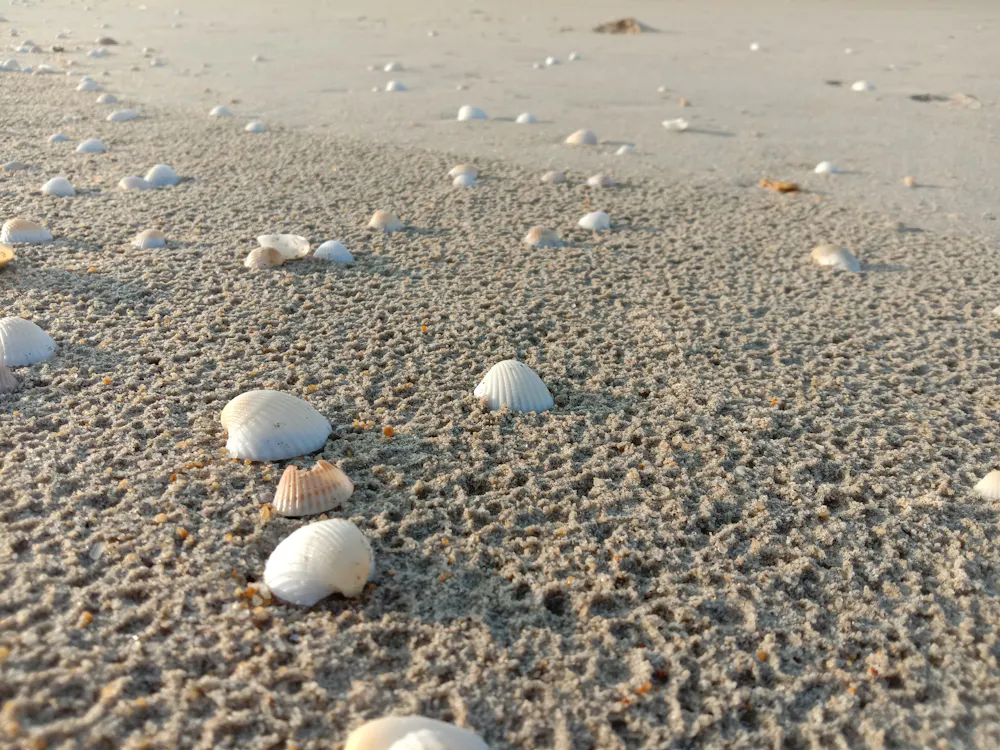 Rain creates a crust that would be difficult to produce any other way.
Shutterstock
Rain creates a crust that would be difficult to produce any other way.
Shutterstock
This and other states of sand could be considered on a continuum of material behaviours, from dry to wet, from dispersed to grouped, from fine to coarse, from quartz, through skeleton, to shell, or from a Newtonian to a non-Newtonian fluid.
In construction there is sharp sand, fat sand and sand of specific dimensions. The sand at the beach is the sand of that beach, undifferentiated by industrial ecologies and taken at its face value. Sluggish waterlogged mass, or blow away dust structure, compact sand, beige, black or grey – its specific qualities determining the outcome as much as the plan we bring to the task.
Working against collapse
Making objects with sand at the beach is a most egalitarian form of art making. Critiques of our constructions are generally of the generous kind. Passersby will applaud the magnitude of our creation, share in the joy as water fills our castle’s moats, and laugh shamelessly when the whole structure collapses.
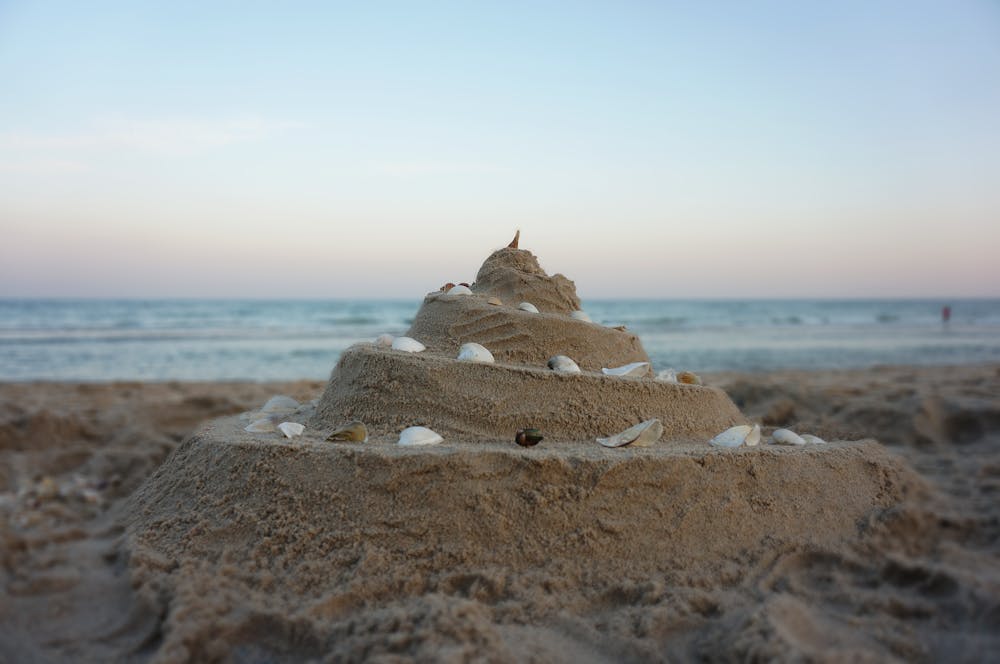 Making objects with sand at the beach is a most egalitarian form of art making.
Shutterstock
Making objects with sand at the beach is a most egalitarian form of art making.
Shutterstock
Sand workers on the beach can adopt a critical position relative to the way the sand acts and be mesmerised by its characteristics as these present themselves. We can understand that sand slumps in a particular way, and compact it in anticipation. Or we can simply burrow furiously as it falls off in great slabs. Each reflects the personal attitude of the builder; neither is better than the other.
Seagrass, kelp, stones, glass and the egg sacs of moon snails may all present themselves for inclusion in a sandcastle. Driftwood will break through hard sand, create moats, or delineate space; large shells make excellent tools for moving bulk material, although using the body for scooping and compacting, or shoving and dragging, is perhaps the ideal way to engage the senses in the job. Collapse is the thing you work against.
Digging down and water begins to pool, piling the sand high and your castle begins to emerge.
Read more: How to get the most out of sand play: 4 tips from a sculptor


