

Vale 'sister suffragette': how Glynis Johns became a pop-culture icon in the story of votes for women
- Written by The Conversation
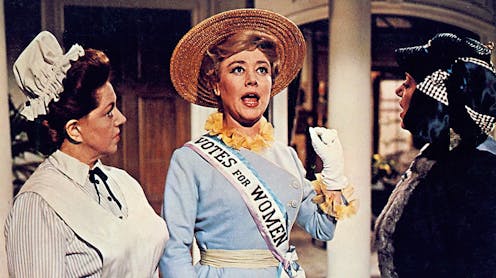
Glynis Johns, most famous for her role as the suffragette mother Mrs Winifred Banks in Disney’s Mary Poppins (1964), passed away last week at the age of 100.
A fourth-generation performer who made her stage debut in London when she was only three weeks old, Johns inherited her Welsh father’s love of acting. She appeared with him in The Halfway House (1944) and The Sundowners (1960) and argued for the establishment of a Welsh National Theatre as early as 1971.
Johns’s career spanned eight decades in Hollywood, Broadway and the British stage and screen. As Palm Springs’s Desert Sun reported in 1962, her “husky voice and big blue eyes” were her hallmarks. But it was her portrayal of Mrs Banks in Mary Poppins which would make her a pop culture icon.
A childhood inspiration
Feminist activists and scholars often describe the Mrs Banks character as a childhood inspiration.
As feminist communications scholar Amanda Firestone reflects on the film:
I especially loved […] Mrs Banks (Glynis Johns), who marches around the family home, putting Votes for Women sashes onto the housekeeper, cook, and the (departing) nanny. Of course, as a kid, I had no idea that the people and events embedded in the song’s lyrics were actual parts of history, but I did find a kind of joy in a vague notion of women’s empowerment.
Set in 1910, the symbolism associated with Mrs Banks references the history of the British suffragettes. Johns’ musical showstopper, Sister Suffragette, directly refers to Emmeline Pankhurst, who founded the militant Women’s Social and Political Union in 1903. In 1906 British newspapers coined the moniker “suffragette” to mock the union.
This ambivalence continued into the 1960s. Historian Laura E. Nym Mayhall argues that American concern over the impact of women’s public roles on their domestic responsibilities influenced the film’s depiction of Mrs Banks, especially her movement from a public suffragette back into an involved mother at the film’s end.
For Mayhall, the figure of the suffragette emerges in popular culture as “a symbol of modernity”: a harbinger of democracy and political progress whose characterisation would elide ongoing struggles such as the civil rights movement.
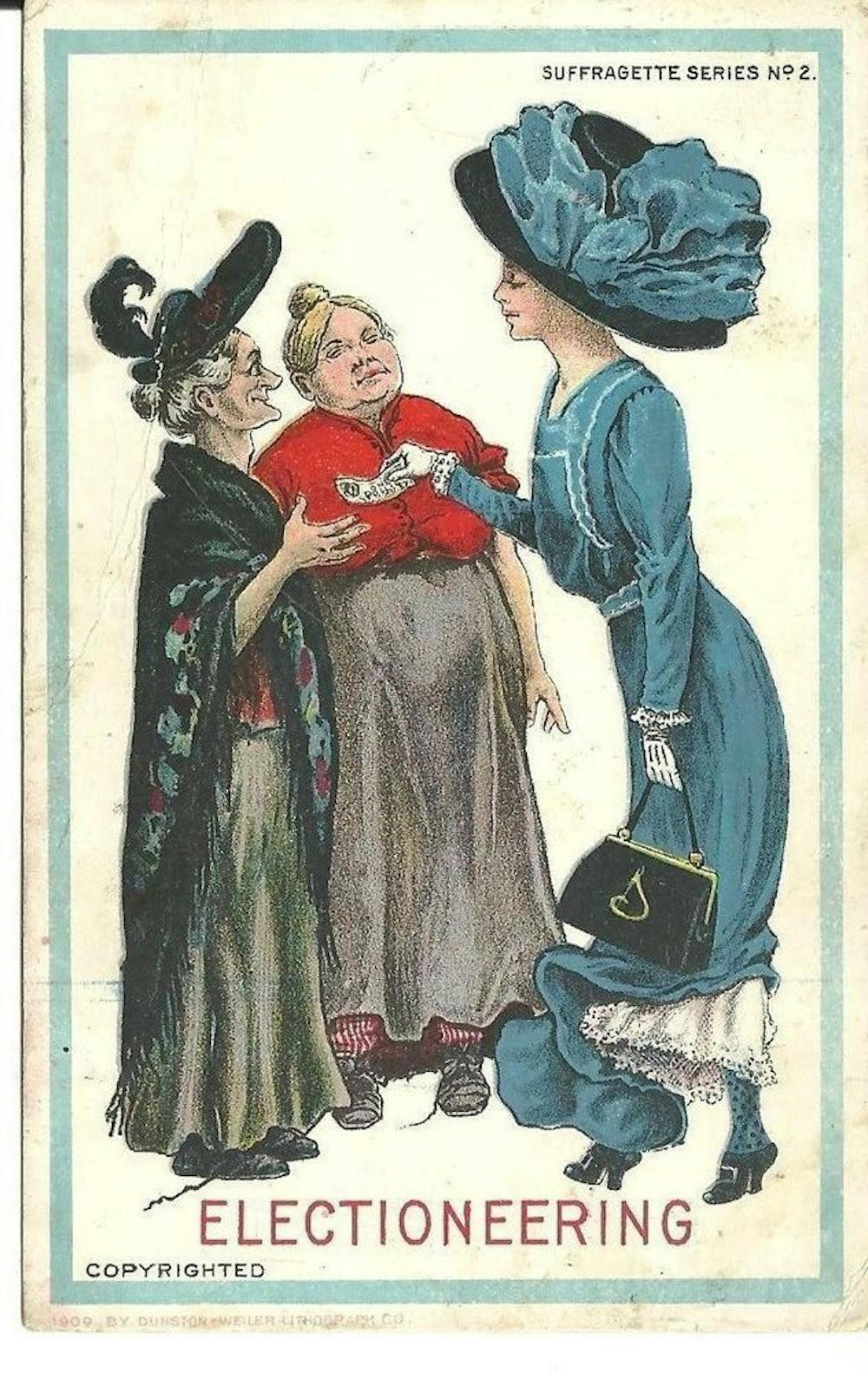
While some see the character of the suffragette mother as supporting women’s votes during the 1910s and women’s liberation during the 1960s, other readings of the film suggest a more satirical representation of the suffrage movement. Some historians even find resonances of anti-suffrage propaganda in Mrs Banks, including in her usage of her Votes for Women sash as the tail of a kite in the film’s final scene.
Looking back at film reviews offers insight into how audiences received this character – and, by extension, Johns as an actor. American studies scholar Lori Kenschaft suggests that film critics who saw Mrs Banks as a “nutty suffragette mother” reiterated popular stereotypes about suffragettes and feminists being “mentally unbalanced”.
Such stereotypes may have been reinforced by the film’s depiction of motherhood and the nuclear family. Involved parenting emerged as the bedrock of the 1960s nuclear family, an idea both supported and actively promoted by Walt Disney in both his films and his theme parks, as argued by American musicologist William A. Everett.
As Mrs Banks, Johns embodied the transition from the distant, uninvolved parenting of the British middle-class in the earlier 20th century to the involved mother who facilitated the stable nuclear family. As women’s studies scholar Anne McLeer argues, Mary Poppins, through Johns’ portrayal of Mrs Banks, demonstrated the liberated woman of the 1960s could be contained within the nuclear family: the bedrock for a Western capitalist economy.
Read more: Will the new Mary Poppins film acknowledge the suffragettes' success?
A long career
Beyond Mary Poppins, her most prominent role was in Stephen Sondheim’s Broadway musical A Little Night Music (1973).
Johns originated the character of ageing actress Desiree Armfeldt, becoming the first to sing Send in the Clowns. As she reflected of the classic in 1991:
It’s still part of me. And when you’ve got a song like Send in the Clowns, it’s timeless.
Sondheim composed this song with Johns’s famously husky voice in mind. Yet some were less enamoured with her performance. One 1973 theatre critic described Johns as “a now somewhat overage tomboy, kittenish and raspy-voiced, precise and amusing in her delivery of lines but utterly, utterly unseductive.”
A veteran of stage and screen, Johns appeared in more than 60 films and 30 plays. In 1998, she was honoured with a Disney Legends Award for her role as Mrs Banks. Johns also received critical acclaim throughout her career, including a Laurel Award for Mary Poppins and a Tony Award and Drama Desk Award for A Little Night Music.
Regardless of how incongruous her status as a “Disney feminist icon” may be, Johns’s extraordinary influence upon the 20th century’s cultural memory is a remarkable legacy.
Read more: Here's to the ladies who lunch: one of Sondheim's greatest achievements was writing complex women


