

Our ancient primate ancestors had an appetite for soft fruits – and their diet shaped human evolution
- Written by The Conversation
The diet of early anthropoids – the ancestors of apes and monkeys – has long been debated. Did these early primates display behaviours and diets similar to modern species, or did they have much humbler beginnings?
Research on early anthropoids has often suggested a diet high in soft fruits. But some species seem to have had a more varied diet, containing harder foods such as seeds and nuts.
Our latest research reveals a different story, one that highlights the dominant role of soft fruits. This likely encompassed various types that were ripe and high in sugar, as evidenced by the presence of tooth decay in some individuals.
This has important implications for understanding how our earliest ancestors adapted and evolved.
Tracking anthropoid evolution
When discussing the primate family tree, it is crucial to address the common confusion arising from the everyday use of terms such as “ape” and “monkey”.
Humans, for instance, are typically excluded from the ape category, and apes are not generally considered monkeys. Yet humans are nested within the ape family tree, which in turn is nested within the broader monkey group, however this is defined.
Read more: Revelations from 17-million-year-old ape teeth could lead to new insights on early human evolution
All of these primates (humans, apes, and monkeys) are collectively called anthropoids, and we all share a common anthropoid ancestor that lived around 40 million years ago.
Genetic and molecular studies, along with fossil evidence, indicate the period from 40 to 25 million years ago was a critical phase for the evolution and spread of anthropoid primates.
The early portion of this period marks when Afro-Eurasian monkeys and apes (Catarrhini) diverged from monkeys native to the Americas (Platyrrhini). The latter part of this period witnessed further divergence between Afro-Eurasian monkeys (Cercopithecoidea) and apes (Hominoidea).
Fossils of our earliest ancestors
The Fayum Depression in the Western Desert of Egypt offers one of the largest and best-preserved collections of fossil primates from this time frame. Between 35 and 29.2 million years ago (when the fossils used in this study were deposited), the Fayum sat on the lush northern coast of Africa.
The terrestrial rocks of the Fayum preserve the remnants of ecosystems that laid the groundwork for Africa’s modern biodiversity. They also capture a pivotal window in primate evolution.
Several of the anthropoid primates from the site may represent either the direct ancestors of all (or some) living anthropoids. Or they were close relatives of this common ancestor.
Fossils of these early anthropoids are relatively abundant in the Fayum, with some species known from dozens of partial skulls and jaws. Because of this, the Fayum offers a fascinating glimpse into the behaviour and life of our early ancestors.
Dietary interpretations
Dental evidence is a powerful tool in palaeontology. Our new study examined dental wear and disease in fossilised teeth from five Fayum anthropoid primates: Aegyptopithecus, Parapithecus, Propliopithecus, Apidium and Catopithecus.
We focused on tooth chipping patterns and dental caries (also known as cavities), key indicators in fossils of dietary habits.
Our findings indicate a predominantly soft fruit diet in early anthropoids, different to some earlier research suggesting a more varied diet, including hard foods.
Read more: Human ancestors had the same dental problems as us – even without fizzy drinks and sweets
A mere 5% of teeth show chipping (minor enamel fractures). This is substantially lower than the frequency observed in most modern anthropoids, where chipping frequencies range from 4% to 40% of teeth.
Additionally, the presence of dental caries, notably in Propliopithecidae (the extinct primate family that includes Aegyptopithecus and Propliopithecus), is consistent with the regular consumption of soft, sugary fruits.
This research also lends support to previous studies suggesting an arboreal (tree-living) lifestyle for early anthropoids. Terrestrial primates often exhibit higher chipping prevalence due to more varied diets and accidental grit consumption when feeding on the ground, none of which was evident in our findings.
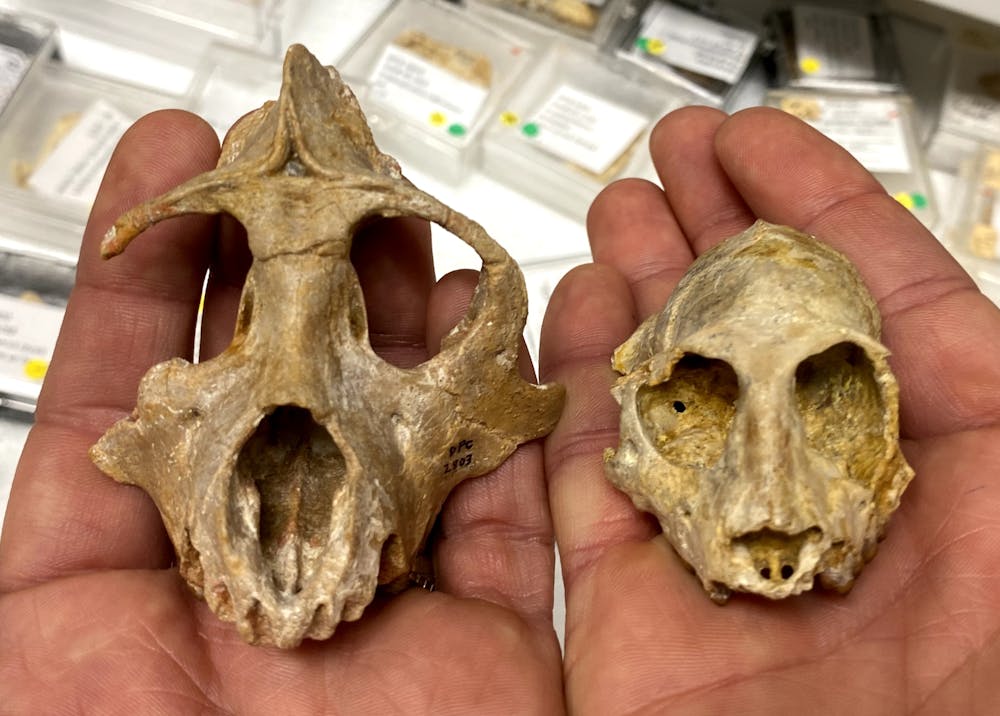
 Skulls of Aegyptopithecus and fossilised Epipremnum fruit from the Fayum Depression in Egypt.
Matt Borths, Author provided (no reuse)
Skulls of Aegyptopithecus and fossilised Epipremnum fruit from the Fayum Depression in Egypt.
Matt Borths, Author provided (no reuse)
Adaptation and evolution
The preference for soft fruits likely had significant impacts on exploration of ecological niches, and even in the development of eyesight in anthropoid primates. This includes colour vision that likely evolved as a need for finding ripe fruit among the foliage.
It would have also influenced the shape of their teeth, social behaviours and foraging strategies, setting the stage for an adaptive radiation, leading to the global spread and diversification of monkeys and apes.
This rapid evolution of diverse species from humble anthropoid beginnings was likely in response to new ecological opportunities opening up.
Other primates more distantly related to us, in the primate suborder Strepsirrhini, which includes lemurs and lorises, split off from the ancestors of anthropoids millions of years earlier.
Unlike anthropoids, Strepsirrhini show a large variation in diet during the same time interval. The diets of fossil lemurs and lorises likely consisted of hard and tough foods, insects, gum, leaves and fruits.
In contrast, our own ancestors took a long time to move away from a diet based on soft fruits. Our journey into the past to unravel the lives of our ancestors continues, with each fossil adding a new piece to the puzzle of early primate evolution.


