

Scientists shocked to discover new species of green anaconda, the world’s biggest snake
- Written by The Conversation
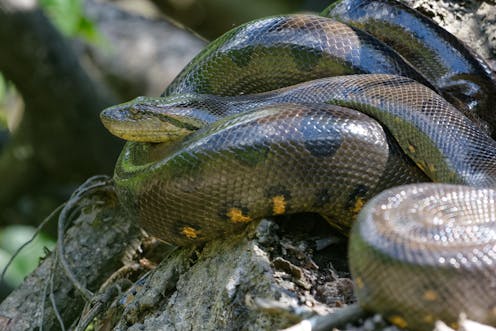
The green anaconda has long been considered one of the Amazon’s most formidable and mysterious animals. Our new research upends scientific understanding of this magnificent creature, revealing it is actually two genetically different species. The surprising finding opens a new chapter in conservation of this top jungle predator.
Green anacondas are the world’s heaviest snakes, and among the longest. Predominantly found in rivers and wetlands in South America, they are renowned for their lightning speed and ability to asphyxiate huge prey then swallow them whole.
My colleagues and I were shocked to discover significant genetic differences between the two anaconda species. Given the reptile is such a large vertebrate, it’s remarkable this difference has slipped under the radar until now.
Conservation strategies for green anacondas must now be reassessed, to help each unique species cope with threats such as climate change, habitat degradation and pollution. The findings also show the urgent need to better understand the diversity of Earth’s animal and plant species before it’s too late.
An impressive apex predator
Historically, four anaconda species have been recognised, including green anacondas (also known as giant anacondas).
Green anacondas are true behemoths of the reptile world. The largest females can grow to more than seven metres long and weigh more than 250 kilograms.
The snakes are well-adapted to a life lived mostly in water. Their nostrils and eyes are on top of their head, so they can see and breathe while the rest of their body is submerged. Anacondas are olive-coloured with large black spots, enabling them to blend in with their surroundings.
The snakes inhabit the lush, intricate waterways of South America’s Amazon and Orinoco basins. They are known for their stealth, patience and surprising agility. The buoyancy of the water supports the animal’s substantial bulk and enables it to move easily and leap out to ambush prey as large as capybaras (giant rodents), caimans (reptiles from the alligator family) and deer.
Green anacondas are not venomous. Instead they take down prey using their large, flexible jaws then crush it with their strong bodies, before swallowing it.
As apex predators, green anacondas are vital to maintaining balance in their ecosystems. This role extends beyond their hunting. Their very presence alters the behaviour of a wide range of other species, influencing where and how they forage, breed and migrate.
Anacondas are highly sensitive to environmental change. Healthy anaconda populations indicate vibrant ecosystems, with ample food resources and clean water. Declining anaconda numbers may be harbingers of environmental distress. So knowing which anaconda species exist, and monitoring their numbers, is crucial.
To date, there has been little research into genetic differences between anaconda species. Our research aimed to close that knowledge gap.
Read more: Stop killing brown snakes – they could be a farmer's best friend
Untangling anaconda genes
We studied representative samples from all anaconda species throughout their distribution, across nine countries.
Our project spanned almost 20 years. Crucial pieces of the puzzle came from samples we collected on a 2022 expedition to the Bameno region of Baihuaeri Waorani Territory in the Ecuadorian Amazon. We took this trip at the invitation of, and in collaboration with, Waorani leader Penti Baihua. Actor Will Smith also joined the expedition, as part of a series he is filming for National Geographic.
We surveyed anacondas from various locations throughout their ranges in South America. Conditions were difficult. We paddled up muddy rivers and slogged through swamps. The heat was relentless and swarms of insects were omnipresent.
We collected data such as habitat type and location, and rainfall patterns. We also collected tissue and/or blood from each specimen and analysed them back in the lab. This revealed the green anaconda, formerly believed to be a single species, is actually two genetically distinct species.
The first is the known species, Eunectes murinus, which lives in Perú, Bolivia, French Guiana and Brazil. We have given it the common name “southern green anaconda”. The second, newly identified species is Eunectes akayima or “northern green anaconda”, which is found in Ecuador, Colombia, Venezuela, Trinidad, Guyana, Suriname and French Guiana.
We also identified the period in time where the green anaconda diverged into two species: almost 10 million years ago.
The two species of green anaconda look almost identical, and no obvious geographical barrier exists to separate them. But their level of genetic divergence – 5.5% – is staggering. By comparison, the genetic difference between humans and apes is about 2%.
Preserving the web of life
Our research has peeled back a layer of the mystery surrounding green anacondas. This discovery has significant implications for the conservation of these species – particularly for the newly identified northern green anaconda.
Until now, the two species have been managed as a single entity. But each may have different ecological niches and ranges, and face different threats.
Tailored conservation strategies must be devised to safeguard the future of both species. This may include new legal protections and initiatives to protect habitat. It may also involve measures to mitigate the harm caused by climate change, deforestation and pollution — such as devastating effects of oil spills on aquatic habitats.
Our research is also a reminder of the complexities involved in biodiversity conservation. When species go unrecognised, they can slip through the cracks of conservation programs. By incorporating genetic taxonomy into conservation planning, we can better preserve Earth’s intricate web of life – both the species we know today, and those yet to be discovered.


