

What ended the ‘dark ages’ in the early universe? New Webb data just brought us closer to solving the mystery
- Written by The Conversation
About 400,000 years after the Big Bang, the cosmos was a very dark place. The glow of the universe’s explosive birth had cooled, and space was filled with dense gas – mostly hydrogen – with no sources of light.
Slowly, over hundreds of millions of years, the gas was drawn into clumps by gravity, and eventually the clumps grew big enough to ignite. These were the first stars.
At first their light didn’t travel far, as much of it was absorbed by a fog of hydrogen gas. However, as more and more stars formed, they produced enough light to burn away the fog by “reionising” the gas – creating the transparent universe dotted with brilliant points of light we see today.
But exactly which stars produced the light that ended the dark ages and triggered this so-called “epoch of reionisation”? In research published in Nature, we used a gigantic cluster of galaxies as a magnifying glass to gaze at faint relics of this time – and discovered that stars in small, faint dwarf galaxies were likely responsible for this cosmic-scale transformation.
What ended the dark ages?
Most astronomers already agreed that galaxies were the main force in reionising the universe, but it wasn’t clear how they did it. We know that stars in galaxies should make a lot of ionising photons, but these photons need to escape the dust and gas inside their own galaxy to ionise hydrogen out in the space between galaxies.
It hasn’t been clear what kind of galaxies would be able to produce and emit enough photons to get the job done. (And indeed, there are those who think more exotic objects like big black holes may have been responsible.)
Read more: Looking back toward cosmic dawn − astronomers confirm the faintest galaxy ever seen
There are two camps among adherents of the galaxy theory.
The first thinks huge, massive galaxies produced the ionising photons. There were not many of these galaxies in the early universe, but each one produced a lot of light. So if a certain fraction of that light managed to escape, it might have been enough to reionise the universe.
The second camp thinks we are better off ignoring the giant galaxies and focussing on the huge number of much smaller galaxies in the early universe. Each one of these would have produced far less ionising light, but with the weight of their numbers they could have driven the epoch of reionisation.
A magnifying glass 4 million lightyears wide
Trying to look at anything in the early universe is very hard. The massive galaxies are rare, so they are hard to find. Smaller galaxies are more common but they are very faint, which makes it difficult (and expensive) to get high-quality data.
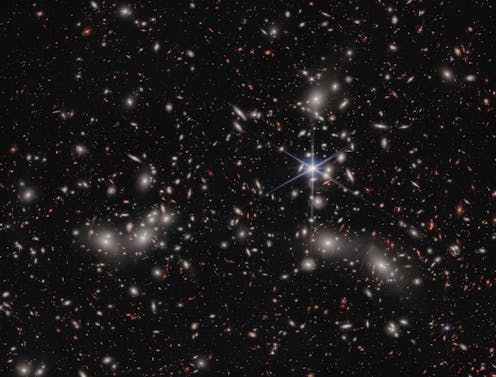
We wanted a look at some of the faintest galaxies around, so we used a huge group of galaxies called Pandora’s Cluster as a magnifying glass. The enormous mass of the cluster distorts space and time, amplifying the light from objects behind it.

As part of the UNCOVER program, we used the James Webb Space Telescope to look at magnified infrared images of faint galaxies behind Pandora’s Cluster.
We first looked at many different galaxies, then chose a few particularly distant (and therefore ancient) ones to examine more closely. (This kind of close examination is expensive, so we could only look at eight galaxies in greater detail.)
The bright glow of hydrogen
We selected some sources which were around 0.5% of the brightness of our Milky Way galaxy at that time, and checked them for the telltale glow of ionised hydrogen. These galaxies are so faint they were only visible at all thanks to the magnifying effect of Pandora’s Cluster.
Our observations confirmed that these small galaxies did exist in the very early universe. What’s more, we confirmed they produced around four times as much ionising light as we would consider “normal”. This is at the highest end of what we had predicted, based on our understanding of how early stars formed.
Because these galaxies produced so much ionising light, only a small fraction of it would have needed to escape to reionise the universe.
Read more: Unlocking the mystery of the first billion years of the universe
Previously, we had thought that around 20% of all ionising photons would need to escape from these smaller galaxies if they are to be the dominant contributor to reionisation. Our new data suggests even 5% would be sufficient – which is about the fraction of ionising photons we see escaping from modern galaxies.
So now we can confidently say these smaller galaxies could have played a very large role in the epoch of reionisation. However, our study was only based on eight galaxies, all close to a single line of sight. To confirm our results we will need to look at different parts of the sky.
We have new observations planned which will target other large galaxy clusters elsewhere in the universe, to find yet more magnified, faint galaxies to test. If all goes well, we will have some answers in a few years.


.jpeg)