

We studied two decades of queer representation on Australian TV, and found some interesting trends
- Written by The Conversation
Television is experiencing a boom of queer representation, and Australian series are no exception. Our new study reveals how trends in lesbian, gay, bisexual, transgender and nonbinary (gender and sexually diverse) scripted stories have developed onscreen over the 2000s and 2010s.
In the 1970s and ‘80s, Australia was considered relatively radical in its representations of gender and sexually diverse people. We’re credited with the first positive portrayal of a gay man, Don Finlayson (Joe Hasham), in the soap opera Number 96 (1972–77).
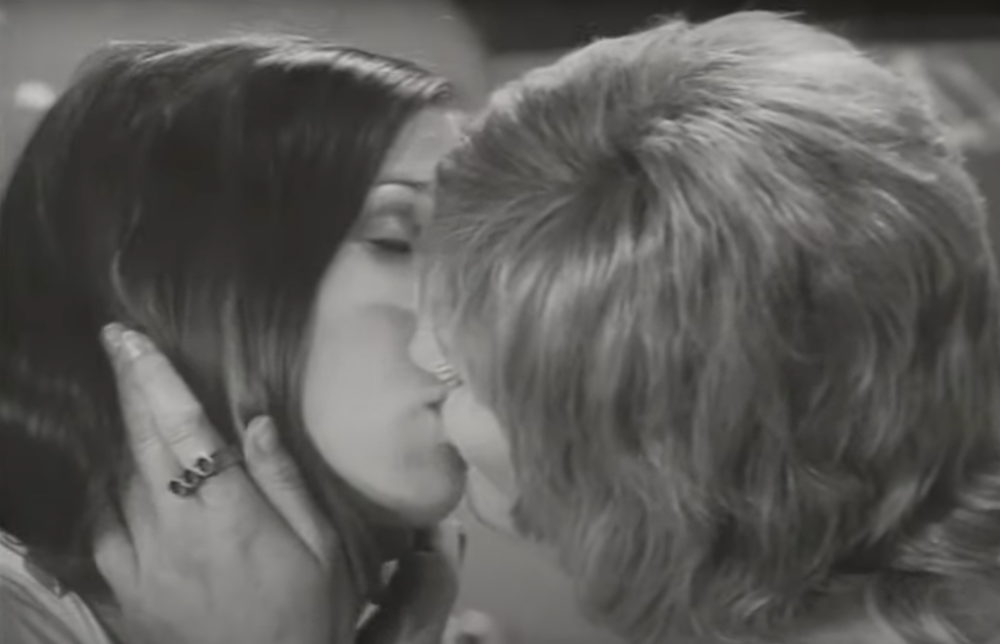
We also portrayed the first lesbian kiss, between Vicki Stafford (Judy Nunn) and Felicity Baker (Helen Hemingway) in the pilot episode of The Box (1974–77), two weeks before the UK’s first televised lesbian kiss.
By the 1990s, queer character appearances shifted to predominantly once-off stories in medical and crime dramas. But things have changed substantially since then.
Gay and bisexual men
Between 2000 and 2019, Australian-scripted television represented gay men more regularly than bisexual men. Specifically, our research found 44 series featuring gay men and only three featuring bisexual men.
Similar to trends in US television throughout the 2000s, many of these examples focused on characters “coming out” as gay – a popular storytelling device.
While bisexual coming-out narratives were rare, one notable exception was the character Sammy Lieberman (Thom Green) in Dance Academy (2010–13), who rejects labels others try to put on him.
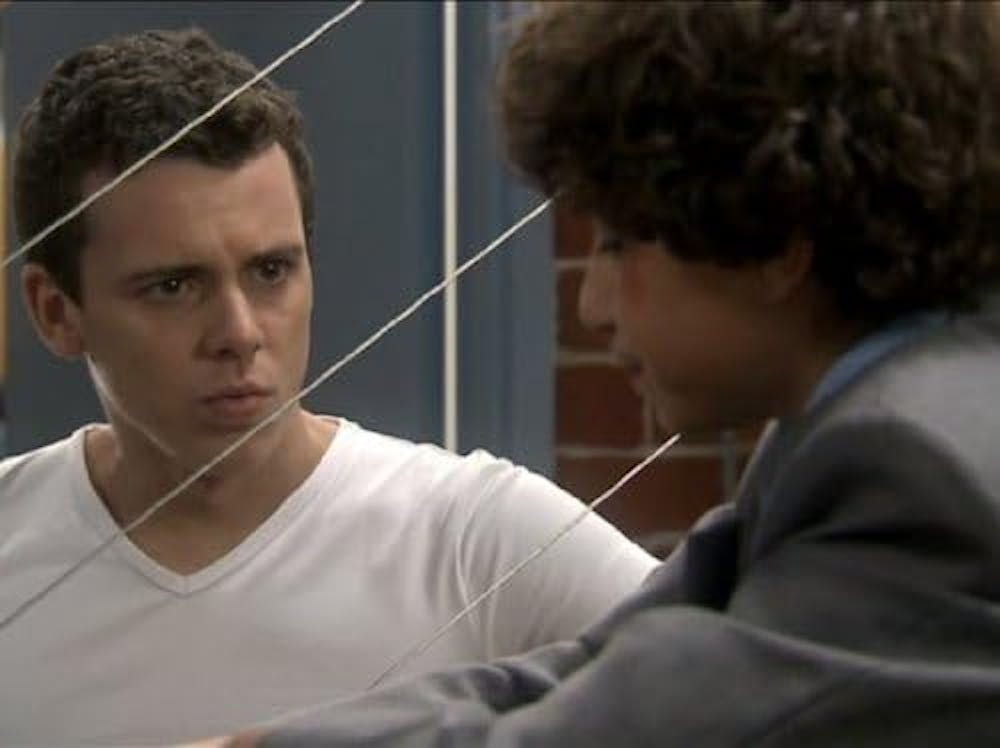 Sammy Lieberman in ABC’s Dance Academy came out as bisexual.
IMDB
Sammy Lieberman in ABC’s Dance Academy came out as bisexual.
IMDB
Although we found a prominence of coming-out narratives, we also saw an increase in already out characters. Previously, gay and bisexual men were commonly written into one-off storylines in which coming out seemed like the only available narrative. Now they’re often shown with complex lives and other sources of drama.
The avoidance of gay intimacy onscreen remains prominent; we noted a tendency to use camera movements and cuts to avoid showing gay sex scenes. But some series are pushing these boundaries. For instance, season three of Please Like Me included a meaningful and critically acclaimed sex scene between Josh (Josh Thomas) and Arnold (Keegan Joyce).
Read more: With Moonlight's Oscar win, Hollywood begins to right old wrongs
Lesbian and bisexual women
While there is a significant number of lesbian and bisexual women in Australian scripted television, they appear in fewer series overall compared with gay and bisexual men. Of a total 38 series, we found 32 with lesbians and 15 with bisexual women. Nine of the series included both.
Trends for lesbian and bisexual women often focus on characters who are assured of their sexuality, or who engage in temporary exploration as a “passing phase”. Coming-out narratives are rare for these women.
For example, Charlie Buckton (Esther Anderson) in Home and Away (1988–) temporarily explores attraction to out lesbian Joey Collins (Kate Bell). The relationship isn’t mentioned again after Joey is written out and Charlie returns to dating men.
Alongside this theme of temporary attraction is a troubling trend of unnamed bisexuality, wherein we identified bisexual women, but the bisexuality wasn’t clearly named.
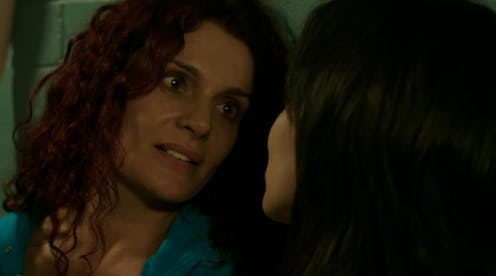
That said, we do note instances where this is due to a resistance to labels. As Bridget (Libby Tanner) tells Bea (Danielle Cormack) in Wentworth (2013–21): “Fuck the labels.”
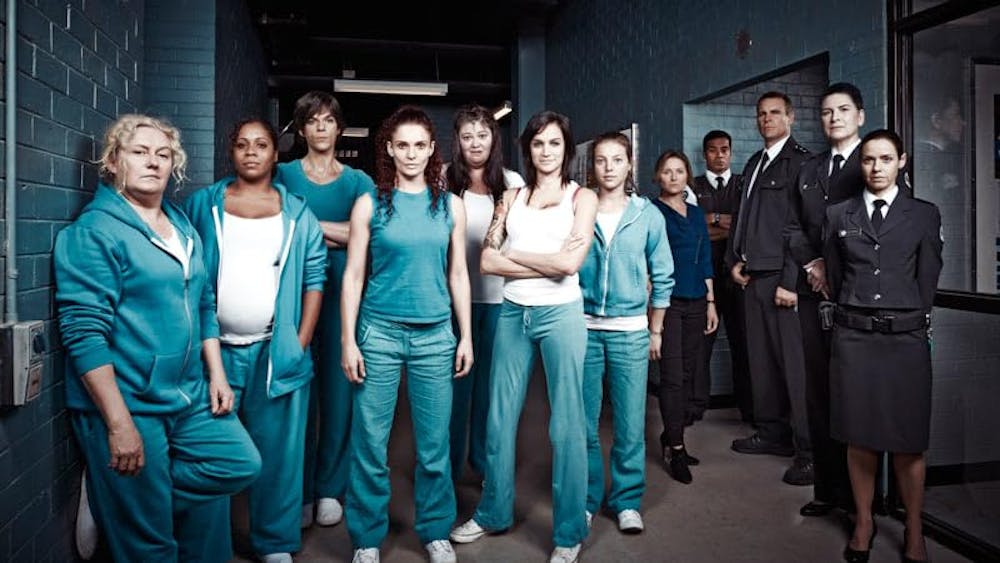 Prison drama Wentworth had several lesbian and bisexual woman characters.
IMDB
Prison drama Wentworth had several lesbian and bisexual woman characters.
IMDB
There are also several examples of lesbian and bisexual women raising families. In 2003, a two-part episode of Blue Heelers (1994–2006) focuses on a custody dispute between a lesbian couple and their sperm donor. These stories often incorporate themes of same-sex IVF and adoption, reflecting legal changes in Australia throughout the decades.
However, in All Saints (1998–2009), Charlotte Beaumont (Tammy Macintosh) – who is originally written as a lesbian and later rewritten as bisexual – becomes pregnant after sleeping with a man.
Transgender and non-binary people
Until recently, and with rare exceptions, out gender-diverse characters have been largely invisible in Australian scripted television.
We found eight series with transgender women, three with transgender men, and one with a non-binary person. Within our study, only one of these characters appeared before 2010.
Most transgender storylines included some focus on self-identity, with the character either coming out or asserting their identity with others. Some stories also included romantic attraction, although almost all were in a heterosexual framing. One exception was Chris (Harvey Zielinski) in Starting From… Now (2014–16) – a trans man who is pansexual.
From 2018 onwards, all gender-diverse characters were portrayed by out actors who aligned with their identity. Before this, only Robyn Ross (Carlotta) in Number 96 and Chris in Starting From… Now were played by out transgender actors.
The emergence of queer story worlds
Australian scripted television has moved away from representing solitary gay or lesbian figures, and towards more inclusive representations that portray queer characters belonging to a shared community. We found increasing instances of these characters appearing in regular, recurring and one-off stories in the same series.
We also found an increase in series that are set in queer story worlds. Outland (2012) was the first Australian series to feature an entirely gay and lesbian ensemble of characters.
Similarly, Starting From… Now is a web series that follows a group of lesbian women living in Sydney’s Newtown. The final two seasons were picked up by SBS in 2016 and, along with Wentworth, contribute significantly to the number of lesbian and bisexual women appearing onscreen.
The queer story world has been featuring even more from 2020 onward, in particular through digital-first and pilot initiatives for talent from underrepresented communities. These initiatives are giving more opportunities to queer creatives, resulting in series such as Iggy & Ace 5eva (2021) and All My Friends Are Racist (2021).
The appearances of gender and sexually diverse stories in Australian television continue to change. We hope our research can provide a starting point for further analysis of these decades and those to come.


