

Vinegar and baking soda: a cleaning hack or just a bunch of fizz?
- Written by The Conversation
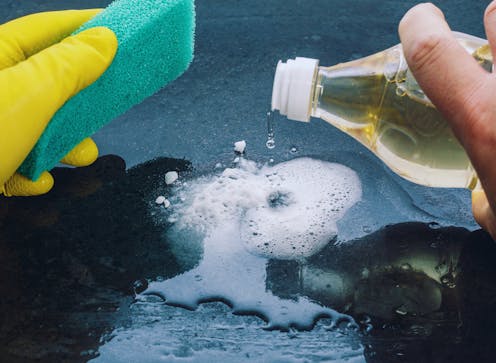
Vinegar and baking soda are staples in the kitchen. Many of us have combined them in childhood scientific experiments: think fizzy volcanoes and geysers.
But people also frequently mix vinegar and baking soda to produce a reportedly effective household cleaner. Unfortunately, the chemistry behind the bubbly reaction doesn’t support the cleaning hype. The fizzy action is essentially a visual “placebo”, formed by the combination of an acid and a base.
So, how does it work, and is it worth using these chemicals for cleaning? To understand all this, it helps to know a little more about chemistry.
What’s an acid?
Foods with a sour taste typically contain acids. These include citric acid in lemon juice, malic acid in apples, lactic acid in yoghurt and phosphoric acids in soft drinks. Most vinegars contain around 4–10% acetic acid, the rest is water and small amounts of flavour chemicals.
There are other naturally occurring acids, such as formic acid in ant bites and hydrochloric acid in our stomachs. Industrially, sulfuric acid is used in mineral processing, nitric acid for fertiliser manufacturing and the highly potent hydrofluoric acid is used to etch glass.
All of these acids share similar properties. They can all release hydrogen ions (positively charged atoms) into water. Depending on their potency, acids can also dissolve minerals and metals through various chemical reactions.
This is why vinegar is an excellent cleaner for showers or kettles – it can react with and dissolve mineral deposits like limescale.
Other common acidic cleaning ingredients are oxalic acid, used for revitalising timber decks, hydrochloric acid in concrete and masonry cleaners, and sulfamic acid in potent toilet cleaners.
What’s a base?
In chemistry, bases – the opposite of acids in many ways – can bind, rather than release hydrogen ions. This can help lift and dissolve insoluble grime into water. Bases can also break apart fat molecules.
Baking soda (also known as sodium hydrogen carbonate, sodium bicarbonate, or bicarb) is a relatively weak base. Stronger common bases include sodium carbonate (washing soda), sodium hydroxide (lye) and ammonia.
Sodium hydroxide is a potent drain cleaner – its strong base properties can dissolve fats and hair. This allows blockages to be broken down and easily flushed away.
Mixing a base and an acid
Mixing vinegar and baking soda causes an immediate chemical reaction. This reaction forms water, sodium acetate (a salt) and carbon dioxide – the fizzy part.
The amount of carbon dioxide gas that is produced from baking soda is remarkable – one tablespoon (around 18 grams) can release over five litres of gas! But only if you add enough acid.
Reactions in chemistry often use equal quantities of chemical reagents. A perfect balance of acetic acid and baking soda would give you just water, carbon dioxide and sodium acetate.
But the majority of vinegar and bicarb cleaner recipes use a large excess of one or the other components. An example from TikTok for a DIY oven cleaner calls for one and a half cups of baking soda and one quarter cup of vinegar.
Crunching the numbers behind the chemical reaction shows that after the fizz subsides, over 99% of the added baking soda remains. So the active cleaning agent here is actually the baking soda (and the “elbow grease” of scrubbing).
Ovens can be cleaned much more rigorously with stronger, sodium hydroxide based cleaners (although these are also more caustic). Many modern ovens also have a self-cleaning feature, so read your product manual before reaching for a chemical cleaner of any sort.
What about the sodium acetate?
Devotees of vinegar and baking soda mixtures might be wondering if the product of the fizzy reaction, sodium acetate, is the undercover cleaning agent.
Unfortunately, sodium acetate is an even weaker base than baking soda, so it doesn’t do much to clean the surface you’re trying to scrub.
Sodium acetate is used in crystallisation-based heating packs and as a concrete sealant, but not typically as a cleaner.
Fun fact: sodium acetate can be combined with acetic acid to make a crystalline food additive called sodium diacetate. These crystals give the vinegar flavour to salt and vinegar chips without making them soggy.
Sorry to burst your bubbles
There are a few rare cases where mixing vinegar and baking soda may be useful for cleaning. This is where the bubbling has a mechanical effect, such as in a blocked drain.
But in most cases you’ll want to use either vinegar or baking soda by itself, depending on what you’re trying to clean. It will be less visually exciting, but it should get the job done.
Lastly, remember that mixing cleaning chemicals at home can be risky. Always carefully read the product label and directions before engaging in DIY concoctions. And, to be extra sure, you can find out more safety information by reading the product’s safety data sheet.
Read more https://theconversation.com/vinegar-and-baking-soda-a-cleaning-hack-or-just-a-bunch-of-fizz-225177


