

Tennis anyone? Bad news for skiers as snow season could shrink by 78% this century
- Written by The Conversation
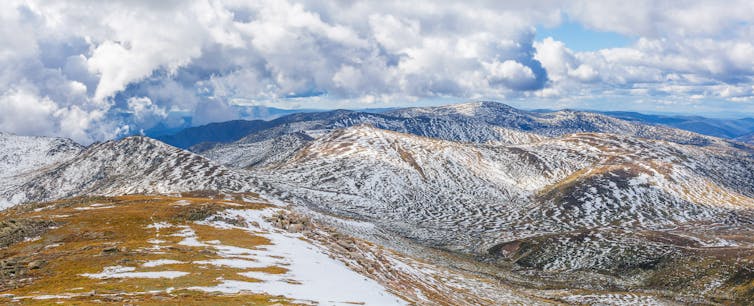
As the days shorten, many of us, particularly in Australia’s south-east, are looking forward to cooler times, and perhaps the allure of snow on the horizon. In the past week many in this region experienced their warmest days for over a century. What does this bode for times to come?
Research released overnight suggests ski areas in Australia and Aotearoa New Zealand will soon have much less snow due to climate change. German researcher Veronika Mitterwallner and her colleagues show average annual snow-cover days may decline by 78% in the Australian Alps and 51% in the Southern Alps of Aotearoa New Zealand (under a high-emissions scenario) by 2071–2100. Worldwide, they found 13% of ski areas will lose all natural snow cover by the end of the century.
It’s often said Australia gets more snow than Switzerland, though the evidence says otherwise. The fact remains that the Australian Alps cover a large area, more than 12,000km, with a third or more covered in snow at peak times. So these changes will have a broad impact on local economies and threaten fragile alpine ecosystems.
How did the study make these findings?
Mitterwallner’s team used a high-resolution climate data set for the global land surface area to identify the annual number of natural snow-cover days. Then, they projected those data under three emissions scenarios, and looked at historical (1950-2010), present (2011-2040), immediate future (2041-2070) and near future (2071-2100) data to examine changes over time.
Under most modelled emission scenarios, they found the annual number of snow-cover days will greatly decrease worldwide. For Australia and Aotearoa New Zealand, in particular, they found the average number will decrease by 78% and 51% respectively. These were the two regions with the greatest losses of snow.
However, under a low-emissions scenario, the good news is no regions will fall below an average of 100 snow-cover days a year. This is historically the minimum number of days a ski resort needs in seven out of ten winters to remain viable (cover must be at least 30–50cm).
How will we adapt to the loss of snow?
Will the way we use our alpine areas have to change permanently? Many resorts have already pivoted to activities such as mountain biking that don’t rely on snow. Skiing may be off the agenda – tennis anyone?
The prognosis of such research has driven the formation of groups such as Protect Our Winters. The mission of the Australian section is to help Australia’s outdoor community protect the integrity of our unique alpine environment and lifestyle from climate change.
Beyond Australia, New York recently had its highest snowfall in two years. Across the United States in general, though, they just experienced the warmest winter ever.
What is going on? And what might this new research mean, particularly for Australia and Aotearoa New Zealand?
These predictions, for almost all emissions scenarios, do not bode well for the skiers among us. More importantly, as many communities in the Himalaya are finding out, snow is not just a recreational “nice to have”. It’s a life-source for alpine communities, both human and non-human, and all those that depend on rivers sustained by snow melt around the globe.
Perhaps a greater concern in our region is the potential for ecological damage as resorts seek to increase ski slope metreage in areas that remain snow-covered. Expanding resort footprints is not a sustainable approach to a problem that probably won’t be going away.
Is artificial snow an option?
So how might we support the goals of Protect Our Winters? What alternatives do we have? How about artificial snow, would that work?
As part of my PhD studies many years ago, at the University of Cambridge’s Scott Polar Research Institute, I made masses of “polar snow” in a cold room (while effectively destroying the air-conditioning units at the same time). Artificial snow can be created quite readily, assuming enough water is at hand.
Artificial snow will have a different form and its density and microstructure will differ, potentially affecting longevity. (You can read more about snow mechanics here.)
But once on the ground, artificial snow, like natural snow, is subject to the vagaries of our weather. If the sun is shining and the day is hot, snow won’t last long, regardless of whether it’s natural or artificial.
There’s a lot to think on here as we contemplate what our world and our region might look like when skiing and snow-covered ground become no more than a memory in some areas. Yes, our recreational activities might change as we wonder whether it’s worth waxing up the skis this year – or is it time to break out the racquets? The ongoing survival of many communities might be jeopardised as a result.


