

Large old trees are vital for Australian birds. Their long branches and hollows can’t be replaced by saplings
- Written by The Conversation
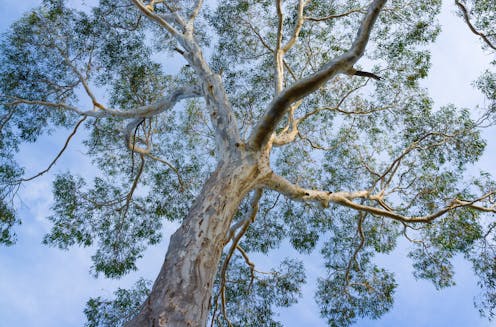
When we make roads, houses or farmland, we often find large old trees in the way. Our response is often to lop off offending branches or even cut the tree down.
This is a bad idea. The more we learn about large old trees, the more we realise their fundamental importance to birds, mammals, insects, plants and other inhabitants. More than 300 species of Australian birds and mammals need large old trees to live.
Why focus on mature trees? It’s because they have many features that younger trees simply don’t have: cracks, hollows, dead branches, peeling bark and large quantities of nectar and seeds. The limbs and leaves that fall on the ground make excellent homes for many small creatures.
Our new research sheds light on the importance of such grand old trees for birds. We used lidar (scanning using lasers) to map small, medium and large tree crowns in unprecedented detail. On average, we found large old trees had 383 metres of the horizontal or dead branches preferred by birds, while medium trees had very little and young trees none. Some old trees had almost 2 kilometres of branches.
Why are branches so important?
If we think of long, overhanging branches, chances are we may think “threat”. Some large trees can drop limbs without warning, although some arborists have pointed out the threat is overstated. To reduce the risk, councils and land managers may remove the limbs of large old trees.
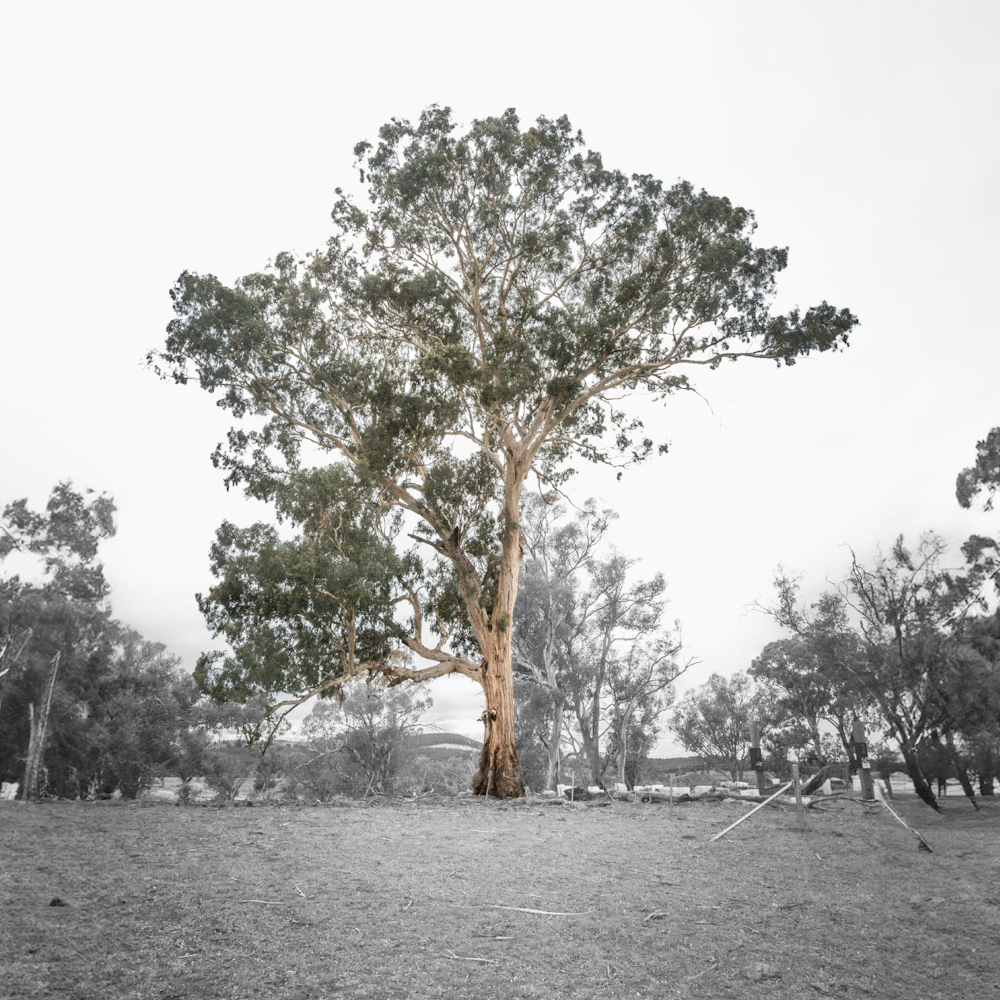
But if you cut down a 300-year-old river red gum, you can’t simply replace it with a sapling of the same species. It will take centuries for the sapling to take up the same ecological role as its predecessor.
In our research, we mapped more than 100,000 branches from many millions of laser samples and recorded how birds use branches through years of field observations.
 Our data shows only large old trees have the branches preferred by birds (in yellow).
Author provided
Our data shows only large old trees have the branches preferred by birds (in yellow).
Author provided
When we spot a bird using a branch, we can safely infer the bird has chosen it for a reason, whether resting, socialising, feeding, hunting or nesting.
What our data shows is that not all branches are equal. Birds find it easier to perch on horizontal or slightly inclined branches. Branches with few or no leaves offer clear vantage points for birds to land, hunt or see predators. You may have noticed crows and currawongs choosing dead branches for these reasons.
As trees mature, their branches begin to grow horizontally. Some branches may die due to lightning strikes, fire, wind damage, or attacks by insects or fungi, while the rest of the tree continues living. These long-term patterns of growth, decay and random events are necessary to produce the horizontal and dead branches prized by birds. For a large eucalypt, that process can take up to 200 years.
 Birds have strong branch preferences. Lower numbers and red tints indicate exposed branches likely to offer clearer vantage points for birds.
Author provided
Birds have strong branch preferences. Lower numbers and red tints indicate exposed branches likely to offer clearer vantage points for birds.
Author provided
Mapping the canopy with lasers
Until recently, it’s been hard to map the tree canopy. Traditional methods rely on researchers visually assessing this vital habitat. But we know eye observations don’t do well at capturing parts of trees such as branches.
That’s where lidar comes in. Lidar sends out laser pulses, which bounce back when they hit objects. By recording the time taken for the light to return, we can build very detailed three-dimensional models. It’s a little like echolocation, but using light rather than sound.
This laser-scanning technology has been used in the jungles of Central America to find the ruins of lost Mayan cities. But it can do much more.
In forests, lidar is now increasingly used to estimate how dense the tree cover is, and how variable. This useful data feeds into how we assess a forest’s ability to store carbon, how much timber is present, and the current fire risk. We can even use it to spot animal pathways.
To get the canopy detail we wanted, we used lidar on the ground rather than from the air, and processed the data with algorithms that can recognise and describe about 90% of branches in even the largest trees.
We mapped trees in an area near Canberra. We chose this area because it represents the plight of temperate eucalypt woodlands, which have shrunk by up to 99% since European colonisation.
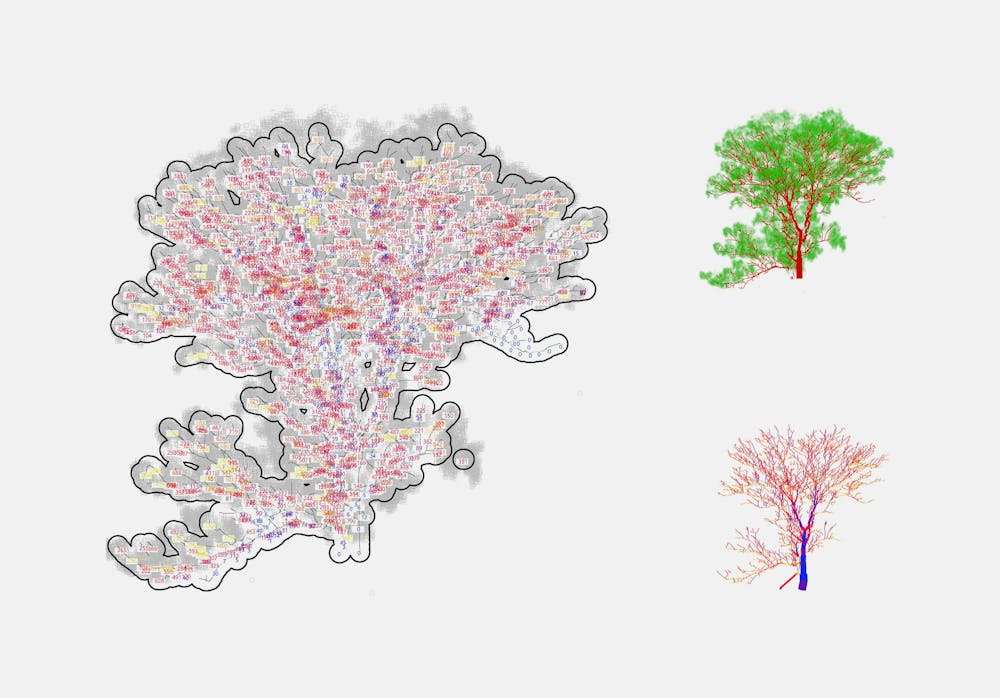 Trees as seen by algorithms. Here, lower numbers show more exposed branches, leaves are in green and connected branches in red with yellow indicating horizontal branches.
Author provided
Trees as seen by algorithms. Here, lower numbers show more exposed branches, leaves are in green and connected branches in red with yellow indicating horizontal branches.
Author provided
Read more: An act of God, or just bad management? Why trees fall and how to prevent it
What should we do?
The very things that make branches good real estate for birds can make them seem dangerous or aesthetically displeasing to us. We tend to cut dead or long, horizontal branches and leave the living or more upright ones. But for birds, this is a disaster as many cannot live without such branches.
Young trees are no substitutes for their older counterparts. Planting saplings or installing nest boxes cannot replicate the ecological value of large, mature trees.
We can live alongside large old trees. To reduce the chance of injury or worse from falling limbs, we could use exclusion zones, add artificial supports for branches, and install devices to catch or redirect falling limbs. We can also look at emergency solutions such as prosthetic hollows on younger trees or even artificial replicas of old trees.
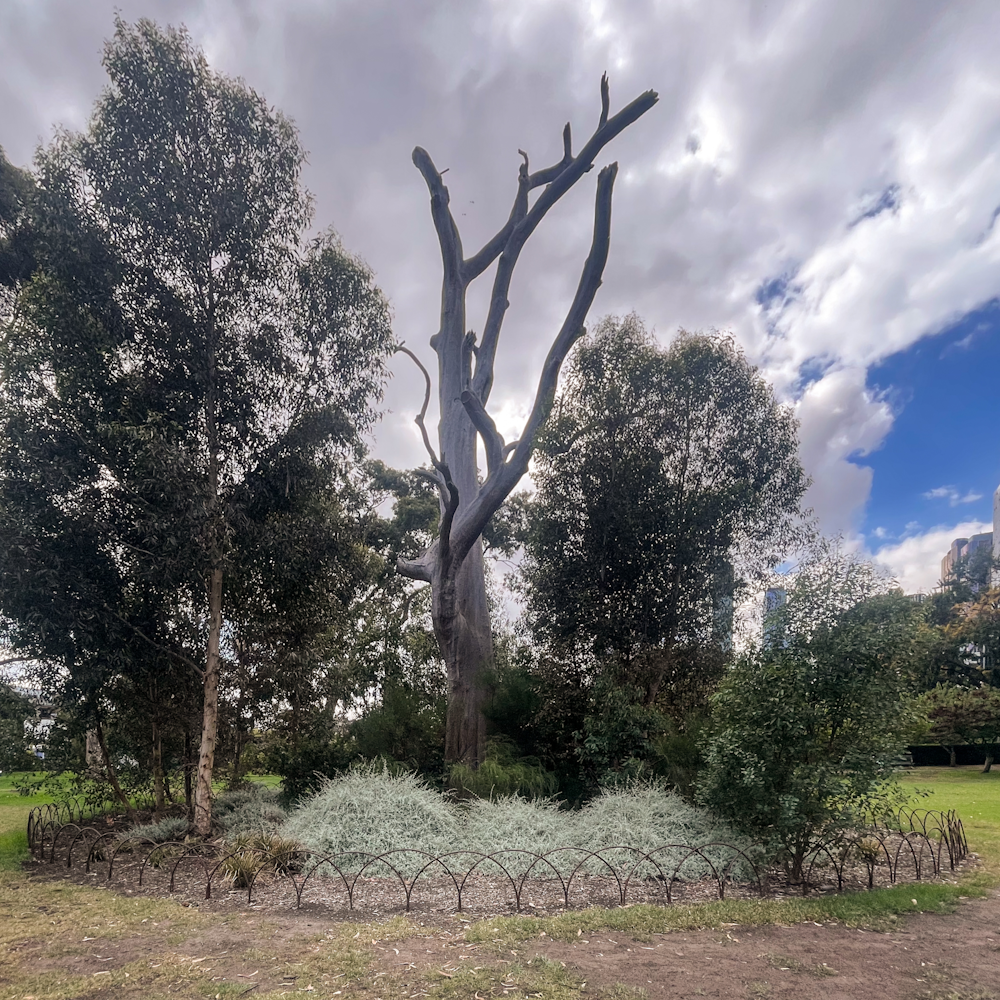 This dead tree has been kept intact in an urban park for use by wildlife, with landscape features designed to minimise the risk of injury to humans.
Author provided
This dead tree has been kept intact in an urban park for use by wildlife, with landscape features designed to minimise the risk of injury to humans.
Author provided
We should preserve these trees wherever we can and aim to keep them intact with their complex crowns and dead branches. We should also make sure there is a pipeline of young and medium trees to make sure there will be old trees in the future.
Read more: An act of God, or just bad management? Why trees fall and how to prevent it


