

We went looking for glowing interstellar gas – and stumbled on 49 unknown galaxies
- Written by The Conversation
Stars are born from huge clouds of mostly hydrogen gas floating in space. Astronomers like me study this gas because it helps us understand how stars and galaxies form and grow.
Hydrogen gas gives off a faint glow that is invisible to human eyes but can be observed with a telescope tuned to detect radio waves.
Recently, my colleagues and I were using a telescope like this – a radio telescope called MeerKAT, in South Africa – to look for hydrogen gas in a particular galaxy. We were only observing for less than three hours, which is quite a short amount of time since the hydrogen glow is so faint.
When we looked at the results, we were in for a huge surprise. Instead of discovering hydrogen gas in the galaxy we aimed at, we spotted it in no less than 49 previously unknown galaxies. Our findings are published in the Monthly Notices of the Royal Astronomical Society.
Gas in galaxies
The giant clouds of gas in which stars are born are called nebulae. When stars eventually die, they expel their gas into their surrounding environment, where it eventually cools and forms new nebulae.
Galaxies are like huge factories where the life cycle of stars repeats itself over and over. To properly understand galaxies and how they grow and evolve, astronomers need to consider both the stars and the gas making up the galaxy.
One thing we are particularly interested in is “merger events”, when two galaxies collide and merge into a single, larger galaxy. These events can also impact the gas, and kickstart star formation.
Studying gas can often help us understand a galaxy’s history. Gas often extends far further out than the stars in galaxies.
When we see trails of disturbed gas, it is a classic clue that a recent galaxy merger or interaction has occurred.
But we don’t see galactic gas easily with optical telescopes. Thankfully, radio telescopes are a great tool for finding hydrogen gas.
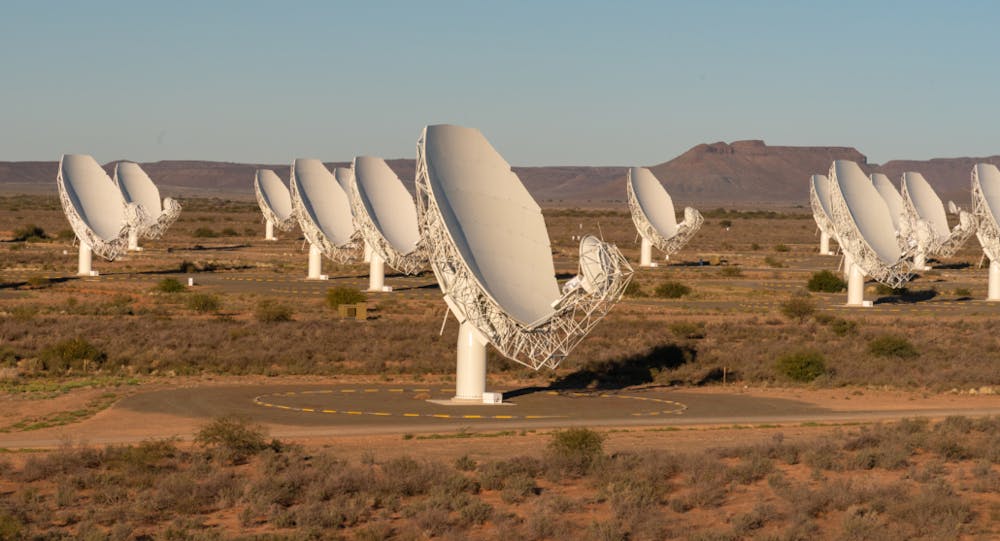
The MeerKAT radio telescope
The MeerKAT radio telescope in South Africa recently celebrated its fifth birthday. It is one of the “pathfinder” telescopes for the much larger Square Kilometre Array (SKA), a project under construction in South Africa and Australia.
MeerKAT has already achieved some great results, from detecting giant radio galaxies to studying the centre of our own galaxy, the Milky Way.
There are large survey projects underway with MeerKAT to study the star-forming hydrogen gas in galaxies. These include the MIGHTEE-HI and LADUMA surveys, the latter of which will use MeerKAT for more than 3,000 hours searching one part of the sky for hydrogen gas in very distant galaxies. These surveys are specifically focused on finding hydrogen gas and are carefully planned and carried out with that goal in mind.
But that’s not the only way MeerKAT can be used. Astronomers can also pitch ideas for “open time” observations to tackle other science questions or goals.
That’s how this discovery came about. I was hoping to detect hydrogen gas in one specific galaxy with MeerKAT, as it is the most sensitive telescope for these studies.
We did not find hydrogen gas in that galaxy, which was fine. We astronomers don’t always find what we are looking for.
But when I inspected the MeerKAT data, I spotted some gas located away from the target galaxy. So we investigated further.
By using techniques developed for the larger MeerKAT science surveys such as LADUMA, we found a lot more gas. In total, we had 49 detections.
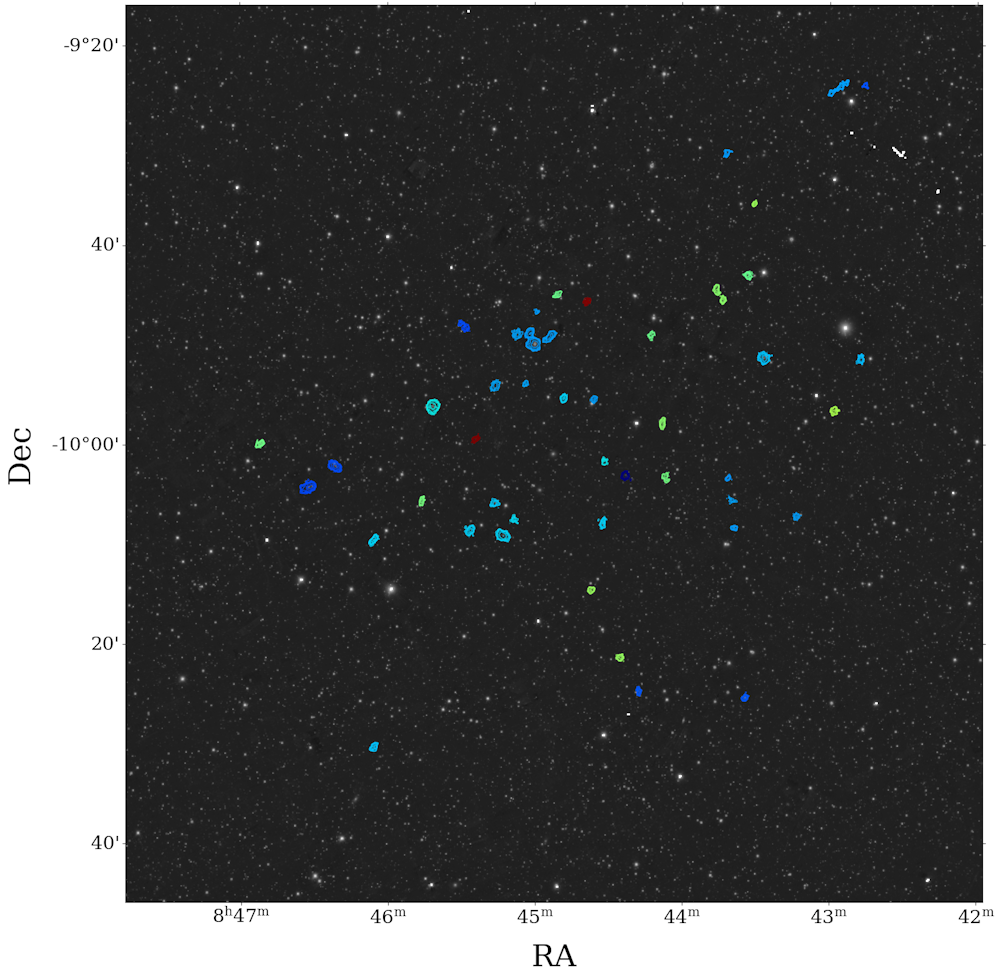 The 49 new gas-rich galaxies detected by the MeerKAT radio telescope in South Africa. Each detection is shown as coloured contours, with redder colours indicating more distant gas from us, and bluer colours as closer gas. The background image comes from the optical PanSTARRS survey.
Glowacki et al. 2024
The 49 new gas-rich galaxies detected by the MeerKAT radio telescope in South Africa. Each detection is shown as coloured contours, with redder colours indicating more distant gas from us, and bluer colours as closer gas. The background image comes from the optical PanSTARRS survey.
Glowacki et al. 2024
Meet the 49ers
Each detection of the gas in these galaxies was brand new. In little more than two hours of observing time, MeerKAT had revealed several collections of neighbouring galaxies.
Some of these neighbours are even interacting with each other, as their gas content shows. This was not at all obvious from just looking at the optical images of their stars.
In one case, a galaxy is stealing gas from two companion galaxies, and using it to fuel its own star formation.
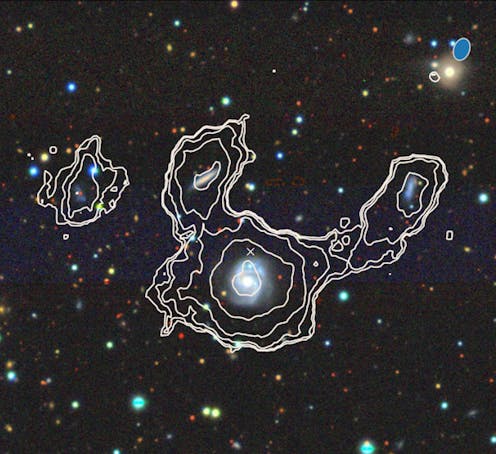
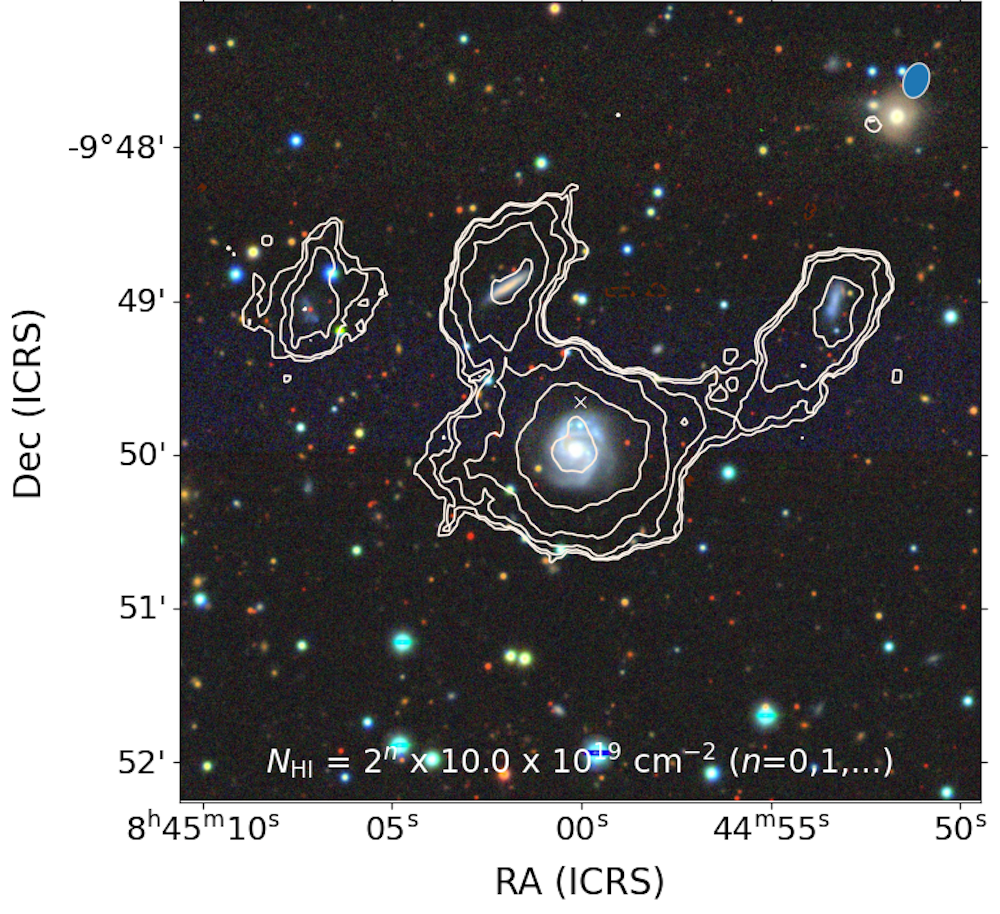 Examples of individual detections of the gas detected by MeerKAT (white contours) on top of a three-colour optical image from the DECaLS DR10 survey. The gas seen here extends further out than the stars in the galaxies.
Glowacki et al. 2024
Examples of individual detections of the gas detected by MeerKAT (white contours) on top of a three-colour optical image from the DECaLS DR10 survey. The gas seen here extends further out than the stars in the galaxies.
Glowacki et al. 2024
I’ve informally nicknamed this collection of galaxies the 49ers, a reference to the miners of the 1849 California gold rush.
While MeerKAT took the observations containing the 49 gold nuggets in just a couple of hours, winnowing them out required several other tools. These included the ilifu cloud supercomputer, where we reduced the MeerKAT observations (“data reduction” is a kind of pre-processing that makes the raw observations useful) and a data visualisation tool called CARTA which we used for the initial discovery of the 49 new galaxies.
We also examined our data with iDaVIE-v, a virtual reality software for viewing astronomical datasets in 3D. This software has already been used for new discoveries such as polar ring galaxies.
VR view of several “49er” gas-rich galaxies. VR view of a zoom-in of the 49er galaxies.More gold nuggets to be found
Finding 49 new galaxies in such a short amount of observation time is quite unusual, even with a telescope as powerful as MeerKAT. However, we know there are more galaxies waiting to be found in upcoming and existing MeerKAT observations.
In some other recent work, our team found traces of gas in more than 80 galaxies (most brand new) across three separate MeerKAT observations. Each of these observations was originally focused on a single galaxy, like the “open time” observation in which we found the 49ers.
What will we find next? We don’t know, but with MeerKAT – and eventually its more powerful successor, the SKA telescope – we’re confident astronomers will turn up plenty more pieces of gold.


