

Why the war in Ukraine is pushing the Doomsday Clock’s hands closer to midnight
- Written by The Conversation
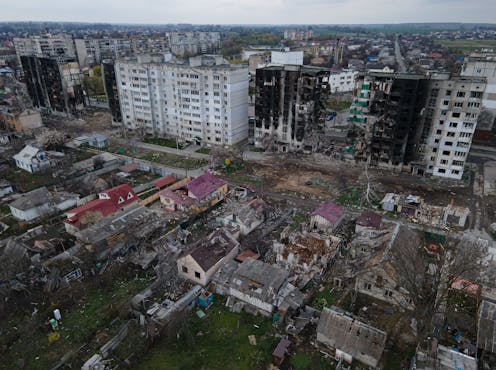
The so-called Doomsday Clock, created by the Bulletin of the Atomic Scientists to measure the imminent risk of nuclear conflagration, has been at 100 seconds to midnight since 2020. It’s now looking increasingly out of time with current events.
News that Russia has tested a nuclear-capable missile this week, and warnings by Ukrainian president Volodymyr Zelenskyy that Russia may resort to nuclear or chemical weapons, suggest the clock’s hands should be moving.
To bring events to this point, Russian president Vladimir Putin has exploited gaps in international law and policy that have failed to better regulate the arsenals of the world’s nuclear powers.
Perhaps following former US president Donald Trump’s lead, Putin has broken with diplomatic norms around the reckless use of nuclear rhetoric, threatening the West it would “face consequences that you have never faced in your history”.
And following the failure of the international community to create a convention that nuclear weapons should be kept at a non-alert status (meaning they can’t be fired quickly), Putin has put his nuclear forces into “special combat readiness”.
Sabre-rattling or not, these are worrying developments in a world that has struggled to pull back from the precipice of nuclear disaster since the Doomsday Clock began in 1947.
Putting back the clock
Even when the United States and Russia were closest to a nuclear conflict during the Cuban missile crisis in 1962, the clock only got to seven minutes to midnight.
While the clock moved backwards and forwards as threats came and went, the US and Russia extended the bilateral arms control treaty capping the number of deployed warheads, and in January this year the five main nuclear powers agreed that a nuclear war “cannot be won and must never be fought”.
The very next month this small pause of reason was broken when Russia launched its invasion of Ukraine.
Although Ukraine is hardly comparable to Cuba in the 1960s – there were no missiles on Russia’s doorstep and no blockade – Putin feared the country could potentially become a nuclear base for NATO. His aim has been to force all the former Eastern bloc countries now aligned with the West to agree to their 1997 pre-NATO positions.
To achieve this, Putin violated the United Nations Charter, sidelined the rule of global order set by the International Court of Justice, and possibly allowed his military to commit war crimes.
Tactical nuke fears
Since Trump quit the Intermediate-Range Nuclear Forces Treaty in 2019, Putin has been free to rebuild and redeploy his nuclear land forces.
Perhaps most ominously, Russia (to be fair, not alone) has been interested in developing low-yield tactical nuclear weapons (typically smaller than the 15 kiloton bomb that destroyed Hiroshima) to give battlefield “flexibility”.
These weapons would breach international humanitarian laws and their use could quickly spiral out of control, but there is no international law prohibiting them.
Read more: Beyond tougher trade sanctions: 3 more ways NZ can add to global pressure on Russia
Finally, Putin has exploited the world’s failure to form a nuclear “no first use” agreement. Current Russian nuclear doctrine doesn’t require an enemy state to use nuclear weapons against it as justification for its own strike.
A nuclear build-up by a potential adversary in neighbouring territories would be justification enough, along with a number of other potential non-nuclear triggers.
While the use of nuclear weapons to protect the sovereignty and territorial integrity of the Russian state might sound reasonable, the illegal annexation of Crimea in 2014 shows how available such justifications might be.
‘Unpredictable consequences’
The worst has so far been avoided because the US and its NATO allies are not belligerents in the Ukraine war, having carefully avoided direct involvement, declining appeals for a NATO-enforced no-fly zone.
But the West is hardly neutral. Providing weapons to assist one country’s fight with another is an unfriendly act by any definition. While the amount and variety of that military aid has been carefully calibrated, it is growing and it has clearly made a significant difference on the battlefield.
Read more: Ukraine crisis: how do small states like New Zealand respond in an increasingly lawless world?
In return, Russia continues to ramp up the rhetoric, warning the West of “unpredictable consequences” should military assistance continue.
And while the director of the CIA has moved to quieten concerns, saying there is no “practical evidence” Russia might resort to using nuclear weapons, what happens from here is hard to predict.
As has been the case since the Doomsday Clock was first set 75 years ago, our possible futures lie in the minds and hands of a very small group of decision makers in Moscow and Washington.


