

Quantum computing just got hotter: 1 degree above absolute zero
- Written by The Conversation
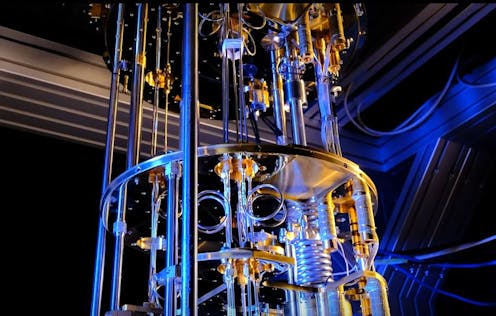
For decades, the pursuit of quantum computing has struggled with the need for extremely low temperatures, mere fractions of a degree above absolute zero (0 Kelvin or –273.15°C). That’s because the quantum phenomena that grant quantum computers their unique computational abilities can only be harnessed by isolating them from the warmth of the familiar classical world we inhabit.
A single quantum bit or “qubit”, the equivalent of the binary “zero or one” bit at the heart of classical computing, requires a large refrigeration apparatus to function. However, in many areas where we expect quantum computers to deliver breakthroughs – such as in designing new materials or medicines – we will need large numbers of qubits or even whole quantum computers working in parallel.
Quantum computers that can manage errors and self-correct, essential for reliable computations, are anticipated to be gargantuan in scale. Companies like Google, IBM and PsiQuantum are preparing for a future of entire warehouses filled with cooling systems and consuming vast amounts of power to run a single quantum computer.
But if quantum computers could function at even slightly higher temperatures, they could be much easier to operate – and much more widely available. In new research published in Nature, our team has shown a certain kind of qubit – the spins of individual electrons – can operate at temperatures around 1K, far hotter than earlier examples.
The cold, hard facts
Cooling systems become less efficient at lower temperatures. To make it worse, the systems we use today to control the qubits are intertwining messes of wires reminiscent of ENIAC and other huge computers of the 1940s. These systems increase heating and create physical bottlenecks to making qubits work together.
Read more: How long before quantum computers can benefit society? That's Google's US$5 million question
The more qubits we try to cram in, the more difficult the problem becomes. At a certain point the wiring problem becomes insurmountable.
After that, the control systems need to be built into the same chips as the qubits. However, these integrated electronics use even more power – and dissipate more heat – than the big mess of wires.
A warm turn
Our new research may offer a way forward. We have demonstrated that a particular kind of qubit – one made with a quantum dot printed with metal electrodes on silicon, using technology much like that used in existing microchip production – can operate at temperatures around 1K.
This is only one degree above absolute zero, so it’s still extremely cold. However, it’s significantly warmer than previously thought possible. This breakthrough could condense the sprawling refrigeration infrastructure into a more manageable, single system. It would drastically reduce operational costs and power consumption.
The necessity for such technological advancements isn’t merely academic. The stakes are high in fields like drug design, where quantum computing promises to revolutionise how we understand and interact with molecular structures.
The research and development expenses in these industries, running into billions of dollars, underscore the potential cost savings and efficiency gains from more accessible quantum computing technologies.
A slow burn
“Hotter” qubits offer new possibilities, but they will also introduce new challenges in error correction and control. Higher temperatures may well mean an increase in the rate of measurement errors, which will create further difficulties in keeping the computer functional.
It is still early days in the development of quantum computers. Quantum computers may one day be as ubiquitous as today’s silicon chips, but the path to that future will be filled with technical hurdles.
Read more: Explainer: quantum computation and communication technology
Our recent progress in operating qubits at higher temperatures is as a key step towards making the requirements of the system simpler.
It offers hope that quantum computing may break free from the confines of specialised labs into the broader scientific community, industry and commercial data centres.
Read more https://theconversation.com/quantum-computing-just-got-hotter-1-degree-above-absolute-zero-226401


