

‘Strong theatre with unwavering precision’: Into the Shimmering World asks us what does it mean to be good?
- Written by The Conversation
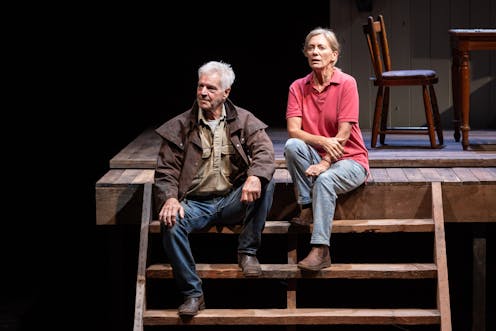
Angus Cerini’s Into the Shimmering World is an unforgiving and, frankly, bleak meditation on what it is to be good; what it is to live a good life.
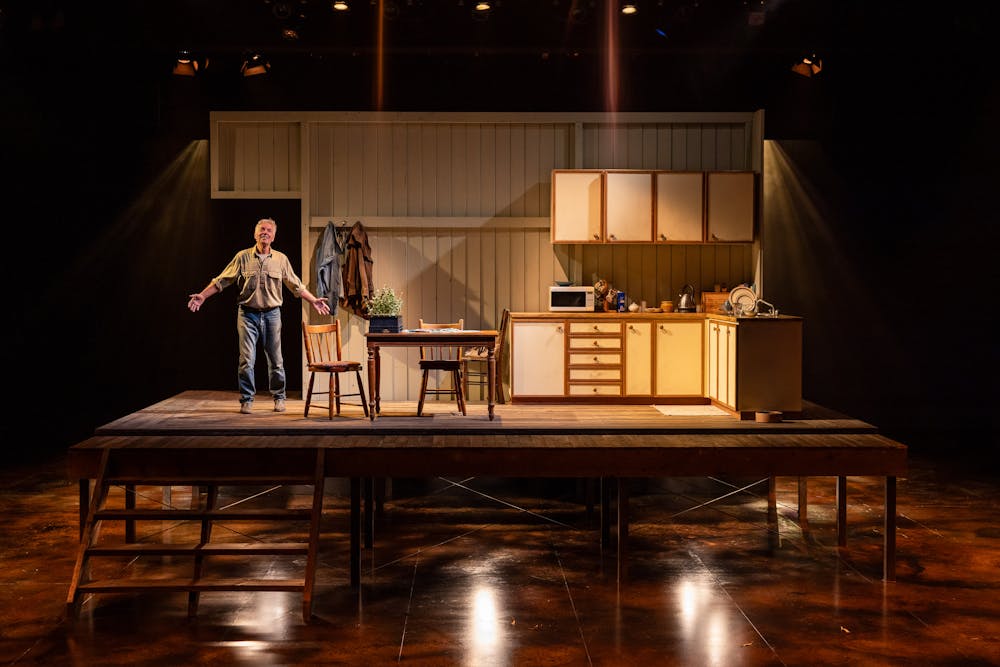
The scene is the kitchen of the farmstead home of cocky Ray (Colin Friels) and his health-care worker wife, Floss (Kerry Armstrong). David Fleischer’s set floats in a great dark void: a formally precise form hovering on cross-braced timber pillars a metre above the floor of the theatre, separated from the audience by a dark moat, towards which descend a flight of wooden stairs.
Nestled in the stark nothingness, the kitchen is rendered in shades of beige: a bare table, two chairs; a kitchen sink, a microwave, kettle, cupboards and drawers from which meals, a first aid kit, and mostly tea cups are retrieved and then returned. Two jackets – Ray’s Driza-Bone and Floss’ denim – hang from pegs.
The domestic setting is as arid as the implied landscape beyond its walls: there is nothing here. No sign of the life of a family, no pictures, photographs, books, clutter. There is life, but not much more. A meal, when served, is a slab of unadorned meat accompanied by a mound of unappetising potato mash, at which Ray picks at without eating.
Read more: What are the great Australian plays? Refining our theatre canon
A barren life
The life Ray and Floss have scraped out for themselves is – notwithstanding the cups of teas and recurrent mantra of “it’s okay” – barren. There is love, but the unasked question is whether love is enough. The scraping is literal: a hillside scraped bare of trees; an ill-conceived dam scraped out of the bowl between ridges.
When the drought breaks, the dam and its surrounding paddock turns to a muddy ruin. Ray sets out with a handful of cartridge boxes to take care of the cows stranded in the mire. He has missed the opportunity to sell off the stock. Now, the rains have come, and he has lost them all. He and Floss are broke.
But not broken. They’ve been there before: life on the land is feast or famine. In the good years, Ray tells us, there is a radiance and joy. In the more frequent bad years? Cups of tea and the mantra: it’s okay.
Ray tries to be good. He is proud of being a loving husband, a man committed to making a home, and being a good farmer. Unlike his neighbour: a criminal who seems to be able to restock overnight, and who Ray fantasises about accidentally shooting, or throwing into a wombat hole.
Ray also fantasises about killing the banker who has taken over his debts, and who turns up in city shoes in a brand new Landcruiser to rub Ray’s nose in his misfortunes. Circumstances – the weather, the bankers, the unethical neighbour – conspire against him, against his goodness.
Ray knows what he knows: the farm. He has no interest in seeing anything else of the world. When Floss proposes a beach holiday, he declines: too much sand. When it gets too much for Ray, his “Old Mate” (Bruce Spence) advises a judicious dose of self-harm: just enough to prick him back into life. But what, exactly, is that life?
Ray loves his adult sons, although he struggles to tell them as much. Neither want anything to do with the farm. Their horizons are grander: children, cities. Life.
How can life be good?
The drama unfolds subtly and inexorably. Friels is exceptional, charting Ray’s decline as his robust, blokey, she’ll-be-right bonhomie curdles, as his bladder fails, and his dark homicidal speculations — presented as stark, alarmingly funny monologues to the audience — assume, with the visit of the local policeman to seize his guns, a disconcerting menace.
Friels’ performance culminates in an extraordinary sequence, in which the almost televisual realism of the production (the isolated set against a black frame unmistakably evokes a cinema screen) gives way to a towering theatricality.
After a beautifully rendered scene in which Ray and (the now departed) Floss recall their whirlwind romance, Ray gently starts to dance with Floss’ denim jacket, moving into a wrenchingly primal apotheosis on the bare kitchen table: a fraught full-body peering into the abyss. Nothing is okay. No cup of tea will ever fill the deep emptiness, all he has to show for a lifetime of doing the right thing, of loving, making a home, being honest, being good.
 Ray and Floss are broke – but not broken.
Daniel Boud/Sydney Theatre Company
Ray and Floss are broke – but not broken.
Daniel Boud/Sydney Theatre Company
Only at the end does Ray really step down from the kitchen set. Some action has been fleetingly staged in the emptiness between set and audience: a brief (fantasised) beach scene, in which waves ripple across the dark floor; a couple of encounters with his Old Mate, in which both remain anchored to the set.
Now, however, Ray descends and places his hand on the ground, allowing it to rest on the very earth on which he has built his home, but he has never really understood.
It is a powerful, unsettling moment. I found myself thinking: what kind of life is possible here? How can life be good? What do we need, when we find surviving, making do and, yes, even loving, is not enough? The answer Ray offers is confronting, and of little comfort: the dream of a postmortem reunion with his dead wife.
This is strong theatre, rendered with unwavering directorial precision from Paige Rattray and committed, finely-crafted performances.
Into the Shimmering World is at the Sydney Theatre Company until May 19.


