

Heat from El Niño can warm oceans off West Antarctica – and melt floating ice shelves from below
- Written by The Conversation
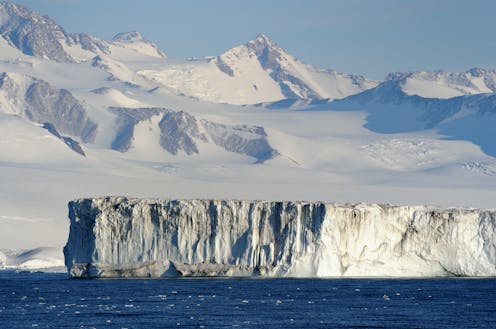
As snow falls on Antarctica, layers build up and turn to ice. Over time, this compressed snow has become a continent-sized glacier, or ice sheet. It’s enormous – almost double the size of Australia and far larger than the continental United States.
As the weight of ice builds up, the ice sheet begins to move towards the oceans. When it reaches the sea, the ice floats. These floating extensions are known as ice shelves. The largest is over 800 kilometres wide.
When the ocean water has a temperature close to 0°C, these ice shelves can persist for a long time. But when temperatures rise, even a little, the ice melts from below. Antarctic ice shelves are now losing an alarming 150 billion tons of ice per year, adding more water to the ocean and accelerating global sea level rise by 0.6 mm per year. Ice shelves in West Antarctica are particularly prone to melting from the ocean, as many are close to water masses above 0°C.
While the melting trend is clear and concerning, the amount can vary substantially from year-to-year due to the impact of both natural climate fluctuations and human-made climate change. To figure out what is going on and to prepare for the future, we need to tease apart the different drivers – especially El Niño-Southern Oscillation, the world’s largest year-to-year natural climate driver.
Our new research explores how heat brought by El Niño can warm the ocean around West Antarctica and increase melting of the ice shelves from below.
Antarctic Ice Mass Loss 2002-2023. Credit: NASA Climate Change.How can El Niño-Southern Oscillation affect Antarctica?
Australians are very familiar with the two phases of this climate driver, El Niño and La Niña, as they tend to bring us hotter, dryer weather and cooler, wetter weather, respectively. But the influence of this cycle is much larger, affecting weather and climate all around the Pacific.
Can it reach through Antarctica’s cold, fast currents of air and water? Yes.
Giant convective thunderstorms in the Pacific’s equatorial regions move east during El Niño and intensify in the West during La Niña. As these storm systems change, they excite ripples in the atmosphere that are able to travel large distances, just as waves can cross oceans. Within two months, these atmospheric waves reach the Antarctic continent, where their energy can affect the coastal atmosphere and ocean circulation. During El Niño, the energy from these waves weakens the easterly winds off West Antarctica (and vice versa for La Niña).

Using satellite data, researchers recently found that West Antarctic ice shelves actually gain height but lose mass during El Niño. That’s because more low-density snow falls at the top of the ice shelves, while at the same time more warm water flows under the ice shelves where it melts compressed high-density ice from underneath.
What we don’t yet know is how this warmer water (above zero) comes up from below. Similarly, we don’t know what happens during La Niña.
Answering these questions with the few observations we have from Antarctica is challenging because this climate driver doesn’t happen in isolation. Storms, tides, large eddy currents and other climate drivers such as the Southern Annual Mode can change the temperatures of the water under ice shelves too, and they can occur at the same time as El Niño.
Read more: Ice shelves hold back Antarctica's glaciers from adding to sea levels – but they're crumbling
Finding a needle in the ice stack
So how did we do it? Modelling.
We take a high-resolution global ocean circulation model and added El Niño and La Niña events to the baseline simulation. By doing so, we can examine what these anomalies do to the currents and temperatures around Antarctica.
The energy brought by El Niño’s atmospheric waves to West Antarctica weakens the prevailing easterly winds along the coasts.
Normally, most of the warm water reservoir is located off the continental shelf rather than on the continental shelf. As the winds weaken, more of this warmer water – known as Circumpolar Deep Water – is able to flow onto the continental shelf and near the base of the floating ice shelves.
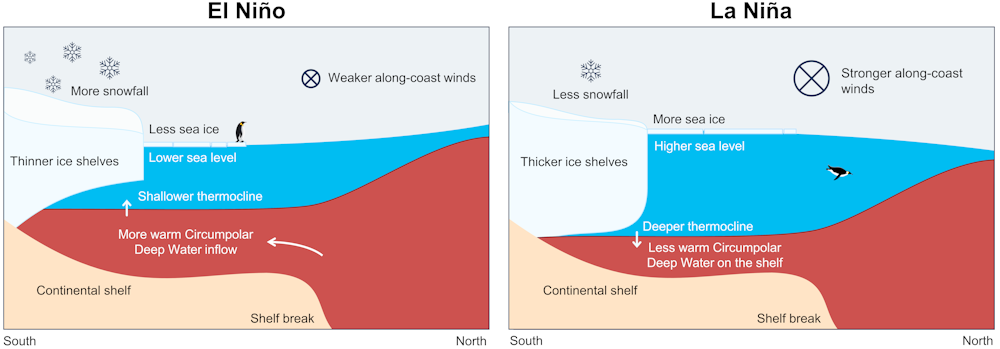 During El Niño, weaker winds along the coasts push less cold Antarctic surface waters towards the continent, allowing warmer Circumpolar Deep Water to flow to the base of the ice shelves. During La Niña, stronger winds drive a wedge of cold water up towards the continent, reducing the inflow of warm water.
Maurice Huguenin, CC BY-SA
During El Niño, weaker winds along the coasts push less cold Antarctic surface waters towards the continent, allowing warmer Circumpolar Deep Water to flow to the base of the ice shelves. During La Niña, stronger winds drive a wedge of cold water up towards the continent, reducing the inflow of warm water.
Maurice Huguenin, CC BY-SA
We call this water mass “warm”, but that’s relative – it’s only 1–2°C above freezing, and the heat only warms the water on the continental shelf by about 0.5°C. But that’s enough to begin melting ice shelves, which are at or below freezing point.
As you’d expect, the longer the warm water stays on the shelf and the hotter it is, the more melting occurs.
During La Niña, the opposite occurs and the ice rebounds. Winds along the coast strengthen, pushing more cold surface water onto the continental shelf and preventing warm water from flowing under the ice shelves.
What does this mean for the near future?
Researchers have found El Niño and La Niña have already become more frequent and more extreme.
If this trend continues, as climate projections suggest, we can expect warming around West Antarctica to get even stronger during El Niño events, accelerating ice shelf melting and speeding up sea level rise.
More frequent and stronger El Niño events could also push us closer to a tipping point in the West Antarctic ice sheet, after which accelerated melting and mass loss could become self-perpetuating. That means the ice wouldn’t melt and reform but begin to steadily melt.
More bad news? Unfortunately, yes. The only way to stop the worst from happening is to get to net zero carbon emissions as quickly as humanly possible.


