

City planners love infill development. So why are cities struggling with it, and how can they do better?
- Written by The Conversation
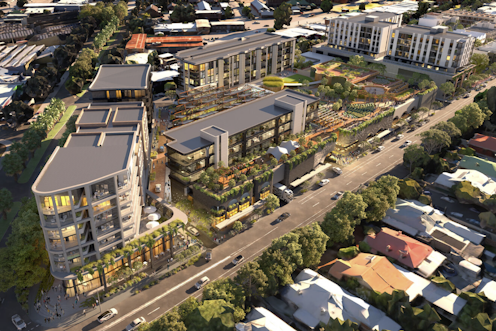
Infill development is an increasingly hot topic in Australian cities. It involves building on unused or underutilised land within existing urban areas.
City planners see infill development as essential. It’s a way to end urban sprawl and improve service delivery to a growing population at lower cost. Infill development has increased in popularity over several decades because it uses existing physical and social infrastructure, is close to amenities and enhances local economies.
Governments and planners have set infill development targets. However, these targets are not being met. Greenfield projects on undeveloped land continue to outpace infill development.
Perth, for example, has an infill target of 47%. The rate of higher-density infill actually fell recently to 29% of all new development.
However, most states and territories already have the means to deliver more infill development, in the form of land development authorities.
Development Victoria’s residential development, Alfie, is located on a former primary school site in Altona North, south-west Melbourne.Read more: To cut urban sprawl, we need quality infill housing displays to win over the public
What are the obstacles?
Infill targets aren’t being met for various reasons. These include:
- opposition from some (but not all) local residents, because of increased noise and traffic disruptions
- difficulty in assembling enough land to make the project feasibile
- higher development costs due to land prices and higher densities
- stronger market demand for greenfield housing
- need to upgrade infrastructure for infill locations
- complex and time-consuming planning approvals.
Greenfield development is popular with developers and consumers because it costs less up-front. However, such development may cost society more. These added costs include transport – both public transport and roads – as well as social, health and other government support services.
Ad-hoc, small-scale infill that typically covers only a few lots is happening. Unfortunately, these projects are not enough to achieve infill targets.
And they are creating other problems. They often convert backyards into housing. This reduces open space and adds to urban heat island impacts.
Development WA’s Subi East project is creating an inner-city village for more than 4,000 residents on the edge of Perth CBD.Read more: Why city policy to 'protect the Brisbane backyard' is failing
What have governments done about it?
Governments have worked on increasing infill development for decades. One of the earliest attempts involved land development authorities. The idea originated with the Whitlam government in the early 1970s.
The Commonwealth Department of Urban and Regional Development encouraged states to establish these authorities in response to the “shortages of residential land and the accompanying rapid price rises that occurred in Sydney, as in the other major cities in Australia in the late 1960s and early 1970s”. Their purpose was “to acquire land for present and future urban development and other public uses to help moderate the housing market, stabilise land supply and support the development industry with homesite sales to be made at the lowest practicable price”.
Many states and territories have land development authorities or their equivalents. These bodies have undertaken a significant number of projects, but it’s small when considering population growth.
For example, LandCom in NSW has been involved with 220 projects and provided housing for 100,000 since it was set up. Sydney’s population has grown by more than 2 million people in this time.
As well as NSW’s Landcom, other authorities of this kind include Development Victoria, Renewal SA, DevelopmentWA and the Australian Capital Territory’s Suburban Land Agency. Queensland had the Urban Land Development Authority, which became part of Economic Development Queensland. (The above links include lists of projects.)
Landcom developed Prince Henry at Little Bay on an 85-hectare former hospital site in Sydney’s eastern suburbs.Read more: Greening the greyfields: how to renew our suburbs for more liveable, net-zero cities
We need to build on this work
While land development authorities have been around for almost 50 years they have not been as successful as hoped. One reason is that they have not focused solely on infill development. They also have tended to use land already owned by the government.
There are other issues too. Population growth has outpaced the authorities’ capacity to deliver housing. There are political sensitivities about the government taking away development opportunities from the private sector.
One reason for Australia’s housing problem is the length of time it takes to get a project approved. This is particularly true for infill development.
One attempt to overcome this obstacle was Queensland’s Priority Development Areas (PDAs), which took effect in 2012. According to Economic Development Queensland, “when a PDA is declared, Economic Development Queensland works closely with local government and other stakeholders to plan, assess and guide development within a PDA. This includes the preparation of a development scheme.” Many PDAs are urban infill projects.
Economic Development Queensland is developing Carseldine Village on a former QUT campus on Brisbane’s northside.Read more: How do we get urban density 'just right'? The Goldilocks quest for the 'missing middle'
Another Queensland initiative announced last February is the A$350 million Incentivising Infill Fund. Its focus is to provide relief from infrastructure charges for “market-ready” private infill developments.
Governments at all levels are looking for ways to make more housing available and affordable. Infill development is a viable option, but it can be improved by making more use of mechanisms like land development authorities. They can provide co-ordinated planning and development at a scale that will improve our cities.
So, rather than looking for new solutions, we should make better use of existing ones that have proven effective.


