

We spent 2 years in deep underground caves to bring this extraordinary fossil to light
- Written by The Conversation
Pitch-black darkness. Crushing squeezes, muddy passages, icy waterfalls. Bats and spiders. Abseiling over ledges into the unknown. How far would you go for a fossil?
On a two-year retrieval mission of nearly 60 hours in an underground cave, we met our limits – and went beyond.
The limestone slope of Potholes Cave Reserve is found in Gunaikurnai Country, north of the township of Buchan in eastern Victoria.
Here, the river valley is peppered with shadowy entrances to underground caves. Portals barely large enough to permit a willing caver open into kilometres of subterranean passages encrusted with delicate crystals twinkling in torchlight.
In one of them, Nightshade Cave, the Museums Victoria Research Institute led a team of recreational cavers and Parks Victoria rangers to excavate an extraordinary fossil: a near-complete skeleton of the extinct short-faced kangaroo Simosthenurus occidentalis. In June this year, it will appear on display at Melbourne Museum.
It started with an unusual skull
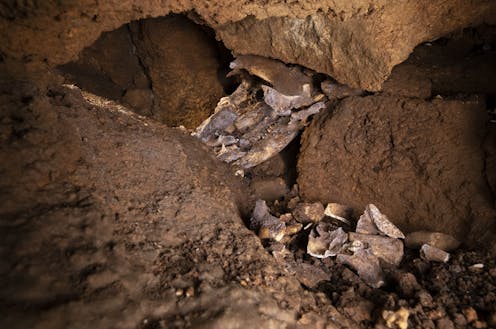
As is so often the case in palaeontology, the discovery began with engaged citizens out in nature. In 2011, a local caving group first entered Nightshade Cave through an opening previously blocked by soil. One of the group, Joshua Van Dyk, sighted an unusual animal skull.
Recognising its potential significance, he reported the find to Melbourne Museum. However, Van Dyk reckoned it was irretrievable, appearing to be crushed under boulders in a narrow vertical collapse. The cave was gated shut to protect its contents, and a decade passed quietly.
In 2021, I took an interest in the intriguing find. Members of the Victorian Speleological Association were only too happy to assist a return to the cave.
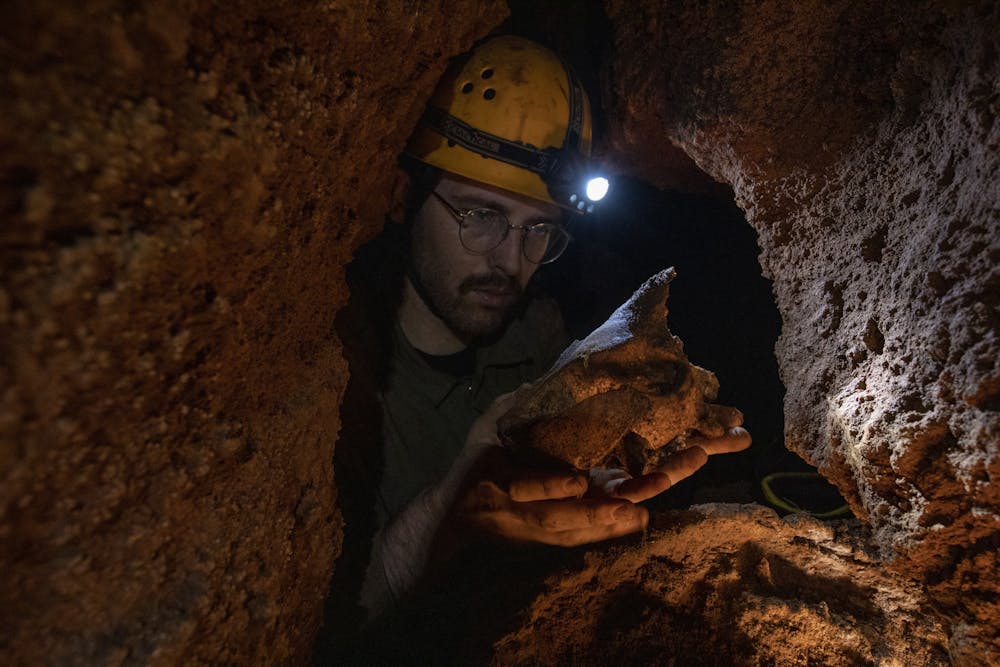 Tim Ziegler retrieving fossil bones from Nightshade Cave.
Rob French/Museums Victoria
Tim Ziegler retrieving fossil bones from Nightshade Cave.
Rob French/Museums Victoria
Rigging a ropeline, we abseiled down a tight ten-metre rift, emptying our lungs to pass tight points in midair. We corkscrewed into a narrow passage and wormed, single-file, through low-domed chambers hung with dripping stalactites and plastered by popcorn-like calcite formations.
Descending deeper, the cave transformed into tall, narrow, clean-walled rifts, full of dark recesses. Hours passed as we circuited the passages, until a shout echoed around: found again! We scrambled to a chimney-like chute stacked with pinned boulders, to come eye to eye with an ancient.
On reaching it, I felt sudden grief: the beautiful fossilised skull had in the intervening years begun to collapse. It seemed that, despite its long survival, the fossil was newly vulnerable – from little more than the altered air currents and changing humidity caused by the new cave entrance.
We strengthened the exposed bones with protective resins, but exited the cave having left them in place: more time would be needed to plan their retrieval.
A painstaking retrieval
On our return trips, I carefully brushed away fine layers of mud and we photographed and packed the newly freed fossils. The skull had a deep muzzle, with robust jaws and teeth that marked it as a short-faced (sthenurine) kangaroo.
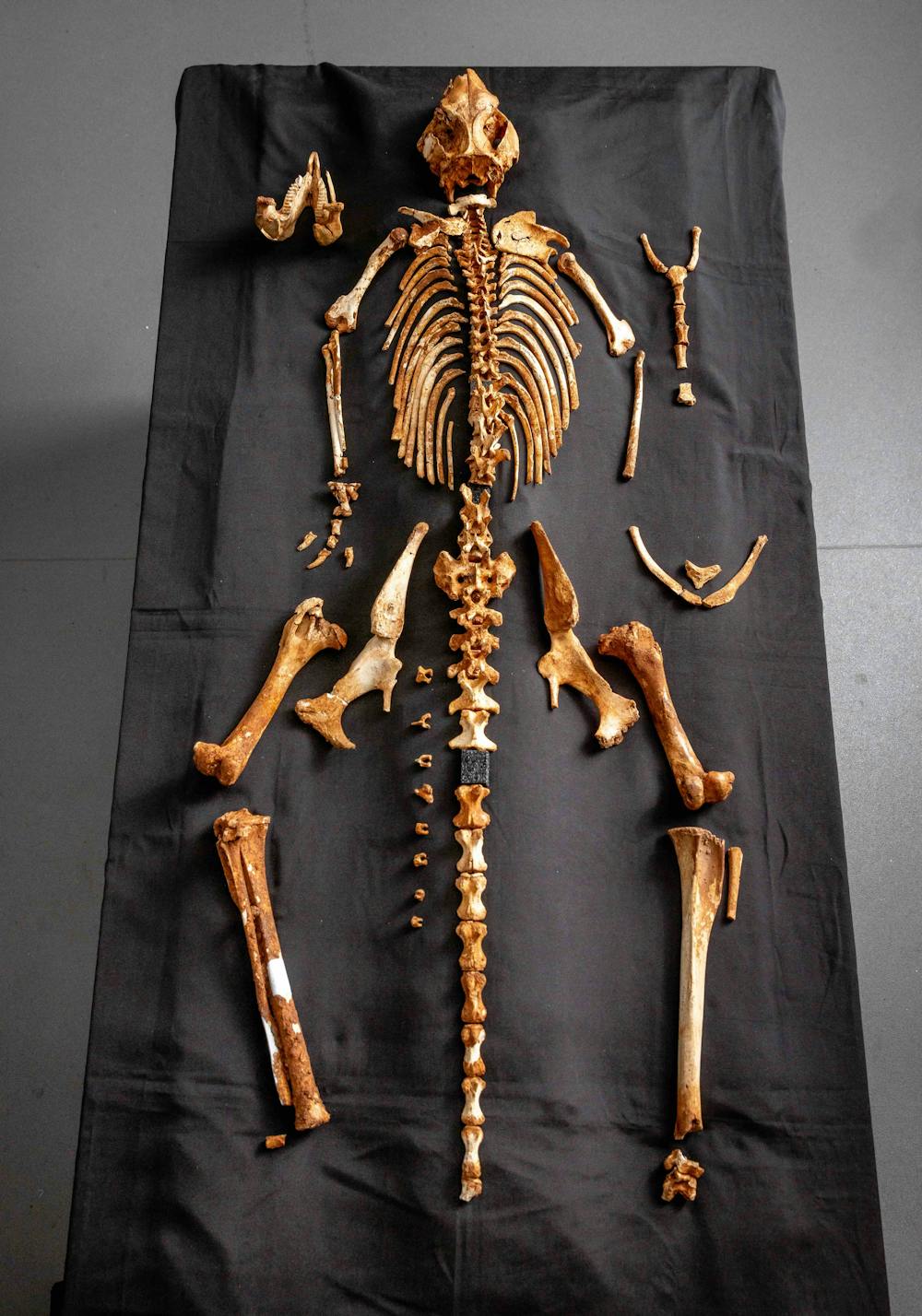
Behind it were more bones. It was a marvel to see vertebrae, shoulders and hips, limbs and a narrow ribcage: many of the bones were wholly undisturbed and still in their original positions. This was a single animal, not a random scattering of bones. It felt like a fossil holy grail.
A detailed comparison to fossils in the Museums Victoria State Collection gave our skeleton its identification as Simosthenurus occidentalis. Comprising 150 preserved bones, it is the most complete fossil skeleton found in a Victorian cave to date.
That it is a juvenile rather than adult kangaroo further distinguishes it from other examples of the species. Its teeth show little wear, its skull bones are still unfused, and its limb ends had not yet joined, suggesting it was still young at its time of death.
From the size of its limbs, we estimate it weighed around 80 kilograms – as much as an average person – but might have grown half as large again had it reached adulthood.
Australia’s extinct megafauna
Short-faced kangaroos appear in Australia’s fossil record from 10 to 15 million years ago, as widespread rainforests began to give way to drier habitats. They became particularly diverse during the shift toward our current arid climate in the later part of the Pleistocene Epoch, from around 500,000 years ago.
But in a pulse of extinction around 45,000 years ago, they vanished across the continent, along with up to 85% of Australia’s megafauna. Radiocarbon dating by the Australian Nuclear Science & Technology Organisation dated the skeleton’s burial to 49,400 years ago. This means our S. occidentalis was among the very last of its kind.
Today, the hills of eastern Gippsland host a precious population of the brush-tailed rock-wallaby, a vulnerable species. Once, they shared the country with larger kin.
A key idea under investigation is whether sthenurine kangaroos walked with a striding gait, rather than hopped. The skeleton we found has a uniquely complete vertebral column, providing new insights we couldn’t get from isolated bones. With the benefit of detailed 3D models, this near-complete skeleton can also be studied from anywhere in the world.
This fossil, along with others from Nightshade Cave, is now housed and cared for in perpetuity at Melbourne Museum. Through Museums Victoria Research Institute, we can preserve a link to its once home of East Gippsland, while opening a door to global research.


